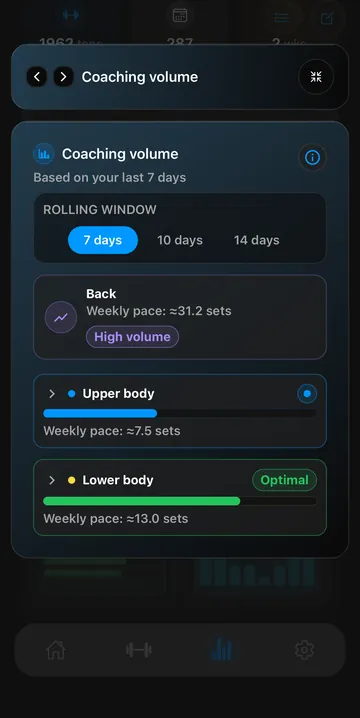
For muscle growth, count hard sets per muscle per week, not tonnage. Tonnage (sets × reps × load) tells you how much external weight you moved, and it is excellent for tracking one exercise over time. But two programmes with identical tonnage can produce very different muscle growth, and two with very different tonnage can produce the same growth.
The research behind that is fairly consistent: hypertrophy is similar across a wide range of loads when sets are taken close to failure, which means tonnage swings wildly with rep range while the growth stimulus does not. Hard-set counts track the stimulus better. Use tonnage for lift-to-lift progress, sets for muscle planning, and RPE or RIR to make sure the sets are actually hard.
What the research says
- Hard sets are a valid way to quantify hypertrophy volume. A systematic review of 14 trials in trained lifters concluded that counting sets taken to or near failure works when reps fall between about 6 and 20+.1 Moderate evidence
- Equal tonnage does not mean equal growth. With volume load matched, training at 20% 1RM grew the vastus lateralis 8.9% versus 19.5% at 80% 1RM over 12 weeks.2 Moderate evidence
- Very different tonnage can give the same growth. Across 21 studies, low-load and high-load training to failure produced similar hypertrophy, despite large differences in volume load.3 Strong evidence
- More weekly sets means more growth, with diminishing returns. Each extra weekly set added about 0.37 percentage points of growth in one meta-analysis,4 and a 67-study meta-regression confirmed a rising but flattening curve.5 Strong evidence
Evidence grades reflect the number and quality of studies (meta-analyses > single RCTs > acute/mechanistic data).
What is weekly tonnage?
Tonnage, also called volume load, is usually calculated as:
sets × repetitions × external weight
If you bench press 80 kg for three sets of eight, session tonnage is:
3 × 8 × 80 = 1,920 kg
Do that workout twice and weekly bench-press tonnage is 3,840 kg. Tonnage is excellent for comparing repeated exposures to the same exercise when technique, range of motion and equipment stay stable.
What does training volume mean?
Training volume is a broader idea. It can be expressed as:
- tonnage or volume load;
- work sets per exercise;
- hard sets per muscle group;
- fractional sets, where compound lifts count partly toward synergist muscles;
- total repetitions; or
- workload adjusted by effort or velocity.
No single calculation captures everything. The right one depends on the question you are asking.
Why do hard sets beat tonnage for muscle growth?
Because the muscle growth stimulus is driven by sets taken close to failure, not by kilograms moved. Three findings make the case.
1. Growth is similar across loads, tonnage is not
Schoenfeld and colleagues pooled 21 studies comparing low-load (≤60% 1RM) and high-load (>60% 1RM) training, with every set taken to momentary failure. Hypertrophy was similar between conditions; 1RM strength improved more with heavy loads.3 A larger network meta-analysis of 119 hypertrophy studies (3,364 participants) reached the same conclusion: all the prescriptions tested promoted muscle growth comparably, while heavier loads maximised strength.6
Now look at the tonnage. Three sets of 8 at 80 kg is 1,920 kg. Three sets of, say, 25 at 40 kg, also to failure, is 3,000 kg. The tonnage differs by more than 50%, yet the research predicts roughly similar growth. Tonnage would tell you the light session was much "bigger". Set counts would tell you both were three hard sets, which is closer to the truth.
2. Matching tonnage does not match growth
Key study
Equal volume load, unequal growth (Lasevicius et al., 2018)
- Design
- 12-week within-subject trial, training twice a week
- Who
- 30 men
- Compared
- One arm and leg trained at 20% 1RM for three sets to failure; the other limb trained at 40%, 60% or 80% 1RM with sets adjusted to match the 20% limb's volume load
- Result
- Vastus lateralis cross-sectional area grew 8.9% at 20% 1RM versus 20.5%, 20.4% and 19.5% at 40%, 60% and 80%. Elbow flexors grew 11.4% versus about 25%.
Why it matters: identical tonnage produced roughly half the growth when the load was very light. Tonnage alone could not tell these programmes apart. The caveat: 20% 1RM is an unusually light load, and 40%, 60% and 80% all grew about equally at matched tonnage. The lesson is that tonnage cannot detect when a set is too light to be effective, not that heavier is always better.2
3. Set counts predict growth in dose-response research
The main hypertrophy dose-response studies count weekly sets, not tonnage. In Schoenfeld's 15-study meta-analysis, each additional weekly set was associated with about 0.37 percentage points more growth.4 Pelland and colleagues' 2026 meta-regression of 67 studies (2,058 participants) found that growth keeps rising with weekly sets but with diminishing returns, and that counting indirect sets from compound lifts as half a set predicted outcomes best.5 The Baz-Valle review concluded that set counting is adequate when sets are to or near failure and reps fall in roughly the 6–20+ range, with other variables held constant.1
For targets, see How Many Sets per Week to Build Muscle? The short version: about 10–20 hard sets per muscle per week is a well-supported range for most lifters.
What counts as a hard set?
Set counts only work if the sets are genuinely hard. A set of 10 with a load you could lift 20 times is not equivalent to a set of 10 you could barely finish. A 2024 series of meta-regressions found that muscle growth increased as sets were stopped closer to failure, while strength was much less sensitive to proximity to failure.7
A practical definition: count working sets that end roughly 0–3 reps in reserve. Warm-ups and easy back-off sets do not count. This is also why logging RPE or RIR matters. Perceived-exertion scales show moderate positive correlations with bar velocity and relative load, making them a practical complement to load-based tracking.8 For how close to go, see Do You Need to Train to Failure to Build Muscle?
| Question | Best metric | Why |
|---|---|---|
| Is my bench press progressing? | Tonnage or e1RM on that lift | Same exercise, same setup, so kilograms are comparable |
| Is my chest getting enough work? | Hard sets per muscle per week | Works across exercises and rep ranges |
| Were my sets hard enough to count? | RPE / RIR | Tonnage cannot tell 0 RIR from 5 RIR |
| Is recovery keeping up? | Reps at matched load and RIR across weeks | Falling performance at the same effort is a fatigue signal |
| Am I getting stronger at heavy singles? | e1RM trend or tested 1RM | Strength responds most to heavy, specific practice |
Where tonnage is still useful
Tonnage is the right tool for lift-to-lift comparisons. If your barbell row goes from 70 kg for 3×8 to 70 kg for 3×10 at the same effort, tonnage rises from 1,680 kg to 2,100 kg. That is real progress on that lift.
It breaks down across exercises. A chest-supported machine row and a barbell row can both read 70 kg but use different lever arms, ranges and stability demands. Use tonnage to compare:
- the same exercise across weeks;
- the same equipment and setup;
- similar ranges of motion;
- work sets classified consistently; and
- sessions where bodyweight assistance did not change substantially.
Avoid using it as a universal scoreboard. Adding a heavy leg press can double your weekly lower-body tonnage without doubling the stimulus to any muscle.
Why effort changes the meaning of volume
Two weeks can contain identical sets, reps and weight while producing different training stress:
- Week one: every set ends around three RIR.
- Week two: sleep is poor and the same work reaches zero or one RIR.
Tonnage is identical. The fatigue is not. A meta-analysis of 12 crossover studies found that training to failure produced a larger drop in performance measures (SMD −0.96), more muscle damage and higher RPE than stopping short.9 RPE and RIR add the context that tonnage misses.
A practical three-layer weekly review
1. What work was completed?
Check sessions, exercises, work sets and reps. Missing workouts or shortened ranges should be visible before you interpret trends.
2. Did each muscle get enough hard sets?
Count weekly hard sets per muscle (try the training volume calculator), and check tonnage only on stable exercises. Separate planned increases from accidental spikes.
3. What happened to performance and effort?
Compare load, reps, estimated 1RM and RPE. Rising workload with stable or improving performance is different from rising workload while performance deteriorates. See how to interpret an estimated 1RM trend.
When is lower tonnage fine?
Lower tonnage is often intentional: a deload, a heavy strength block, an exercise swap, travel, or a taper before a test. A heavy block of 5×3 produces far less volume load than 4×10, yet heavier loads improve maximal strength more.3,6 A good dashboard shows the decline without labelling it as failure.
The research on dieting lifters also shows how inconsistently volume is reported. A review of 15 studies on lean-mass retention during caloric restriction could calculate tonnage or weekly sets per muscle for only 4 of them. Higher-volume programmes (10+ weekly sets per muscle) were associated with little to no lean-mass loss, but the authors judged the evidence insufficient to conclude that higher volume is better while dieting.10
What should a training-volume app show?
- hard sets per muscle per week, with indirect sets handled transparently;
- weekly tonnage by exercise, not just one global total;
- warm-up exclusion;
- RPE or RIR context;
- estimated strength trends; and
- exercise-history comparisons.
Our training-volume tracker guide goes through how a tracker can combine weekly sets per muscle, tonnage and RPE. For app comparisons, see weight training apps with advanced analytics.
Frequently asked questions
Is tonnage the best measure of workout volume?
It is a good measure for the same weighted exercise over time. For muscle growth across exercises and rep ranges, weekly hard sets per muscle are a better-supported measure.
Should warm-up sets count toward tonnage?
Keep the rule consistent. Working-set tonnage is easier to interpret because warm-up structures change from day to day, and warm-ups should not count as hard sets either.
Can I compare squat tonnage with leg-press tonnage?
You can record both, but the values are not equivalent. Compare each exercise with its own history rather than treating the higher number as the larger muscular stimulus.
Does more weekly tonnage mean more muscle growth?
Not automatically. Studies show similar growth across very different loads, and matched tonnage can still produce unequal growth. Hard-set count, proximity to failure, exercise selection and recovery matter more.
References
- Baz-Valle E, Fontes-Villalba M, Santos-Concejero J. Total number of sets as a training volume quantification method for muscle hypertrophy: a systematic review. J Strength Cond Res. 2021;35(3):870-878. PubMed
- Lasevicius T, Ugrinowitsch C, Schoenfeld BJ, et al. Effects of different intensities of resistance training with equated volume load on muscle strength and hypertrophy. Eur J Sport Sci. 2018;18(6):772-780. PubMed
- Schoenfeld BJ, Grgic J, Ogborn D, Krieger JW. Strength and hypertrophy adaptations between low- vs. high-load resistance training: a systematic review and meta-analysis. J Strength Cond Res. 2017;31(12):3508-3523. PubMed
- Schoenfeld BJ, Ogborn D, Krieger JW. Dose-response relationship between weekly resistance training volume and increases in muscle mass: a systematic review and meta-analysis. J Sports Sci. 2017;35(11):1073-1082. PubMed
- Pelland JC, Remmert JF, Robinson ZP, Hinson SR, Zourdos MC. The resistance training dose response: meta-regressions exploring the effects of weekly volume and frequency on muscle hypertrophy and strength gains. Sports Med. 2026;56(2):481-505. PubMed
- Currier BS, Mcleod JC, Banfield L, et al. Resistance training prescription for muscle strength and hypertrophy in healthy adults: a systematic review and Bayesian network meta-analysis. Br J Sports Med. 2023;57(18):1211-1220. PubMed
- Robinson ZP, Pelland JC, Remmert JF, et al. Exploring the dose-response relationship between estimated resistance training proximity to failure, strength gain, and muscle hypertrophy: a series of meta-regressions. Sports Med. 2024;54(9):2209-2231. PubMed
- Petro JL, Ferrari G, Cardozo LA, et al. Validity of rating of perceived exertion scales in relation to movement velocity and exercise intensity during resistance-exercise: a systematic review. Sports Health. 2025;17(3):621-628. PubMed
- Vieira JG, Sardeli AV, Dias MR, et al. Effects of resistance training to muscle failure on acute fatigue: a systematic review and meta-analysis. Sports Med. 2022;52(5):1103-1125. PubMed
- Roth C, Schoenfeld BJ, Behringer M. Lean mass sparing in resistance-trained athletes during caloric restriction: the role of resistance training volume. Eur J Appl Physiol. 2022;122(5):1129-1151. PubMed