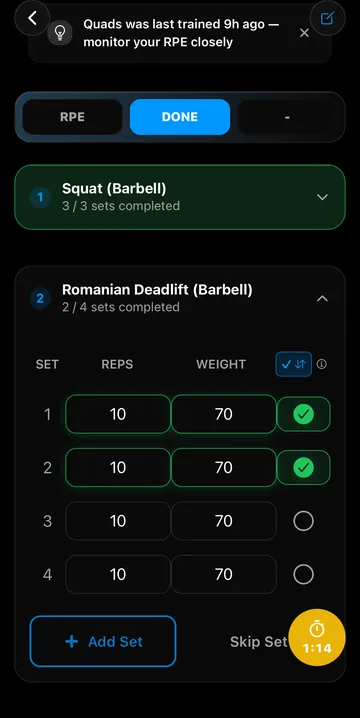
To calibrate RPE and RIR, use the same exercise, setup, rep range, and rest periods across three sessions. Start conservatively, record how each set actually moved and felt, then adjust your estimate by no more than one rep at a time. You do not need to train to failure to make the scale useful: on average people misjudge reps left by about one rep, and trained lifters predicting 1 and 3 reps in reserve on the bench press were off by only about 0.65 reps.1,2
The goal is not to identify the exact number of repetitions you could have completed in every set. That number can only be known by continuing the set, and even then it changes with technique standards and motivation. The useful goal is a consistent estimate that helps you choose loads, manage fatigue, and compare similar work over time.
What the research says
- People slightly underestimate how many reps they have left. Across 12 studies and 414 participants, lifters underpredicted reps to failure by about 0.95 reps on average, with large differences between studies.1 Moderate evidence
- Accuracy improves near failure and with heavier loads. Predictions were better when made closer to failure, in later sets, and in sets of 12 reps or fewer; training experience made little difference.1 Moderate evidence
- Trained lifters can be accurate within about one rep. 24 trained men and women predicting 1 and 3 RIR on the bench press had an average absolute error of 0.65 reps.2 Emerging evidence
- RPE-based loading works at least as well as percentages. A meta-analysis found similar strength gains with autoregulated and percentage-based loading, and an 8-week trial found a likely small strength edge for RPE.3,4 Moderate evidence
Evidence grades reflect the number and quality of studies (meta-analyses > single RCTs > acute/mechanistic data).
RPE and RIR: related, but not every RPE means the same thing
Reps in reserve (RIR) estimates how many more technically acceptable repetitions you could have completed at the end of a set.
The RIR-based rating of perceived exertion (RPE) scale expresses that same estimate on a 1–10 scale. In this specific resistance-training scale, RPE 10 means no reps left, RPE 9 means about one rep left, and RPE 8 means about two reps left.5 The scale was introduced in a 2016 study of 29 squatters, where RIR-based ratings tracked bar speed closely (r = −0.88 in experienced lifters), and was later outlined for practical program design.5,6
That is different from session RPE, which is a rating of how difficult the whole workout felt. A session can feel demanding because it was long, dense, or involved a lot of muscle mass even if no individual set reached RPE 10. If your program asks for “3 sets at RPE 8,” it normally means the RIR-based rating for each set—not a score for the session as a whole.
Here is a practical mapping:
| RIR-based RPE | Approximate reps in reserve | What the end of the set may feel like |
|---|---|---|
| 10 | 0 RIR | No additional clean rep available |
| 9.5 | 0–1 RIR | Another rep might be possible, but uncertain |
| 9 | About 1 RIR | One clean rep likely remains |
| 8.5 | 1–2 RIR | One rep is clear; a second is uncertain |
| 8 | About 2 RIR | Two clean reps likely remain |
| 7 | About 3 RIR | Bar speed or effort has changed, but the set is not near its limit |
| 6 or lower | 4+ RIR | Relatively low effort; exact RIR becomes harder to distinguish |
Treat the table as a shared language, not a conversion formula. RPE 8 and 2 RIR are approximately aligned within this scale, but perception is noisy. Half-points are optional and are only useful if you can apply them consistently.
Why RPE and RIR estimates miss
RIR prediction is not perfectly accurate. A scoping review and exploratory meta-analysis of 12 studies (414 participants) found that people underpredicted the reps they had left by about 0.95 on average—they stopped with more repetitions available than they thought—with very high heterogeneity between studies (I² = 97.9%). Estimates became more accurate closer to failure, in later sets, and in sets of 12 reps or fewer; above 12 reps, errors grew noticeably. Training status did not meaningfully improve accuracy.1
Key study
How accurate are trained lifters at calling RIR? (Refalo et al., 2024)
- Design
- Two sessions, two bench press sets to momentary failure at 75% of 1RM
- Who
- 24 resistance-trained adults (12 men, 12 women)
- Compared
- The point where lifters said they had 1 or 3 reps left vs. the reps they actually completed
- Result
- Average error was −0.17 reps (direction) and 0.65 reps (size), similar for 1 vs. 3 RIR, set 1 vs. set 2, and session 1 vs. session 2. Accuracy was unrelated to sex, experience, or relative strength.
Why it matters: With a familiar lift and a moderate rep range, a trained lifter's “2 RIR” is usually within a rep of the truth. Caveat: one exercise, one load, and small sample—higher-rep isolation work is likely less precise.2
Common reasons include:
- Unfamiliar effort. If you have rarely completed hard, technically consistent sets, you may interpret normal discomfort as the end of the set.
- Changing technique. A squat to inconsistent depth or a row with increasing body movement changes what counts as an available rep.
- Different exercises and rep ranges. Two RIR on a heavy bench press does not necessarily feel like two RIR on a 20-rep lateral raise.
- Fatigue and recovery. Sleep, food intake, stress, previous sets, and rest duration can change both performance and perception.
- Fear or safety constraints. Sensibly stopping a free-weight squat before technique deteriorates is different from reaching local muscular failure on a stable machine.
- Expectation bias. Knowing the planned RPE can encourage you to label the set with the target rather than the effort you experienced.
This is why a useful log preserves context. Load and reps alone can hide whether a set was smooth, rushed, painful, or much harder than last week. RPE is another data point—not a laboratory measurement.
A safe three-session calibration workflow
Choose one or two familiar exercises to calibrate at a time. Use a rack with correctly positioned safeties for barbell lifts, or choose a stable machine or isolation movement. Avoid calibration during pain, acute illness, or unusually poor recovery.
Keep the exercise variation, setup, range of motion, rep target, and rest period as consistent as practical. Video can help you compare technique and rep speed, but it cannot tell you an exact RIR by itself.
If your program starts from a percentage of max, a 1RM calculator can provide an initial load estimate. It cannot predict how many reps you have left on a given day, so use the first work set to refine the choice.
To turn a rated set into a load, the RPE chart and calculator estimates 1RM from weight, reps and RPE, and suggests a load for a target number of reps at a chosen RPE.
Session 1: establish a conservative reference
After your normal warm-up, choose a load you expect to complete for your target reps with 3–4 RIR. Perform two or three work sets, stopping while technique is clearly repeatable.
Immediately after each set, record:
- Load and reps
- Estimated RIR and RPE
- Whether the final rep slowed noticeably
- Any technique change, pain, or setup issue
- Rest time before the set
Do not change your rating to match what the program prescribed. If a target-RPE-7 set felt like RPE 8, log 8.
Session 2: move one step closer
Repeat the exercise under similar conditions three to seven days later. If session 1 was clean and recovery is normal, either add the smallest practical load increase or keep the load and add one rep. Aim for 2–3 RIR.
Compare the final repetitions with session 1. Did speed slow earlier? Did technique remain within your agreed standard? Did the same load feel unexpectedly different? The comparison matters more than whether your estimate was “correct.”
If you overshot and the set became a grind, record it and reduce the next set. Do not add another hard set to prove the rating.
Session 3: confirm, do not test
In the third session, repeat the session-2 prescription or make one small adjustment. On a stable, low-risk exercise, an experienced lifter may use 1–2 RIR to make the endpoint easier to recognize. On a heavy squat, deadlift, unsupported row, or any movement where failure would be unsafe, stay at 2 RIR or farther.
End the set if technique breaks down, pain appears, the environment is unsafe, or you are uncertain about completing the next rep. That may mean you stopped for a safety or technique limit rather than muscular failure, which is worth noting in the log.
After three sessions, look for a repeatable pattern. If sets labeled 2 RIR repeatedly look controlled and progress normally, the estimate is useful enough. If every “2 RIR” set is fast and you consistently exceed the planned rep range later, you may be underestimating what remains. Adjust future ratings gradually—one RIR, not a wholesale rewrite.
Exercise examples
Barbell squat
Suppose you squat 100 kg for five reps and estimate 3 RIR. The next week, with the same depth, belt, shoes, and rest, 102.5 kg for five feels like 2 RIR. In session 3 you repeat 102.5 kg and again estimate 2 RIR, with similar technique and final-rep speed.
That is a useful reference point. There is no need to perform three more reps or attempt failure in a rack to validate it. For compound lifts, your technical standard and safety margin are part of the estimate.
Bench press
A lifter completes eight reps at 70 kg and logs 2 RIR. On video, the final rep slows but stays on the same bar path. In the next session, the same load and reps feel like 3 RIR after better sleep. Rather than assuming the first rating was wrong, the lifter records the recovery difference and watches the next session. One set is noisy; a trend is more useful.
Cable lateral raise
Higher-repetition isolation work can create a strong burning sensation before technique or rep speed changes much. If that discomfort makes every set feel like 1 RIR, use several sessions to learn the sensation instead of assuming the first rating is exact. Keep technique strict. You still do not need to force failure, especially if the shoulder feels uncomfortable. A meta-analysis found no hypertrophy advantage for training to momentary failure over stopping short of it—see do you need to train to failure.7
Turn estimates into training decisions
An RPE number is only valuable if it changes what you do next. The following are conservative examples, not validated universal thresholds:
- Below target by 1 RPE or more: add a small amount of load or one rep next time, provided technique and recovery are good.
- On target: repeat or progress according to the program, not because one set felt easy enough to make a large jump.
- Above target by 1 RPE: keep the next set the same or reduce the load slightly.
- Above target by 2 RPE or more: reduce load or volume for the remaining work and check recovery, rest time, and setup.
- Pain or technique breakdown: stop or modify the exercise. Do not solve pain by relabeling the RPE.
Use actual RPE, not target RPE, in your log. Add a short note when the number needs context: “short rest,” “lost brace,” “left shoulder discomfort,” or “rep speed steady.” Compare the same exercise and rep range whenever possible. An RPE 8 set of five and an RPE 8 set of 15 can both be valid while feeling very different. Honest RPE entries also make your estimated 1RM trend easier to interpret.
RPE also works best alongside a clear approach to progressive overload. If load, reps, range of motion, and technique all change at once, you will struggle to interpret the rating. Keep enough variables stable to learn from the result. For how effort fits with weekly volume in a hypertrophy program, see how many sets per week you need and the science of muscle growth.
Good calibration is consistent, not perfect
RIR-based RPE can help autoregulate training when readiness changes from day to day, but it does not remove judgment. A scoping review of 31 studies (855 participants) concluded that RIR scales are feasible and useful for prescribing and adjusting training intensity, and that ratings are most accurate when made close to failure.8 In an 8-week trial in trained men, squat and bench programs loaded by RPE produced similar muscle growth to percentage-based loading and likely a small strength advantage (squat +17.1 kg vs. +13.9 kg).4 A meta-analysis of 15 studies found no significant strength difference between autoregulated and standardised load prescription.3 Research supports its practical use while also showing meaningful uncertainty. Use ranges, repeat familiar movements, and let several sessions inform decisions. That matters most in powerlifting programs that prescribe heavy sets by RPE.
If you are new to lifting, train with a qualified coach when possible and stay farther from failure while technique develops. If you have an injury, medical condition, dizziness, unusual shortness of breath, or persistent pain, seek appropriate medical guidance rather than using an RPE drill to test your limits.
The best calibrated estimate is not the most dramatic one. It is the one you can apply honestly, safely, and consistently enough to make the next training decision.
References
- Halperin I, Malleron T, Har-Nir I, et al. Accuracy in predicting repetitions to task failure in resistance exercise: a scoping review and exploratory meta-analysis. Sports Med. 2022;52(2):377-390. PubMed
- Refalo MC, Remmert JF, Pelland JC, et al. Accuracy of intraset repetitions-in-reserve predictions during the bench press exercise in resistance-trained male and female subjects. J Strength Cond Res. 2024;38(3):e78-e85. PubMed
- Hickmott LM, Chilibeck PD, Shaw KA, Butcher SJ. The effect of load and volume autoregulation on muscular strength and hypertrophy: a systematic review and meta-analysis. Sports Med Open. 2022;8(1):9. PubMed
- Helms ER, Byrnes RK, Cooke DM, et al. RPE vs. percentage 1RM loading in periodized programs matched for sets and repetitions. Front Physiol. 2018;9:247. PubMed
- Zourdos MC, Klemp A, Dolan C, et al. Novel resistance training-specific rating of perceived exertion scale measuring repetitions in reserve. J Strength Cond Res. 2016;30(1):267-275. PubMed
- Helms ER, Cronin J, Storey A, Zourdos MC. Application of the repetitions in reserve-based rating of perceived exertion scale for resistance training. Strength Cond J. 2016;38(4):42-49. PubMed
- Refalo MC, Helms ER, Trexler ET, Hamilton DL, Fyfe JJ. Influence of resistance training proximity-to-failure on skeletal muscle hypertrophy: a systematic review with meta-analysis. Sports Med. 2023;53(3):649-665. PubMed
- Bastos V, Machado S, Teixeira DS. Feasibility and usefulness of repetitions-in-reserve scales for selecting exercise intensity: a scoping review. Percept Mot Skills. 2024;131(3):940-970. PubMed