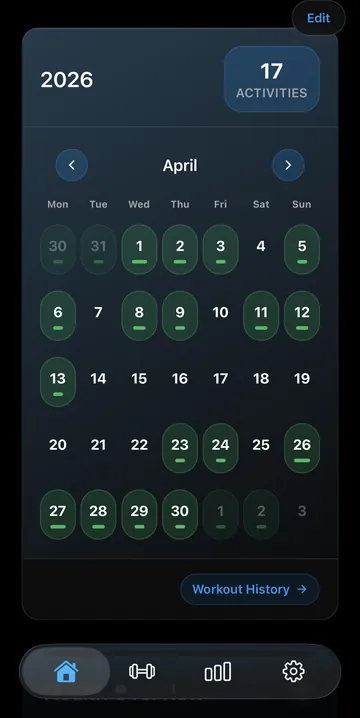
A five-day PPL split is usually better when recovery or calendar flexibility is the priority. A six-day PPL split is better when you can reliably complete two Push/Pull/Legs rotations every week and recover from the resulting workload. Neither schedule builds more muscle simply because it occupies a particular number of days.
The crucial difference is easy to miss: five PPL sessions do not train every body region twice in each calendar week. PPL is a rolling sequence. Six sessions complete two rotations; five sessions complete one rotation plus two workouts and then continue where they stopped.
For the exact exercise, set, and rep prescriptions, see the complete intermediate and advanced PPL plans. This guide focuses on scheduling and recovery without duplicating those tables.
What the research says
- Frequency itself barely changes muscle growth. A 25-study meta-analysis found no significant difference between higher and lower frequencies when weekly volume was equated, and a 2026 meta-regression of 67 studies found frequency’s effect on hypertrophy compatible with negligible.1,2 Strong evidence
- Twice a week per muscle is still a sensible default. An earlier 10-study meta-analysis found a larger hypertrophy effect with twice-weekly than once-weekly training (effect size 0.49 vs 0.30).3 Six-day PPL hits each muscle twice every week; five-day PPL averages about 1.7 times. Moderate evidence
- The real difference is weekly sets. Each extra weekly set was associated with about 0.37 percentage points more growth in a 15-study meta-analysis,4 and 12–20 weekly sets per muscle is a common default for trained lifters.5 The intermediate plan gives about 12 weekly direct sets for chest, back, quads and hamstrings on six days and about 10 on five; the advanced plan about 16–17 versus 13–14. Moderate evidence
- Extra frequency helps strength mainly by adding volume. In a 22-study meta-analysis, strength gains rose with weekly frequency, but the effect disappeared when volume was equated.6 Moderate evidence
Evidence grades reflect the number and quality of studies (meta-analyses > single RCTs > acute/mechanistic data).
Five-day versus six-day PPL at a glance
| Question | 5-day PPL | 6-day PPL |
|---|---|---|
| Sessions per week | 5 | 6 |
| Complete PPL rotations in seven days | 1⅔ | 2 |
| Calendar-week muscle frequency | Alternates by workout | Usually twice |
| Rest days | 2 | 1 |
| Schedule | Rolls across weeks | Can repeat weekly |
| Best fit | Lifters wanting more recovery or flexibility | Lifters with six reliable days and proven recovery |
This comparison assumes the exercises and per-session work stay the same. If a six-day plan reduces work per session while a five-day plan compresses it, the total weekly demand may differ in less obvious ways. Compare what is performed, not just how many dates are marked “gym.”
How a five-day PPL rotation works
A simple five-day schedule might look like this:
| Week | Mon | Tue | Wed | Thu | Fri | Sat | Sun |
|---|---|---|---|---|---|---|---|
| 1 | Push | Pull | Legs | Rest | Push | Pull | Rest |
| 2 | Legs | Push | Pull | Rest | Legs | Push | Rest |
| 3 | Pull | Legs | Push | Rest | Pull | Legs | Rest |
Across three weeks, each workout occurs five times. Within any single Monday-to-Sunday week, however, some sessions appear twice and one appears once. That is not a programming error. Frequency balances over the rolling schedule.
If you miss a workout, resume with that workout at the next opportunity. Missing Friday Pull does not make Monday Push. Your next session remains Pull. Restarting the sequence each Monday can systematically undertrain whichever session keeps falling at the end.
Advantages of five-day PPL
- Two weekly rest days give you more room for work, family, sleep, and other activity.
- The lower average weekly workload can be easier to recover from.
- A rest day can be inserted where performance most needs it.
- The rotation survives an irregular week without requiring you to “make up” two sessions in one day.
Tradeoffs of five-day PPL
- Workout labels change weekdays, which can complicate fixed equipment or training-partner plans.
- Each muscle group is not trained exactly twice per calendar week.
- A priority workout may drift onto a less convenient day.
- Tracking only Monday-to-Sunday totals can misrepresent the actual rotation.
Use a sequence-based log instead of treating Sunday as a reset. Over several weeks, compare like sessions with like sessions.
How a six-day PPL week works
| Day | Session |
|---|---|
| Monday | Push |
| Tuesday | Pull |
| Wednesday | Legs |
| Thursday | Push |
| Friday | Pull |
| Saturday | Legs |
| Sunday | Rest |
This schedule trains each session category twice inside seven days and makes weekdays predictable. That convenience is the strongest argument for six days—not an inherent anabolic property of training on Saturday.
The intermediate app plan contains 47 working sets per Push/Pull/Legs rotation. Repeating it twice means 94 working sets across six sessions. The advanced A/B plan contains 101 working sets per complete six-session microcycle. Those totals show why “six days” should not be interpreted as permission to add more work automatically.
Advantages of six-day PPL
- Push, Pull, and Legs each occur twice in a fixed week.
- Weekday assignments stay consistent.
- Work for a muscle group can be divided across two focused exposures.
- Lifters who enjoy shorter, specialized sessions may prefer it to fewer broad workouts.
Tradeoffs of six-day PPL
- One rest day leaves little margin for poor sleep, travel, or demanding life periods.
- Missing one day disrupts the tidy weekly pattern.
- High total set counts can exceed recovery even when each session feels manageable.
- Consecutive sessions can overlap through joints, grip, spinal erectors, and general fatigue.
The advanced program should be selected only after you have demonstrated tolerance for this demand. Training age alone does not prove readiness.
The Pull-before-Legs issue
In the app’s intermediate and advanced PPL programs, Barbell Deadlift remains on Pull before Legs. That placement trains the deadlift with the back-focused session, but it can also create posterior-chain and systemic fatigue before squats and Romanian deadlifts.
Do not change the program while claiming to run it exactly. Instead:
- Begin deadlift work around 2–3 repetitions in reserve.
- Keep technique and rest periods consistent.
- Avoid turning prescribed sets into maximal grinders.
- Track next-day squat and hinge performance at a similar effort.
- Use a five-day rotation or insert a rest day if performance repeatedly deteriorates.
A demanding sequence is not automatically a bad sequence. It becomes a poor fit when the log repeatedly shows that fatigue prevents the intended work.
Which schedule is better for hypertrophy?
Neither wins categorically. Reviews suggest that frequency has limited independent influence on hypertrophy when weekly volume is equated.1,2 Split choice works the same way: a 2024 meta-analysis of 14 studies found split and full-body routines produced similar growth at equal volume.7 Frequency remains useful because distributing work can preserve set quality and make a target volume practical. How Often Should You Train Each Muscle? covers that evidence in detail.
What the sixth day does change is volume. Repeating the intermediate rotation twice gives about 12 weekly direct sets each for chest, back, quads, and hamstrings, while the five-day rotation averages about 10. Both sit inside the 10–16 sets that How Many Sets per Week to Build Muscle? suggests for intermediates, and more sets generally mean more growth up to a point.4 Direct arm, side-delt, and calf work is lower (about 5–8 sets), but pressing and pulling add partial credit to those muscles.
Six days may help if the second weekly exposure lets you perform productive sets with better quality. Five days may help if the extra rest day improves effort, technique, and progression. If the sixth day causes chronic missed reps or skipped sessions, its theoretical frequency advantage is irrelevant.
Which schedule is better for strength?
Six days can provide more frequent practice when the important lifts or close variations appear twice. Five days can offer more recovery between demanding exposures. Strength depends on specific practice, loading, fatigue management, and progression—not simply the number of gym visits. In a 22-study meta-analysis, higher frequencies produced larger strength gains, but not once weekly volume was equated.6
For either schedule, start at approximately 2–3 RIR. Failure is not required—a 15-study meta-analysis found no significant hypertrophy difference between failure and non-failure training8—but sets should still finish close to it, because growth increased as sets ended with fewer reps in reserve in a 2024 meta-regression.9 See Do You Need to Train to Failure to Build Muscle? Increase load by the smallest practical amount only after all prescribed sets and reps are clean at the target effort across repeat exposures. Do not add load after one unusually good first set, and do not use extra sets as your default progression method.
Use the RPE and RIR calibration guide if your effort estimates fluctuate. Keep rest between sets long enough to preserve performance on priority lifts.
What happens when you miss a workout?
On five-day PPL
Continue the rotation. A missed Pull remains the next Pull. Shift the following sessions rather than skipping one body region or doubling the next session.
On six-day PPL
You have three reasonable options:
- Continue the sequence and let the weekdays shift.
- Use the planned rest day for the missed session when recovery and schedule permit.
- Accept a five-session week and resume the sequence next week.
Do not combine two full workouts or add all “missed” sets to the next day. One lower-volume week is usually less disruptive than a recovery problem you create trying to repair the calendar.
If missed days happen often, six-day PPL does not fit your reliable availability. That is scheduling information, not a motivation defect.
A simple decision rule
Choose five-day PPL when:
- you have five dependable training days;
- performance improves with two rest days;
- you accept a rolling sequence; or
- work and family occasionally move sessions.
Choose six-day PPL when:
- six days are genuinely dependable;
- you already tolerate the program’s set total;
- performance remains stable across consecutive sessions; and
- a fixed twice-weekly pattern makes adherence easier.
If you reliably have only four days, an upper/lower split will usually map more cleanly to your calendar. If you want five fixed sessions with two rest days, a PPLUL split may be easier than a rolling PPL sequence. For more hypertrophy-focused templates, browse the bodybuilding programs.
Frequently asked questions
Can I do PPL five days a week?
Yes. Run Push, Pull, and Legs in order and continue with the next workout the following week. Do not expect every body region to appear twice inside every calendar week.
Is six-day PPL too much?
It can be, particularly when per-session volume is already high. The intermediate app plan reaches 94 working sets across two rotations, while the advanced plan totals 101. Your performance and recovery trends determine whether that workload is appropriate.
Should I rest after Legs?
You can, but a five-session rolling schedule may place rest elsewhere according to your calendar. Keep the workout sequence intact and put rest where it best preserves performance.
Can I alternate five- and six-day weeks?
Yes. Continue the sequence rather than resetting each Monday. Alternating weeks can match changing availability, although it makes a sequence-based log more important.
Is five-day PPL the same as PPLUL?
No. Five-day PPL continues a Push/Pull/Legs rotation. PPLUL contains dedicated Push, Pull, Legs, Upper, and Lower sessions within a fixed five-day structure.
The practical takeaway
Five-day PPL exchanges a perfectly symmetrical calendar for another recovery day. Six-day PPL completes two rotations on fixed weekdays but demands six reliable sessions and tolerance for a large workload. Choose from your real calendar and logged recovery, not from the idea that more days must be more advanced.
References
- Schoenfeld BJ, Grgic J, Krieger J. How many times per week should a muscle be trained to maximize muscle hypertrophy? A systematic review and meta-analysis of studies examining the effects of resistance training frequency. J Sports Sci. 2019;37(11):1286-1295. PubMed
- Pelland JC, Remmert JF, Robinson ZP, Hinson SR, Zourdos MC. The resistance training dose response: meta-regressions exploring the effects of weekly volume and frequency on muscle hypertrophy and strength gains. Sports Med. 2026;56(2):481-505. PubMed
- Schoenfeld BJ, Ogborn D, Krieger JW. Effects of resistance training frequency on measures of muscle hypertrophy: a systematic review and meta-analysis. Sports Med. 2016;46(11):1689-1697. PubMed
- Schoenfeld BJ, Ogborn D, Krieger JW. Dose-response relationship between weekly resistance training volume and increases in muscle mass: a systematic review and meta-analysis. J Sports Sci. 2017;35(11):1073-1082. PubMed
- Baz-Valle E, Balsalobre-Fernández C, Alix-Fages C, Santos-Concejero J. A systematic review of the effects of different resistance training volumes on muscle hypertrophy. J Hum Kinet. 2022;81:199-210. PubMed
- Grgic J, Schoenfeld BJ, Davies TB, Lazinica B, Krieger JW, Pedisic Z. Effect of resistance training frequency on gains in muscular strength: a systematic review and meta-analysis. Sports Med. 2018;48(5):1207-1220. PubMed
- Ramos-Campo DJ, Benito-Peinado PJ, Andreu-Caravaca L, Rojo-Tirado MA, Rubio-Arias JÁ. Efficacy of split versus full-body resistance training on strength and muscle growth: a systematic review with meta-analysis. J Strength Cond Res. 2024;38(7):1330-1340. PubMed
- Grgic J, Schoenfeld BJ, Orazem J, Sabol F. Effects of resistance training performed to repetition failure or non-failure on muscular strength and hypertrophy: a systematic review and meta-analysis. J Sport Health Sci. 2022;11(2):202-211. PubMed
- Robinson ZP, Pelland JC, Remmert JF, Refalo MC, Jukic I, Steele J, Zourdos MC. Exploring the dose-response relationship between estimated resistance training proximity to failure, strength gain, and muscle hypertrophy: a series of meta-regressions. Sports Med. 2024;54(9):2209-2231. PubMed