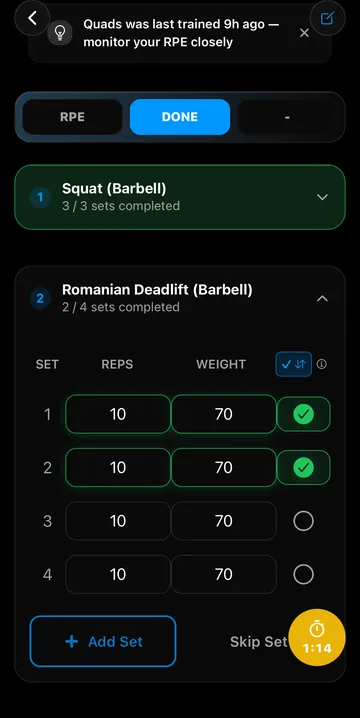
Rest long enough to make the next set productive—not merely long enough for the timer to beep. For muscle growth, the research points to at least 60–90 seconds between sets, with little extra benefit beyond about 90 seconds for most exercises; for heavy strength work, 2–5 minutes.1,2
That usually means more rest for heavy compound lifts and less for smaller isolation exercises. But there is no universal optimal duration. Your exercise, load, goal, conditioning, and performance on the day all matter.
If you want a starting point, use these ranges as heuristics, not rules:
- Heavy strength work: about 3–5 minutes
- Moderate-to-heavy compound hypertrophy work: about 2–3 minutes
- Isolation and lower-fatigue exercises: about 60–120 seconds
- Very demanding sets or near-maximal attempts: 5 minutes or more may be useful
Then adjust. If your next set loses several reps, your technique changes, or you cannot reproduce the intended effort, a longer rest may improve the quality of your training. If performance is stable and you feel ready sooner, you may not need to wait out the full range.
What the research says
- Very short rests slightly blunt growth. A Bayesian meta-analysis of 9 studies found a small hypertrophy benefit for resting longer than 60 seconds, but no appreciable difference once rest exceeded about 90 seconds.1 Moderate evidence
- Trained lifters grew more with 3 minutes than 1 minute. In an 8-week trial, 3-minute rests produced greater squat and bench 1RM gains and more quadriceps growth than 1-minute rests with the same sets and reps.3 Moderate evidence
- Strength needs longer rests in trained lifters. A review of 23 studies (491 participants) concluded that rests above 2 minutes maximise strength in trained people, while 60–120 seconds is enough for beginners.2 Moderate evidence
- Short rests cost reps on later sets. With 1-minute rests, trained men lost reps from the second set onward and completed far fewer total bench press reps than with 3 or 5 minutes.4,5 Strong evidence
- Supersets save time without hurting results. A meta-analysis of 19 studies found similar long-term strength and hypertrophy with supersets and traditional sets, in less session time.6 Moderate evidence
Evidence grades reflect the number and quality of studies (meta-analyses > single RCTs > acute/mechanistic data).
Why rest time changes the next set
A hard set creates several kinds of fatigue. Your working muscles need to restore energy, your breathing and heart rate need to settle, and you need to regain focus and bracing for the next effort. These processes do not all recover at the same speed.
Short rests can therefore change what you are able to do. A load that allowed 10 controlled reps in set one might allow only six or seven in set two if you start again too soon. That does not automatically make the shorter rest bad. It does mean the workout is now providing a different training exposure: less load or fewer reps, more accumulated fatigue, and often more discomfort.
The relevant question is not, “Am I completely recovered?” Performance cannot prove complete physiological recovery. Instead ask, “Am I recovered enough to perform the next planned set with the intended load, technique, and effort?”
Rest for strength: protect force and technique
For strength-focused work, start near the longer end of the ranges. Sets of squats, deadlifts, presses, and rows with heavy loads require more than local muscle recovery. They also demand coordination, bracing, and concentration.
A systematic review of 23 studies on rest intervals and strength development found that robust strength gains are possible even with rests under 60 seconds, but that trained lifters appear to need rests longer than 2 minutes to maximise strength. For untrained people, 60–120 seconds seemed sufficient.2 The American College of Sports Medicine position stand likewise recommends 3–5 minutes between heavy sets for intermediate and advanced lifters.7
Acute studies show why. When 15 trained men did five sets of bench press with a 3-repetition-maximum load, they completed about 7.6 total reps with 1-minute rests, versus about 11.7 with 3 minutes and 12.9 with 5 minutes.5 Near-maximal loads need particularly generous recovery.
In practice, use about three to five minutes between hard working sets of a main lift. Longer can make sense after an unusually difficult set, before a near-maximal attempt, or when the exercise carries a high cost if technique breaks down. Warm-up sets usually need less rest because they are farther from failure, though the final warm-up before a heavy attempt may deserve more.
Do not shorten rest simply to make strength work feel harder. A burning chest and a high heart rate are not the same as producing high force. If the goal is to practice lifting heavy with stable technique, preserve the conditions that let you do that.
Rest for muscle growth: keep the hard sets productive
Hypertrophy training does not require breathless, short-rest circuits. Muscle can grow across a range of rest intervals, but very short rests can reduce the reps or load you can complete in later sets.
A 2024 Bayesian meta-analysis pooled 19 measurements from 9 randomised studies that changed only rest duration. Effect sizes overlapped heavily, but central estimates favoured longer rests for the arms and thighs, suggesting a small benefit to resting more than 60 seconds—probably because longer rests let you complete more reps with more load. Beyond about 90 seconds, the authors found no appreciable further difference.1 An earlier systematic review reached a similar, cautious conclusion: both short and long rests can build muscle, with a possible advantage for longer rests in trained lifters.8
Key study
1-minute vs. 3-minute rests in trained men (Schoenfeld et al., 2016)
- Design
- 8-week randomised trial, 3 full-body sessions per week
- Who
- 21 young resistance-trained men
- Compared
- 1-minute vs. 3-minute rests; 3 sets of 8–12RM on 7 exercises, all other variables identical
- Result
- The 3-minute group gained significantly more squat and bench press 1RM and more anterior-thigh muscle thickness, with a trend toward more triceps growth (p = 0.06). Muscular endurance improved similarly.
Why it matters: Cutting rest to “increase intensity” can reduce the work you actually do and the results you get. Caveat: a small sample, ultrasound measurements, and the same number of sets in both groups—the short-rest group simply lifted less in total.3
The practical reading is modest: do not treat 30–60 seconds as mandatory, especially on demanding multi-joint exercises. The ACSM position stand still lists 1–2 minutes for hypertrophy work, which is reasonable for many accessories.7
For compound hypertrophy work, two to three minutes is a useful starting point. For isolation exercises, 60–120 seconds often works because the systemic demand is lower. These ranges can overlap. A hard set of Bulgarian split squats may need longer than a moderate set of machine rows, even if both are programmed for 10 reps.
Rest duration is also tied to effort. A set stopped with four reps in reserve will usually be easier to repeat than one taken to failure. If you train close to failure, you may need more time before the next high-quality set. Since stopping a rep or two short builds muscle about as well as going all-out, that is one more reason not to grind every set—see do you need to train to failure.
A worked example: when 90 seconds is not enough
Imagine your program calls for three sets of eight to ten reps on the bench press, with roughly two reps in reserve.
You log:
- Set 1: 80 kg × 10, about 2 reps in reserve
- Rest: 90 seconds
- Set 2: 80 kg × 7, about 0 reps in reserve
- Rest: 90 seconds
- Set 3: 80 kg × 5, technique beginning to change
The first set matched the plan. The later sets did not. Several factors could be responsible—sleep, nutrition, load selection, or an optimistic effort estimate—but the consistent short rest is an obvious variable to test.
At the next session, keep the load and target the same but rest three minutes:
- Set 1: 80 kg × 10, about 2 reps in reserve
- Set 2: 80 kg × 9, about 2 reps in reserve
- Set 3: 80 kg × 8, about 1–2 reps in reserve
The longer rest did not prove that you were “fully recovered.” It simply helped you reproduce the programmed work more closely. That makes it a better fit for this exercise and target.
Use this practical adjustment rule: if reps fall by more than expected, effort jumps sharply, or technique becomes less repeatable, add 30–60 seconds next time before changing the exercise or load. If several sessions remain stable, you can keep that rest or cautiously test a slightly shorter interval.
Isolation work can usually move faster
Lateral raises, curls, triceps extensions, calf raises, and many machine exercises often need less rest than heavy compounds. They use less total muscle mass, require less bracing, and are generally simpler to perform safely under fatigue.
They are not immune to short rests, though. In trained men doing 10-rep-max sets, leg press, leg extension and machine chest fly reps all dropped more with 1 minute than with 3 or 5 minutes.4 With near-maximal loads, 2 minutes was enough to sustain chest-fly performance, while the bench press needed 3–5 minutes.5
Start around 60–90 seconds, then use the same performance check. If 15 controlled reps become eight rushed reps on the next set, more rest may help. If your reps and technique remain within the target, the shorter interval is probably doing its job.
There is no prize for making every exercise follow the same clock. A session can sensibly use four minutes for squats, two minutes for leg curls, and 75 seconds for calf raises.
Supersets: save time without sabotaging the target
Supersets pair two exercises before a longer rest. They can make a workout more efficient, but exercise selection matters.
A 2025 meta-analysis of 19 studies (313 participants) found that supersets cut session time while producing similar volume load and similar long-term gains in strength (SMD 0.10) and hypertrophy (SMD −0.05) compared with traditional sets. The trade-off: higher perceived exertion and a higher acute physiological load.6
Pairing matters. Agonist–antagonist supersets (such as a row with a press, or a curl with a triceps extension) actually let lifters complete more reps than traditional sets, while pairing two exercises for the same muscle reduced volume load.6 Alternating also gives each movement some indirect recovery while you perform the other.
For example:
- Perform a set of chest-supported rows.
- Take 15–30 seconds to transition.
- Perform a set of dumbbell presses.
- Rest 90–120 seconds before repeating.
Each exercise effectively receives the transition, the other exercise, and the final rest before it is repeated. Still, monitor performance. If the press limits the row because you are breathing heavily, extend the final rest or separate the movements.
Avoid pairing two technically demanding lifts merely to finish faster. Heavy squats and heavy deadlifts are rarely a useful time-saving combination.
What to do when time is limited
When you have 35 minutes instead of an hour, cutting every rest period in half is not your only option. It may preserve the number of programmed sets on paper while reducing the quality of most of them.
A better order of operations is:
- Keep adequate rest for the highest-priority compound lift.
- Remove a lower-priority set or exercise if needed.
- Superset compatible accessories.
- Use shorter rests for low-skill isolation work.
Three productive sets are often more useful than five hurried sets whose load, reps, and technique collapse. Weekly hard sets per muscle are what drive growth over time, so protect the quality of the sets you keep—see how many sets per week you need. You can also set a rest range rather than a fixed time—for example, two to three minutes—and begin at the early end when your breathing, setup, and readiness are back.
Density can be a deliberate progression variable, but treat it carefully. Completing the same quality work in slightly less time can be progress. Simply doing less work because you rushed is not. For more ways to assess improvement, see Progressive Overload Is More Than Weight and Reps.
Track rest alongside performance
Rest time becomes useful when it has context. Record the exercise, load, reps, effort, and approximate rest between working sets. Over several sessions, look for patterns:
- Do repetitions fall sharply after short rests?
- Does a longer interval let you keep technique more consistent?
- Are you resting longer without gaining any meaningful performance?
- Does one exercise need more recovery than others in the same rep range?
Keep comparisons fair. If load, exercise order, range of motion, and effort all change at once, rest time will be hard to evaluate. A consistent training log gives you a better basis for adjustment than memory alone.
Rest also interacts with recovery outside the gym. A difficult calorie deficit, poor sleep, or inconsistent fueling can make the same workout feel harder. For the nutrition side of that equation, see Strength Training Nutrition Needs.
A safety note
Do not begin another set while you are dizzy, faint, nauseated, unable to control your breathing, or unable to brace and handle the equipment safely. Rest longer, reduce the load, or end the exercise. Use appropriate spotters or safeties for heavy lifts. If unusual symptoms persist—especially chest pain, fainting, or severe shortness of breath—stop training and seek appropriate medical care.
The practical answer
Start with longer rests for heavy, technical, or near-failure sets and shorter rests for low-fatigue isolation work. Then let the logbook refine the range.
Your timer should support the goal of the set. If an extra minute lets you repeat the intended reps with stable technique and effort, it is not wasted time. If performance is already stable, waiting longer is optional—not automatically better. For how rest fits alongside volume, effort and frequency, see the science of muscle growth.
References
- Singer A, Wolf M, Generoso L, et al. Give it a rest: a systematic review with Bayesian meta-analysis on the effect of inter-set rest interval duration on muscle hypertrophy. Front Sports Act Living. 2024;6:1429789. PubMed
- Grgic J, Schoenfeld BJ, Skrepnik M, Davies TB, Mikulic P. Effects of rest interval duration in resistance training on measures of muscular strength: a systematic review. Sports Med. 2018;48(1):137-151. PubMed
- Schoenfeld BJ, Pope ZK, Benik FM, et al. Longer interset rest periods enhance muscle strength and hypertrophy in resistance-trained men. J Strength Cond Res. 2016;30(7):1805-1812. PubMed
- Senna G, Willardson JM, de Salles BF, et al. The effect of rest interval length on multi and single-joint exercise performance and perceived exertion. J Strength Cond Res. 2011;25(11):3157-3162. PubMed
- Senna GW, Willardson JM, Scudese E, et al. Effect of different interset rest intervals on performance of single and multijoint exercises with near-maximal loads. J Strength Cond Res. 2016;30(3):710-716. PubMed
- Zhang X, Weakley J, Li H, Li Z, García-Ramos A. Superset versus traditional resistance training prescriptions: a systematic review and meta-analysis exploring acute and chronic effects on mechanical, metabolic, and perceptual variables. Sports Med. 2025;55(4):953-975. PubMed
- American College of Sports Medicine. American College of Sports Medicine position stand. Progression models in resistance training for healthy adults. Med Sci Sports Exerc. 2009;41(3):687-708. PubMed
- Grgic J, Lazinica B, Mikulic P, Krieger JW, Schoenfeld BJ. The effects of short versus long inter-set rest intervals in resistance training on measures of muscle hypertrophy: a systematic review. Eur J Sport Sci. 2017;17(8):983-993. PubMed