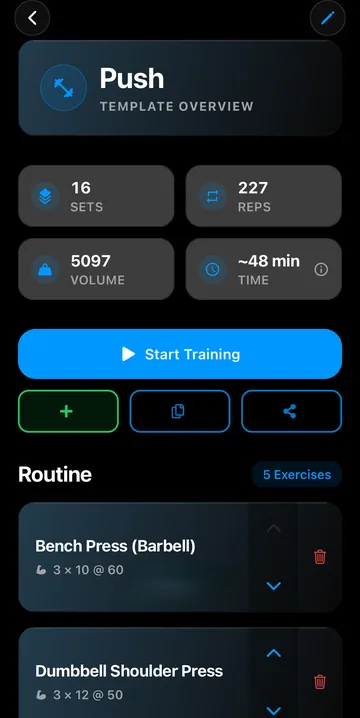
The best PPL split matches your training experience and the number of days you can reliably lift. The intermediate plan below repeats one Push, Pull, and Legs rotation over five or six sessions. The advanced plan uses six distinct A/B workouts for lifters with a proven ability to recover from more volume and complexity.
Neither plan is automatically better because it is longer. Start with the intermediate version unless your training log already shows that you can progress through high-volume six-session blocks without persistent performance loss, joint irritation, or missed workouts.
What the research says
- The split label is not the active ingredient. A 2024 meta-analysis of 14 studies (392 participants) found similar strength and muscle growth with split and full-body routines when volume was equated, and a 25-study meta-analysis found no significant difference between training frequencies at equal weekly volume.1,2 Strong evidence
- More weekly sets build more muscle, with diminishing returns. In a 15-study meta-analysis, each additional weekly set was associated with about 0.37 percentage points more muscle growth.3 Strong evidence
- Both plans land in an evidence-consistent range. A review of trained young men found 12–20 weekly sets per muscle a sensible standard.4 The intermediate plan gives about 10–12 weekly direct sets for chest, back, quads and hamstrings (five vs six days); the advanced plan gives about 16–17 for chest, back and quads. Moderate evidence
- Train close to failure, not necessarily to it. A 15-study meta-analysis found no significant hypertrophy difference between failure and non-failure training, while a 2024 meta-regression found growth increased as sets ended closer to failure.5,6 Moderate evidence
Evidence grades reflect the number and quality of studies (meta-analyses > single RCTs > acute/mechanistic data).
What is a PPL split?
PPL stands for Push, Pull, Legs:
- Push trains the chest, shoulders, and triceps.
- Pull trains the back, rear delts, and biceps.
- Legs trains the quadriceps, hamstrings, glutes, and calves.
After Legs, the sequence returns to Push. This makes PPL a rotation, not necessarily a Monday-to-Sunday prescription. A six-session week can complete Push, Pull, Legs twice. A five-session week completes five workouts and resumes with the next uncompleted session the following week.
Research does not show that the PPL label itself produces superior strength or muscle growth.1 A split is useful when it helps you distribute productive weekly training, maintain set quality, recover, and complete the plan consistently. Frequency is a scheduling tool; the exercises, working sets, effort, progression, and recovery determine what you actually adapt to.2 Training each muscle about twice a week is still a sensible default, which is why the six-day version repeats every session. See How Often Should You Train Each Muscle? for the full evidence.
Which PPL program should you choose?
| Choose | When it fits |
|---|---|
| Intermediate PPL | You reliably train 5–6 days, know the basic lifts, recover well, and want one repeatable rotation without advanced isolation work |
| Advanced PPL | You have proven tolerance for high training volume, can sustain six distinct workouts, and benefit from additional exercise variety |
“Advanced” describes demonstrated readiness, not how many years have passed since your first gym session. If the intermediate plan still produces measurable progress, it has not become ineffective merely because it looks simpler.
Intermediate push pull legs workout plan
Level: Intermediate Frequency: 5–6 sessions/week Time: 60+ minutes/session Best for: Intermediate lifters who recover well and want a high-frequency PPL without advanced isolation work. Description: A classic Push, Pull, Legs rotation with straightforward accessories. Repeat the three workouts twice for six sessions, or add a rest day for five.
The following prescriptions reproduce the intermediate program available in the app. All listed sets are working sets; perform appropriate warm-up sets before demanding lifts.
Push — Chest, Shoulders and Triceps
| Exercise | Sets × reps |
|---|---|
| Barbell Bench Press | 3×10 |
| Shoulder Press (Dumbbells) | 3×12 |
| Incline Bench Press (Dumbbells) | 3×12 |
| Lateral Raise (Dumbbells) | 4×15 |
| Triceps Pushdown (Cable) | 3×15 |
Pull — Back and Biceps
| Exercise | Sets × reps |
|---|---|
| Barbell Deadlift | 3×5 |
| Lat Pulldown (Machine) | 3×12 |
| Seated Row (Cable) | 3×12 |
| Rear Delt Fly (Machine) | 3×15 |
| Hammer Curl (Dumbbells) | 3×12 |
Legs — Quads, Hamstrings and Calves
| Exercise | Sets × reps |
|---|---|
| Barbell Squat | 3×8 |
| Romanian Deadlift (Barbell) | 3×10 |
| Leg Extension (Machine) | 3×15 |
| Seated Leg Curl (Machine) | 3×15 |
| Standing Calf Raise | 4×15 |
One Push/Pull/Legs rotation contains 47 working sets: 16 on Push, 15 on Pull, and 16 on Legs. Completing the rotation twice produces 94 working sets. That is already substantial. Do not automatically add exercises or sets because another program advertises more volume.
Five-day intermediate schedule
| Week | Mon | Tue | Wed | Thu | Fri | Sat | Sun |
|---|---|---|---|---|---|---|---|
| 1 | Push | Pull | Legs | Rest | Push | Pull | Rest |
| 2 | Legs | Push | Pull | Rest | Legs | Push | Rest |
| 3 | Pull | Legs | Push | Rest | Pull | Legs | Rest |
This example illustrates the important point: five PPL sessions do not train every body region twice in each calendar week. The sequence rolls forward, so frequency balances across multiple weeks. If you miss Friday Pull, your next session is still Pull. Do not skip ahead to Push because a new Monday arrived.
Six-day intermediate schedule
| Day | Session |
|---|---|
| Monday | Push |
| Tuesday | Pull |
| Wednesday | Legs |
| Thursday | Push |
| Friday | Pull |
| Saturday | Legs |
| Sunday | Rest |
This completes two rotations in seven days. It also places Barbell Deadlift on Pull directly before Legs twice. That ordering is part of the fixed program, so the answer is demand management—not silently moving the deadlift. Keep deadlift sets controlled, avoid turning every set into a maximal test, and assess whether grip, spinal erectors, or general fatigue reduces squat and Romanian deadlift performance the next day. If it consistently does, use the five-session rotation or add a rest day while preserving workout order.
Advanced push pull legs workout plan
Level: Advanced Frequency: 5–6 sessions/week Time: Often 60+ minutes/session Best for: Advanced trainees wanting a true twice-weekly PPL microcycle and able to tolerate greater volume, complexity, and exercise variety. Description: Six distinct workouts with heavier compounds and advanced accessories such as cable flyes, preacher curls, pullovers, and front squats.
The A and B sessions are not interchangeable grab bags. Preserve the sequence—Push A, Pull A, Legs A, Push B, Pull B, Legs B—so that performance comparisons remain meaningful.
Six sessions complete the full A/B microcycle inside one week. If you use five sessions, continue with the next lettered workout the following week rather than resetting at Push A.
Push A
| Exercise | Sets × reps |
|---|---|
| Barbell Bench Press | 4×6 |
| Shoulder Press (Dumbbells) | 3×10 |
| Incline Bench Press (Dumbbells) | 3×10 |
| Chest Fly (Cable) | 3×12 |
| Lateral Raise (Dumbbells) | 4×12 |
| Triceps Rope Pushdown (Cable) | 3×15 |
Pull A
| Exercise | Sets × reps |
|---|---|
| Barbell Deadlift | 4×4 |
| Pull-ups | 4×8 |
| Seated Row (Cable) | 3×10 |
| Face Pulls (Cable) | 3×15 |
| Preacher Curl (EZ-Bar) | 3×10 |
Legs A
| Exercise | Sets × reps |
|---|---|
| Barbell Squat | 4×6 |
| Romanian Deadlift (Barbell) | 3×8 |
| Leg Press (Machine) | 3×12 |
| Lying Leg Curl (Machine) | 3×12 |
| Standing Calf Raise | 4×15 |
Push B
| Exercise | Sets × reps |
|---|---|
| Incline Bench Press (Barbell) | 3×8 |
| Overhead Press (Barbell) | 3×8 |
| Chest Fly (Dumbbells) | 3×12 |
| Lateral Raise (Cable) | 3×15 |
| Skull Crushers (EZ-Bar) | 3×10 |
Pull B
| Exercise | Sets × reps |
|---|---|
| Barbell Row | 4×8 |
| Lat Pulldown (Machine) | 3×12 |
| Pullover (Cable) | 3×15 |
| Biceps Curl (Barbell) | 3×10 |
| Hammer Curl (Cable, Rope) | 3×12 |
Legs B
| Exercise | Sets × reps |
|---|---|
| Front Squat (Barbell) | 3×6 |
| Hip Thrust (Barbell) | 3×10 |
| Bulgarian Split Squat (Dumbbells) | 3×10 |
| Leg Extension (Machine) | 3×15 |
| Seated Calf Raise (Machine) | 4×15 |
The complete advanced microcycle contains 101 working sets: 20 on Push A, 17 on Pull A, 17 on Legs A, 15 on Push B, 16 on Pull B, and 16 on Legs B. That total is a workload to earn through prior training, not a target every intermediate lifter should aspire to.
Barbell Deadlift again occurs on Pull A immediately before Legs A. Preserve that order if you use this exact program. Because four sets of four can create meaningful systemic and posterior-chain demand, use technically repeatable reps and leave a margin rather than grinding. If the next day’s squat performance repeatedly deteriorates at matched effort, the program may exceed your current recovery capacity.
How many weekly sets per muscle does each plan give?
Counting only direct working sets (a row counts for the back, not the biceps), the two plans deliver roughly this much weekly work per muscle. The five-day column averages the rolling rotation over three weeks.
| Muscle | Intermediate, 6 days | Intermediate, 5 days (average) | Advanced, 6 days |
|---|---|---|---|
| Chest | 12 | 10 | 16 |
| Back (lats and upper back) | 12 | 10 | 17 |
| Quads | 12 | 10 | 16 |
| Hamstrings | 12 | 10 | 6 (+4 deadlift) |
| Side delts | 8 | ~7 | 7 |
| Biceps | 6 | 5 | 9 |
| Triceps | 6 | 5 | 6 |
| Calves | 8 | ~7 | 8 |
Read against the research, the large muscles sit where they should. How Many Sets per Week to Build Muscle? uses about 10–16 weekly sets for intermediates and 12–20 for advanced lifters, in line with a review of trained young men that found no extra quadriceps or biceps growth beyond 12–20 sets (only the triceps benefited from more).4 Arms, side delts, and calves get fewer direct sets, but compound lifts count partly: the best-fitting model in a 2026 meta-regression of 67 studies counted indirect sets as half a set.7 Counted that way, the six-day intermediate plan gives the triceps about 15 weekly sets and the biceps about 12.
The one thin spot is the advanced plan’s hamstrings: six direct sets per week from Romanian deadlifts and leg curls, plus four deadlift sets on Pull A. If hamstring performance stalls while everything else progresses, that is the first place your log should look—not a reason to add work everywhere.
How hard should you train?
Begin most work at roughly two to three repetitions in reserve (RIR). In plain language, stop while you could still complete about two or three clean repetitions. This is deliberately conservative while you learn how the volume affects you.
You do not need to take every set to failure. Reviews comparing failure and non-failure training do not support blanket failure as a requirement for strength or hypertrophy, while repeated failure can increase acute fatigue.5 Proximity still matters: a 2024 series of meta-regressions found muscle growth increased as sets ended closer to failure.6 Treat 2–3 RIR as a starting point, not a ceiling; once your estimates are reliable, finishing isolation sets around 0–2 RIR is consistent with Do You Need to Train to Failure to Build Muscle? Stable machine or isolation exercises can sometimes be trained closer to failure once you understand your response, but that is not a reason to turn all 94 or 101 weekly sets into maximal efforts.
If estimating RIR is unfamiliar, use the RPE and RIR calibration guide before making effort-based changes.
How to progress the PPL program
Use small, conditional load increases:
- Keep the exercise, technique, range of motion, and rest period consistent.
- Complete the prescribed sets and reps at about 2–3 RIR.
- When all sets are clean and the effort target is met across repeat exposures, add the smallest practical load.
- If the load increase causes missed reps or grinding, return to the previous load or use a smaller jump.
The printed rep target does not require a load increase every workout. A set can improve through cleaner execution, more consistent bar speed, or the same performance at lower perceived effort. Read progressive overload beyond weight and reps for a broader framework.
Do not add sets as the default progression method. Both programs already contain high set totals. More volume can build more muscle—in an 8-week trial of trained men, higher-volume groups grew more at three of four measured sites while strength gains were similar across groups8—but the returns shrink as volume climbs.7 Extra work is justified only when your log shows stable recovery, adequate effort, and a specific muscle that is not progressing—not because soreness faded.
Rest and recovery
As a starting point, rest roughly three to five minutes for heavy barbell compounds, two to three minutes for other multi-joint exercises, and one to two minutes for isolation work. In trained men, 3-minute rests produced greater strength gains and more quadriceps growth than 1-minute rests over eight weeks.9 The correct rest period is long enough to reproduce the intended performance and technique. See how long to rest between sets for practical adjustments.
Review performance across several exposures. One bad workout can reflect sleep, food, stress, or ordinary variability. More concerning signs include repeated regression at similar RIR, persistent joint irritation, worsening technique, and dread that does not resolve after normal rest.
If fatigue accumulates across the program, first reduce effort or frequency rather than adding compensatory work. A planned deload week can help, but recurring emergency deloads suggest the baseline plan is too demanding.
Common PPL mistakes
Treating five days as two complete weekly rotations
Five sessions finish only one and two-thirds PPL rotations. Continue the sequence next week. Do not repeatedly omit whichever workout falls beyond Sunday.
Choosing Advanced for the exercise variety
Cable flyes and preacher curls do not confer advanced status. The advanced plan requires tolerance for 101 work sets and six distinct sessions. Use it because the workload suits your demonstrated needs, not because the exercise list looks more interesting.
Testing the deadlift on every Pull day
Deadlifts are placed before Legs in these programs. Maximal grinders can compromise the following lower-body session. Respect the prescribed reps, retain 2–3 RIR initially, and judge the sequence from logged performance.
Adding work before calibrating effort
A high-volume plan performed too easily can underdeliver; the same plan taken to failure can be unnecessarily exhausting. Establish repeatable RIR before changing the number of sets.
Forcing PPL onto a four-day calendar
PPL works best here when you can reliably train five or six times. Four reliable days often fit an upper/lower split better, while one to three days can fit full-body training. For a fixed five-day alternative, compare PPLUL and ULPPL.
Frequently asked questions
Is PPL good for building muscle?
Yes, PPL can support hypertrophy when it distributes an appropriate amount of hard training that you can recover from and progress. The split name is not the active ingredient.
Is PPL good for strength?
It can be. The programs include bench presses, deadlifts, squats, rows, and overhead presses. Strength outcomes still depend on lift specificity, loading, effort, rest, and recovery. These are general strength-and-hypertrophy templates, not competition peaks.
Is five-day or six-day PPL better?
Neither is categorically better. Five days offers more recovery but rolls across calendar weeks. Six days completes two PPL rotations weekly but carries greater workload and scheduling demand. Use the detailed five-day versus six-day PPL comparison to choose.
Can a beginner use this PPL split?
The exercises can be learned, but beginners usually do not need five or six long sessions. A one-to-three-day full-body program provides frequent practice with fewer moving parts.
What should I do if I miss a PPL workout?
Resume with the next uncompleted workout. If you miss Pull, perform Pull next rather than skipping to Legs or restarting at Push. If missed sessions are routine, choose a schedule with fewer required days.
How long should I run the program?
Run it long enough to evaluate repeatable performance trends—often at least six to eight weeks—unless pain, persistent regression, or schedule failure requires an earlier change.
The practical takeaway
The intermediate plan is the best starting PPL split for most experienced lifters moving to five or six days: it is repeatable, complete, and already supplies 47 sets per rotation. The advanced version earns its name through workload—101 working sets across six distinct A/B sessions—and belongs with lifters whose logs demonstrate that tolerance.
Choose one version, preserve the sequence, begin around 2–3 RIR, and increase load only when every prescribed set and rep is controlled. Consistency and recoverable progression beat collecting more exercises.
References
- Ramos-Campo DJ, Benito-Peinado PJ, Andreu-Caravaca L, Rojo-Tirado MA, Rubio-Arias JÁ. Efficacy of split versus full-body resistance training on strength and muscle growth: a systematic review with meta-analysis. J Strength Cond Res. 2024;38(7):1330-1340. PubMed
- Schoenfeld BJ, Grgic J, Krieger J. How many times per week should a muscle be trained to maximize muscle hypertrophy? A systematic review and meta-analysis of studies examining the effects of resistance training frequency. J Sports Sci. 2019;37(11):1286-1295. PubMed
- Schoenfeld BJ, Ogborn D, Krieger JW. Dose-response relationship between weekly resistance training volume and increases in muscle mass: a systematic review and meta-analysis. J Sports Sci. 2017;35(11):1073-1082. PubMed
- Baz-Valle E, Balsalobre-Fernández C, Alix-Fages C, Santos-Concejero J. A systematic review of the effects of different resistance training volumes on muscle hypertrophy. J Hum Kinet. 2022;81:199-210. PubMed
- Grgic J, Schoenfeld BJ, Orazem J, Sabol F. Effects of resistance training performed to repetition failure or non-failure on muscular strength and hypertrophy: a systematic review and meta-analysis. J Sport Health Sci. 2022;11(2):202-211. PubMed
- Robinson ZP, Pelland JC, Remmert JF, Refalo MC, Jukic I, Steele J, Zourdos MC. Exploring the dose-response relationship between estimated resistance training proximity to failure, strength gain, and muscle hypertrophy: a series of meta-regressions. Sports Med. 2024;54(9):2209-2231. PubMed
- Pelland JC, Remmert JF, Robinson ZP, Hinson SR, Zourdos MC. The resistance training dose response: meta-regressions exploring the effects of weekly volume and frequency on muscle hypertrophy and strength gains. Sports Med. 2026;56(2):481-505. PubMed
- Schoenfeld BJ, Contreras B, Krieger J, Grgic J, Delcastillo K, Belliard R, Alto A. Resistance training volume enhances muscle hypertrophy but not strength in trained men. Med Sci Sports Exerc. 2019;51(1):94-103. PubMed
- Schoenfeld BJ, Pope ZK, Benik FM, Hester GM, Sellers J, Nooner JL, Schnaiter JA, Bond-Williams KE, Carter AS, Ross CL, Just BL, Henselmans M, Krieger JW. Longer interset rest periods enhance muscle strength and hypertrophy in resistance-trained men. J Strength Cond Res. 2016;30(7):1805-1812. PubMed