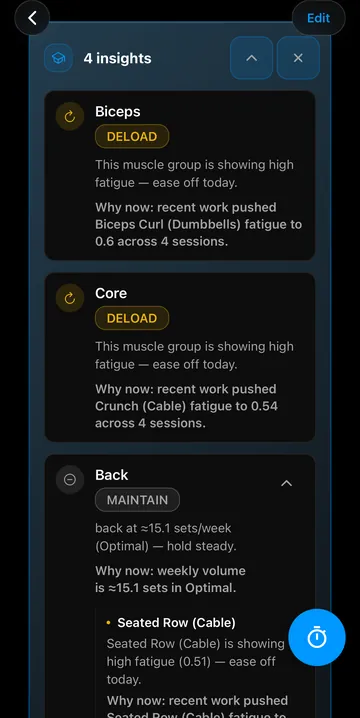
A deload is a short period of deliberately reduced training stress—typically about a week of fewer sets, lighter loads, and easier effort. An international expert consensus defines it as reduced training stress designed to reduce fatigue, promote recovery, and prepare you for the training that follows.1
In practice, you can reduce sets, load, effort, training days, or a combination of them for a short period. There is no universal schedule or percentage reduction that fits everyone. A deload is a programming tool—not an obligatory ritual, a proven shortcut, or a guarantee against injury.
What the research says
- A full week off does not boost muscle growth. In trained lifters, skipping all lifting for one week mid-way through a 9-week program produced similar quadriceps growth but smaller strength gains than training straight through.2 Emerging evidence
- Short breaks do not erase progress either. In untrained men, 6-week training blocks separated by 3-week breaks produced the same muscle and strength gains over 24 weeks as continuous training.3 Emerging evidence
- Experienced athletes deload about every 5–6 weeks, for about a week. 246 competitive strength and physique athletes reported deloads lasting 6.4 ± 1.7 days every 5.6 ± 2.3 weeks.4 Emerging evidence
- Most deloads cut volume and effort rather than stopping training. Athletes mostly reduced sets and reps, lowered load, and left more reps in reserve while keeping frequency and exercises the same.4,1 Moderate evidence
Evidence grades reflect the number and quality of studies (meta-analyses > single RCTs > acute/mechanistic data). Deload research is young: most guidance comes from expert consensus and surveys, so treat it as informed practice rather than proven fact.
Deload, rest week, and taper are not the same
These terms are often mixed together:
- Deload: training continues, but one or more sources of training stress are reduced. A deload can appear between ordinary training blocks or whenever accumulated fatigue needs to be managed.
- Rest week: structured resistance training stops. This may be appropriate during illness, travel, a mental break, or when advised by a clinician, but it is only one possible way to reduce training stress.
- Taper: training is adjusted to express performance at a specific event, such as a powerlifting meet. Taper research for strength athletes commonly emphasizes cutting volume by roughly 30–70% while keeping loads heavy (around 85% of 1RM or more).5 That does not make a competition taper the default template for a recreational lifter's deload.
The purpose determines the design. A powerlifter seven days from competition has a different problem from someone halfway through a hypertrophy block who feels persistently run down.
What the evidence can—and cannot—tell us
Direct experimental evidence on deloading is still limited. Much of the practical guidance comes from expert consensus, surveys of athletes and coaches, and research on the related—but different—practice of tapering. A Delphi study of expert strength and physique coaches (34 in the first round, 21 completing all three) produced design principles and a consensus definition, but expert agreement is not the same as experimental proof.1
Key study
One week off vs. training straight through (Coleman et al., 2024)
- Design
- 9-week randomised trial, two parallel groups
- Who
- 39 resistance-trained young adults (29 men, 10 women)
- Compared
- No resistance training at all in week 5 (“deload”) vs. the same high-volume program performed continuously
- Result
- No appreciable differences in lower-body muscle thickness, local endurance, or power. The continuous group gained more isometric and dynamic lower-body strength and reported slightly better readiness to train.
Why it matters: Taking a week completely off did not “re-sensitise” muscle to growth. Caveat: it tested complete cessation after only four weeks of training—not the reduced-volume deloads most lifters use—and the authors note that programs of 9 weeks or less may simply not need one.2
Longer-term data point the same way. In a 24-week study, 14 untrained young men did bench press either continuously or in three 6-week blocks separated by 3-week breaks. Gains slowed over time in the continuous group, while the periodic group gained faster after its later break—so overall muscle growth and strength were similar despite 25% fewer training weeks.3 That suggests short breaks cost little, though it says nothing direct about trained lifters or reduced-load deloads. For how quickly muscle is lost and regained, see muscle memory and detraining.
The useful conclusion is modest: reduce training stress for a clear reason, choose a method that matches that reason, and do not assume complete rest is automatically better than lighter training.
When should you consider a deload?
There is no validated single-signal test that tells you it is time. One poor session, one night of bad sleep, or a little soreness is usually not enough information. Instead, look for a cluster of changes that persists beyond normal day-to-day variation:
- performance is falling across several sessions or exercises;
- familiar loads require substantially more effort;
- soreness or joint irritation is lingering longer than usual;
- motivation to train has fallen alongside physical signs of fatigue;
- technique becomes less repeatable despite normal warm-ups;
- high work, travel, sleep, or life stress is reducing your ability to recover.
These signs are not specific to training fatigue. An aggressive calorie deficit, poor sleep, illness, exercise selection, or an overly ambitious program can produce similar patterns. A deload may reduce the immediate workload, but it will not fix the underlying program if fatigue quickly returns.
Use your log to separate a trend from a bad day. Compare like with like: the same exercise, load or rep range, approximate rest, and effort target. RPE and RIR calibration can help you interpret effort without pretending that subjective ratings are perfectly precise. If your app shows a fatigue or recovery score, read what a workout-app fatigue score measures before letting it decide.
Pain deserves separate treatment. New, sharp, worsening, or function-limiting pain is not simply a signal to schedule an ordinary deload and carry on. Stop or modify the aggravating exercise and seek qualified medical or physiotherapy advice when appropriate.
Planned versus reactive deloads
A planned deload is placed in the program before fatigue becomes disruptive. It can be convenient after a demanding block, around travel, or before beginning a new phase. Planning removes the temptation to keep extending a block just because no single workout looks disastrous.
A reactive deload is added when trends suggest that current training stress is no longer productive. It is more flexible, but requires reasonably consistent logging and honest decisions. Waiting until every lift is collapsing is not sophisticated autoregulation.
Competitive strength and physique athletes report using both approaches. In a survey of 246 athletes with about 8 years of training experience, 47% used a pre-planned approach, 13% used only a reactive approach, and 39% combined the two. A typical deload lasted 6.4 days and came every 5.6 weeks, and the most common triggers were the program schedule (65%), feeling beat up (63%), and stalled performance.4 Those numbers describe practice; they do not prove which strategy produces better results.
A practical compromise is to place a review point at the end of a training block. Deload if the fatigue trend supports it; otherwise begin the next block conservatively. Do not force a deload merely because a calendar says everyone needs one every fourth week.
The three levers: sets, load, and effort
Training stress can be reduced in several ways. You rarely need to make every lever as low as possible.
1. Reduce sets
Completing fewer hard sets is the most direct way to lower volume. This also shortens sessions and can leave more energy for sleep, food preparation, or other recovery-supporting habits. Keep the highest-priority movements and remove lower-priority accessories or later sets first.
2. Reduce load
Using less weight can lower mechanical and technical demands. This may suit lifters who feel beat up under heavy loads or want to practice a movement without grinding. The load should still be controlled and purposeful; a deload is not a technique-free circuit.
3. Reduce effort
Stop sets farther from failure. If your normal work ends around one to two repetitions in reserve, a deload set might finish while several clean repetitions still appear available. This can reduce fatigue even when the load remains familiar. Avoid failure, forced repetitions, and surprise personal-record attempts. In the athlete survey, 85% reduced effort on multi-joint lifts during a deload.4 Because sets stopped a few reps short of failure still build muscle well, easing off effort costs little—see do you need to train to failure.
You can also reduce training frequency, swap out an aggravating exercise, or shorten the range of exercises. Coach surveys show that real-world deload prescriptions vary widely. Among 204 strength and conditioning coaches, a typical deload week was 1–2 sessions of 30–60 minutes, 1–3 sets of 1–6 reps at 60–84% of 1RM, and the most common volume and intensity reduction was 0–25%.6 Those coaches mostly worked with sport athletes during tapers, competition, and travel, so their numbers are not a template for a hypertrophy block. That variation is a reason to adjust the levers to the person and purpose—not to turn the most common survey answer into a universal rule.
Three example ways to deload
The following are starting examples, not prescriptions. The percentages describe changes from your recent training, not fixed percentages of one-repetition maximum.
Option 1: Keep the movements, do fewer sets
Keep your normal exercises and familiar working loads, but perform roughly half to two-thirds of the usual work sets. End every set comfortably short of failure. This approach preserves regular practice with the main lifts while cutting volume.
Option 2: Keep the schedule, lower load and effort
Train on the same days and perform a similar number of sets, but use clearly lighter loads and leave several repetitions in reserve. This may be useful when recent loading has made your joints or technique feel less reliable. If the added repetitions make sets hard again, the purpose has been defeated.
Option 3: Reduce sessions and simplify
Replace four or five normal sessions with two or three brief full-body sessions. Keep a few main movement patterns, remove optional accessories, and use easy-to-moderate sets. This structure can fit travel or a high-stress work week without requiring complete rest.
None is automatically best. If keeping heavy loads makes you anxious or achy, Option 1 may be a poor fit. If lighter weights tempt you to perform high-repetition sets to failure, Option 2 may not reduce much fatigue. Choose the structure you can execute as intended.
A complete example deload week
Imagine a lifter normally trains four days per week with several hard sets per exercise. Here is one illustrative, three-session deload—not a universal program:
Monday: squat and press practice
- Squat: 2 easy work sets, stopping with several reps in reserve
- Bench press: 2 easy work sets, stopping with several reps in reserve
- Row: 2 controlled sets
- Optional calf or trunk exercise: 1–2 easy sets
Wednesday: hinge and upper body
- Romanian deadlift: 2 easy work sets
- Overhead press: 2 easy work sets
- Pulldown or pull-up variation: 2 controlled sets
- Optional curl or triceps exercise: 1–2 easy sets
Friday: movement rehearsal
- Squat variation: 2 easy sets
- Bench press variation: 2 easy sets
- Light hinge or leg curl: 1–2 easy sets
- Row: 1–2 controlled sets
Tuesday, Thursday, Saturday, and Sunday contain no structured lifting. Easy walking or normal recreational activity is fine if it does not turn into replacement hard training.
The week has fewer sessions, fewer sets, no failure work, and less accessory volume. It retains the movement patterns the lifter wants to practice. Someone with pain, illness, or unusual exhaustion may need a different plan or professional advice. Someone preparing for competition needs a sport-specific taper rather than this generic example.
What to log during the deload
Treat the deload as part of the training process, not a blank page. Record:
- exercises, sets, repetitions, and load;
- RPE or estimated repetitions in reserve;
- any pain or unusual symptoms;
- session duration;
- sleep, motivation, and general fatigue using simple, consistent notes.
You are looking for direction, not a perfect recovery score. Does the same warm-up feel more normal? Is motivation returning? Are aches settling rather than escalating? Do easy sets actually remain easy?
Do not declare the deload a failure because the first session back feels unfamiliar. Surveyed athletes commonly reported returning by starting a new block (68%), progressively making training harder (55%), or adjusting the next block based on the previous one (50%).4 These are descriptions of experienced athletes' choices, not proof of one optimal return method.
How to return to normal training
Resume with a controlled first week rather than trying to prove the deload worked. Reintroduce the planned exercises, leave room in the effort target, and watch whether performance and technique normalize. If your program uses a new block, its first week should usually be more manageable than the final week of the previous block.
Avoid compensating for “missed” volume. Adding extra sets or testing a maximum can recreate the fatigue you just reduced. Use progressive overload beyond weight and reps to build the next block from repeatable performance, and keep rest between sets consistent enough to interpret the log.
If fatigue, pain, or declining performance returns immediately, review the larger plan. Weekly volume, exercise choice, proximity to failure, recovery time, nutrition, and life stress may need adjustment. Often the fix is trimming weekly sets toward the range you can actually recover from—see how many sets per week you need. Persistent unusual fatigue, shortness of breath, dizziness, illness symptoms, or unexplained performance loss warrants medical evaluation rather than repeated self-prescribed deloads.
The practical takeaway
A deload is a temporary reduction in training stress, not a magic recovery week. Consider one when several indicators point to accumulating fatigue, or plan one where it sensibly fits a demanding training block or life schedule. Reduce sets, load, effort, frequency, or some combination—but keep the change proportionate to the problem.
Most importantly, let the deload inform what comes next. If you repeatedly need emergency reductions, the normal weeks may be asking for more than you can currently recover from. For the bigger picture on volume, effort and recovery, read the science of muscle growth.
References
- Bell L, Strafford BW, Coleman M, Androulakis Korakakis P, Nolan D. Integrating deloading into strength and physique sports training programmes: an international Delphi consensus approach. Sports Med Open. 2023;9(1):87. PubMed
- Coleman M, Burke R, Augustin F, et al. Gaining more from doing less? The effects of a one-week deload period during supervised resistance training on muscular adaptations. PeerJ. 2024;12:e16777. PubMed
- Ogasawara R, Yasuda T, Ishii N, Abe T. Comparison of muscle hypertrophy following 6-month of continuous and periodic strength training. Eur J Appl Physiol. 2013;113(4):975-985. PubMed
- Rogerson D, Nolan D, Androulakis Korakakis P, Immonen V, Wolf M, Bell L. Deloading practices in strength and physique sports: a cross-sectional survey. Sports Med Open. 2024;10(1):26. PubMed
- Travis SK, Mujika I, Gentles JA, Stone MH, Bazyler CD. Tapering and peaking maximal strength for powerlifting performance: a review. Sports (Basel). 2020;8(9):125. PubMed
- De Marco K, Goods PSR, Baldwin KM, Hiscock DJ, Scott BR. Resistance training prescription during planned deloading periods: a survey of strength and conditioning coaches across varying sporting codes. J Strength Cond Res. 2024;38(12):2099-2106. PubMed