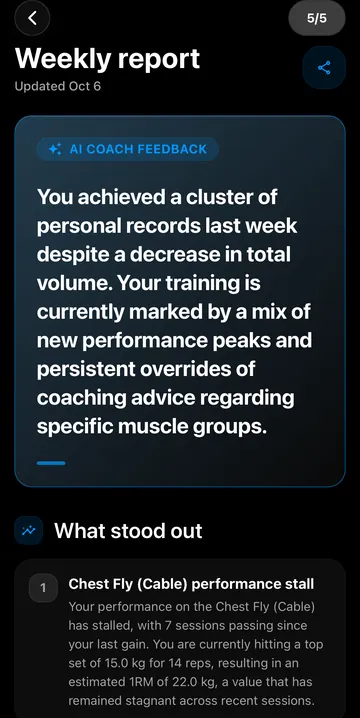
Progressive overload means making training gradually more demanding in a way your body can adapt to. Adding load and adding reps both work: in an 8-week trial in trained lifters, adding reps at a fixed load built muscle and strength about as well as adding weight.1
When people talk about progressive overload, the conversation usually goes straight to adding weight to the bar or chasing extra reps. Those are useful tools—but they are not the whole picture.
Progressive overload means gradually raising the demand of your training. Load and reps are the two most straightforward ways to do that. But when they are forced at the expense of technique, range of motion, recovery, or joint comfort, they can turn a productive set into a messier one.
The goal is not to create a new personal record every workout. The goal is to create a better training stimulus over time.
What the research says
- Adding reps works about as well as adding load. In trained lifters, rep progression and load progression produced muscle-thickness differences under 1 mm at most sites over 8 weeks; a 10-week trial in beginners found the same.1,2 Moderate evidence
- Heavy loads matter more for strength than for size. A network meta-analysis of 178 strength and 119 hypertrophy studies found that loads above 80% of 1RM maximised strength, while all prescriptions built muscle comparably.3 Strong evidence
- More weekly sets usually means more growth. Each extra weekly set was associated with about 0.37% more muscle gain in a meta-analysis of 15 studies.4 Strong evidence
- Full range of motion generally beats partial range. Across 16 studies, full-range training produced larger strength gains (effect size 0.56) and more lower-limb hypertrophy.5 Moderate evidence
- Slower tempo and all-out failure are not magic. Rep durations from 0.5 to 8 seconds produced similar growth, and training to momentary failure showed no clear hypertrophy advantage over stopping short.6,7 Moderate evidence
Evidence grades reflect the number and quality of studies (meta-analyses > single RCTs > acute/mechanistic data).
Do you have to add weight to build muscle?
No. Adding reps at the same load is a legitimate form of overload, and for muscle growth it appears to be roughly as effective as adding weight—at least over the short training blocks that have been studied.
Key study
Load progression vs. rep progression (Plotkin et al., 2022)
- Design
- 8-week randomised trial, two parallel groups
- Who
- 43 men and women with at least 1 year of consistent lower-body training
- Compared
- Adding load while keeping reps constant vs. adding reps while keeping load constant; 4 sets of 4 lower-body exercises, twice per week
- Result
- Rectus femoris growth modestly favoured the reps group; squat 1RM slightly favoured the load group (about 2 kg). Other muscle-thickness differences were under 1 mm.
Why it matters: You do not need to add plates every week to keep progressing. Caveat: 8 weeks, lower body only, and ultrasound muscle thickness rather than whole-muscle volume.1
A within-subject study in 39 previously untrained men and women reached the same conclusion: legs trained with load progression and legs trained with rep progression gained similar 1RM strength and quadriceps cross-sectional area over 10 weeks.2
Load still matters, especially for strength. Heavier prescriptions (above 80% of 1RM) ranked highest for strength gains in a large network meta-analysis, while hypertrophy was similar across loads.3 And there is a floor: in a 12-week trial where volume load was matched, training at 20% of 1RM grew the vastus lateralis by 8.9%, compared with 19.5% at 80% of 1RM.8 For more on load choice, see the best rep range for hypertrophy.
What can progress besides load and reps?
You can make a movement more productive without changing the number on the dumbbell or barbell. For example:
- Use a fuller, more consistent range of motion.
- Control the eccentric instead of dropping or bouncing the weight.
- Add a pause in the stretched or hardest position.
- Reduce momentum so the target muscle does more of the work.
- Improve your setup, stability, and positioning.
- Take the same load closer to failure while keeping form consistent.
- Add a hard set for a lagging muscle, if you are recovering well.
Range of motion is the best-supported of these. In a meta-analysis of 16 studies, full-range training beat partial-range training for strength and for lower-limb muscle growth.5 Newer research suggests the stretched (long-muscle-length) part of the movement may matter most—see training at long muscle lengths.
Tempo is different. Repetition durations between 0.5 and 8 seconds produced similar hypertrophy when sets were taken to failure; only very slow reps (over 10 seconds) looked inferior.6 So a controlled eccentric is mainly a way to standardise your reps and keep the target muscle working—not a growth hack in itself.
Adding sets is a separate lever. Weekly volume shows a graded dose-response with muscle growth: each additional weekly set was associated with about 0.37% more gain.4 That makes an extra set a valid progression when load and reps stall—as long as you can recover from it. See how many sets per week you need.
A squat that is deeper, more stable, and controlled through the whole rep is not necessarily the same training exposure as a rushed squat at the same load. Likewise, a row with less body English or a leg press with a repeatable depth can make your logbook numbers more meaningful.
Better execution makes progression easier to see
Technique is not a cosmetic extra. It helps you compare one session with the next.
If every rep changes depth, tempo, or body position, an added rep may not tell you much. But when you standardise the movement—same setup, similar range of motion, similar effort—load and rep progress become clearer signals.
Think of good execution as the baseline. Once it is consistent, adding a rep or a small amount of load is much more useful information.
Effort matters too
The same set of 10 can be very different depending on how hard it was.
Ten reps with three reps in reserve is not equivalent to ten reps with no reps in reserve. Tracking RPE or reps in reserve alongside weight and reps gives the set context. If you complete the same load and reps with better control and more reps left in the tank, that is a meaningful sign that your capacity has improved. Learn to rate effort with RPE and RIR consistently, and those numbers become much easier to trust.
That does not mean every set needs to be an all-out test. A meta-analysis of 15 studies found only a trivial hypertrophy advantage for sets taken to any definition of failure (effect size 0.19), and no advantage for momentary muscular failure versus stopping short.7 Most training can leave a rep or two in reserve, especially on demanding compound lifts—see do you need to train to failure. The important part is making effort intentional and recording it consistently.
Use the right progression for the exercise
Not every exercise needs the same progression strategy.
A simple, well-established rule is double progression: work within a rep range, and when you can complete one to two reps above the top of the range, increase the load by about 2–10%. That is the approach recommended in the American College of Sports Medicine position stand on progression.9 Smaller lifts and isolation exercises sit at the low end of that range, because a single plate jump is a large relative increase.
| Lever | Best suited to | Example next step |
|---|---|---|
| Load | Barbell compounds, strength goals | Squat 100 kg × 6 → 102.5 kg × 6 |
| Reps | Dumbbells, machines, isolation work | Lateral raise 10 kg × 12 → 10 kg × 14 |
| Range of motion | Movements you have been shortening | Same load, consistent full depth |
| Sets | A lagging muscle when you recover well | 3 → 4 hard sets per week for that muscle |
| Execution | Exercises with momentum or variable setup | Same load and reps, cleaner reps at the same RIR |
On a barbell squat, adding a small amount of load may be the cleanest option. On a lateral raise, better control, a longer range of motion, or one extra quality rep may be a smarter next step. On a machine movement, a controlled eccentric or tighter setup can help keep the target muscle honest before you move the pin.
Pick one or two variables to prioritise for a block of training. Trying to increase load, reps, range, sets, and tempo all at once makes it hard to know what actually changed. Shortening rest is usually a poor progression for muscle growth, because it tends to cost reps on later sets—see how long to rest between sets.
Do not confuse variation with progression
Changing an exercise can be useful, especially for comfort, enjoyment, or addressing a weak point. But constantly swapping movements makes progress difficult to track.
Keep key lifts or movement patterns stable long enough to learn from them. Then compare like with like: similar exercise, setup, range, effort, and rest. That is how a training log becomes more than a list of numbers. If every lever has stalled for a few weeks and effort feels higher at the same loads, it may be time for a deload rather than a new variable.
A simple question after each session
Instead of asking only, “Did I lift more?” ask: Did I create a better stimulus than last time, while keeping the movement honest?
Sometimes the answer will be an extra rep. Sometimes it will be a few more kilos. And sometimes it will be the exact same load, performed with better control, a deeper range, and less compensation.
That is still progress worth tracking. For how overload fits with volume, effort and recovery, read the science of muscle growth.
References
- Plotkin D, Coleman M, Van Every D, et al. Progressive overload without progressing load? The effects of load or repetition progression on muscular adaptations. PeerJ. 2022;10:e14142. PubMed
- Chaves TS, Scarpelli MC, Bergamasco JGA, et al. Effects of resistance training overload progression protocols on strength and muscle mass. Int J Sports Med. 2024;45(7):504-510. PubMed
- Currier BS, Mcleod JC, Banfield L, et al. Resistance training prescription for muscle strength and hypertrophy in healthy adults: a systematic review and Bayesian network meta-analysis. Br J Sports Med. 2023;57(18):1211-1220. PubMed
- Schoenfeld BJ, Ogborn D, Krieger JW. Dose-response relationship between weekly resistance training volume and increases in muscle mass: a systematic review and meta-analysis. J Sports Sci. 2017;35(11):1073-1082. PubMed
- Pallarés JG, Hernández-Belmonte A, Martínez-Cava A, et al. Effects of range of motion on resistance training adaptations: a systematic review and meta-analysis. Scand J Med Sci Sports. 2021;31(10):1866-1881. PubMed
- Schoenfeld BJ, Ogborn DI, Krieger JW. Effect of repetition duration during resistance training on muscle hypertrophy: a systematic review and meta-analysis. Sports Med. 2015;45(4):577-585. PubMed
- Refalo MC, Helms ER, Trexler ET, Hamilton DL, Fyfe JJ. Influence of resistance training proximity-to-failure on skeletal muscle hypertrophy: a systematic review with meta-analysis. Sports Med. 2023;53(3):649-665. PubMed
- Lasevicius T, Ugrinowitsch C, Schoenfeld BJ, et al. Effects of different intensities of resistance training with equated volume load on muscle strength and hypertrophy. Eur J Sport Sci. 2018;18(6):772-780. PubMed
- American College of Sports Medicine. American College of Sports Medicine position stand. Progression models in resistance training for healthy adults. Med Sci Sports Exerc. 2009;41(3):687-708. PubMed