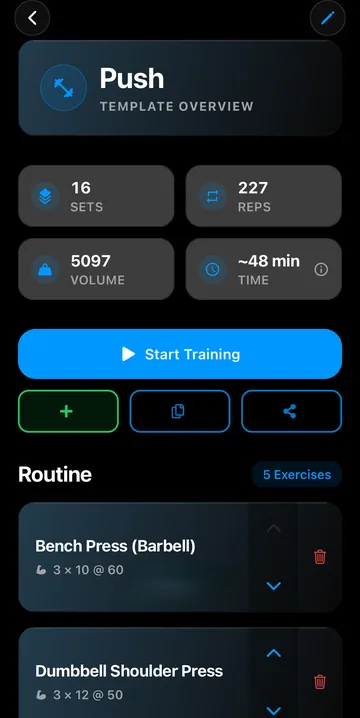
Yes, ChatGPT can write a workable first draft of a workout plan, but not a finished one. When coaching experts graded AI-written plans in peer-reviewed studies, they rated quality as moderate: sensible structure, but often no effort targets or load progression, and the plan can change each time you ask. Detailed prompts help. Check the plan before you follow it.1,2,3
A ChatGPT workout plan is a program written by a large language model (LLM) from whatever you type into the chat. That is only one kind of AI coaching; for software that adjusts training from logged data, and where the field is heading, see AI strength coaches explained. This article covers the chatbot-written plan: its quality, how to prompt for a better one, and what to check before you load a bar.
Short answer: what the research says
- Quality is moderate, not bad. Ten coaches rating 16-week plans from GPT-3.5 and Gemini gave most criteria a median of 3 to 4 out of 5.1 Emerging evidence
- Effort and progression are the usual gaps. Every model in that study lacked detailed intensity parameters, such as how close to failure to train and how to prescribe load.1 Emerging evidence
- More detail in, better plan out. Detailed prompts produced higher-rated plans in two expert-rated studies.2,3 Emerging evidence
- The same prompt can give a different plan. Four runs of one GPT-4 prompt produced structurally different programs.3 Emerging evidence
- Real-world results are thin. Most studies rated plans on paper. In the few head-to-head trials so far, human-designed programs did better.4,5 Emerging evidence
Evidence grades reflect the number and quality of studies (meta-analyses > single RCTs > acute/mechanistic data).
Disclosure: fitzap workout publishes this article and has AI features, including an optional Pro connection for ChatGPT, Claude and Grok. The studies below tested general-purpose chatbots, not our app. We report the findings that cut both ways and keep the app out of the analysis.
What researchers found when experts graded AI plans
Since 2023, sport scientists have asked ChatGPT, Gemini and other models to write training programs, then had experts grade the output. The table summarizes the studies most relevant to lifting. Most rate plans on paper: they show whether a plan looks sound to an expert, not whether anyone who followed it got stronger.
| Study | What was tested | Who judged it | Main finding |
|---|---|---|---|
| Washif et al., 20246 | GPT-3.5 and GPT-4; 12-week plans for hypothetical intermediate and advanced 20-year-olds | Authors, against the NSCA textbook and literature | A sensible-looking draft, but near-identical plans for men and women; needed expert fine-tuning |
| Dergaa et al., 20247 | GPT-4; 30-day plans for 5 hypothetical people with health conditions | Expert evaluation | Safety-conscious but lacked precision, often putting excessive safety ahead of training effectiveness |
| Zaleski et al., 20248 | A chatbot's exercise advice for 26 clinical populations | 2 reviewers, 10 guideline-based categories | 41% comprehensive and 91% accurate; about clinical advice, not lifting programs |
| Havers et al., 2025a2 | GPT-4 and Gemini; 8 hypertrophy plans from short vs detailed prompts | 12 coaching experts | Detailed prompts rated higher; GPT-4 beat Gemini on several criteria |
| Havers et al., 2025b1 | GPT-3.5 (via ChatGPT and Copilot) and Gemini; 16-week hypertrophy and max-strength plans for one advanced trainee | 10 coaches, 27 criteria | Moderate quality (medians 3 to 4 of 5); all lacked detailed intensity parameters; plans tended to be conservative |
| Yang et al., 20263 | GPT-4; simple vs detailed prompts, each run 4 times | 11 blinded experts (mean 18 years' experience) | Detailed prompts scored higher on individualization, safety, feasibility and total, not effectiveness; repeats differed |
| Genç et al., 20259 | ChatGPT-3.5, 4o and 4.1; 12-week plans for a moderately trained young man | Rubric scoring | GPT-4.1 was more detailed, more consistent and better referenced; human expertise still "essential" |
| Li et al., 202510 | GPT-4 vs 3 professional coaches; 16-week plans for one 24-year-old woman | Experts | No significant differences in personalization, effectiveness, safety or comprehensiveness; one case only |
| Montaruli et al., 202611 | 8 models, including Claude 3.5, GPT-4o, o1, Gemini 2.0 and DeepSeek R1; marathon plans | Descriptive comparison | Fundamentals mostly right; some plans omitted mileage or gave inconsistent pacing |
| Choi et al., 202612 | Gemini 2.5; complex clinical cases with 3 levels of prompt structure | Expert rubric | Structurally complete; added structure improved safety scores, up to a point |
Three systematic reviews pull this work together. A review of 10 studies concluded that AI plans generally follow guidelines but "lack specificity, progression, and adaptability" to real-time feedback, and that their role is complementary rather than a substitute.13 A larger review of 24 studies (2,512 participants) found safety flaws in 14 of them, or 58%.4 A 2026 review of 64 studies rated performance "moderate to good" for content and guideline adherence, especially with structured, information-rich prompts, while flagging weak individualization and unstable output.14
Which models were tested matters. These studies used GPT-3.5 through GPT-4.1, Gemini up to version 2.5, and a handful of other models in one endurance study. Today's models may do better, or fail in new ways; none of the studies here graded them. Treat the findings as a list of failure modes to check for, not a fixed score for the version you use.
One more caution: the experts often disagreed with each other. In the 10-coach study, agreement between raters was essentially zero (Fleiss' κ −0.051 to 0.001), and in the Gemini 2.5 study it was low (ICC 0.139).1,12 Human coaching is not a single gold standard either.
What AI plans usually get right
The basics. In an early test, GPT-3.5 proposed about three sessions a week at 70 to 85% of one-rep max (1RM), 4 to 8 reps and 2 to 4 sets, which is a textbook-looking strength plan; GPT-4 proposed 4 to 5 sessions with wider ranges.6 In the marathon study, most models got the fundamentals right, including gradual mileage increases, a taper and mostly low-intensity running.11
That matters more than it sounds, because the fundamentals carry most of the result. The 2026 American College of Sports Medicine (ACSM) position stand, an overview of 137 systematic reviews, found that few prescription variables mattered much. Strength improved with heavier loads (at least 80% of 1RM), full range of motion, 2 to 3 sets, lifts done early in the session and at least two sessions a week. Hypertrophy improved with at least 10 sets per week and eccentric overload. Training to failure, equipment type, time under tension and periodization did not consistently matter.15 A chatbot that has absorbed the textbook usually lands near these defaults.
Newer models also seem to write better plans. In a comparison of ChatGPT versions, GPT-4.1 produced more detailed, more internally consistent and better-referenced programs than GPT-3.5.9 And in the 12-expert study, ratings were stable across repeated prompts on 27 of 28 items, so overall quality may hold steady even when the details change.2
Where ChatGPT workout plans fall short
Missing effort targets and load progression
This is the most consistent finding for lifting. In the 10-coach study, all of the tested models lacked detailed intensity parameters: how close to failure each set should go and how load should be prescribed.1 A plan that says "3 × 10 bench press" without an effort target leaves the hardest decision to you, and the right target depends on your goal. In a 2024 series of meta-regressions, muscle growth increased as sets ended closer to failure, while strength gains were similar across a wide range of reps in reserve (RIR).16 Without a rule for when to add reps or weight, a plan is a workout list, not a program.
Too conservative or too generic
GPT-4's plans for people with health conditions were described as "often prioritizing excessive safety over the effectiveness of training", and asking for revisions did not fully fix it.7 In the 16-week study, plans for an advanced trainee also tended to be conservative.1 Generic shows up in other ways too: an early study found the programs were "objectively similar regardless of sex".6 For a trained lifter, a conservative plan can mean months of under-dosed training.
Same prompt, different plan
When researchers entered the same prompt into GPT-4 four times, they got "structurally and qualitatively different outputs".3 The study's abstract says detailed prompts produced generally lower variability, but in the full results the overall difference in variability was not statistically significant (p = 0.814), and variability in effectiveness scores was actually higher with detailed prompts (11.2% vs 8.6%).3 So a detailed prompt improves the plan, but does not guarantee the same plan twice. Regenerating until you like the look of one is not a quality check.
Medical and injury blind spots
The most cited number in this area comes from a 2024 study of chatbot exercise advice for 26 clinical populations, not lifting programs. Answers covered only about 41% of what guideline-based prescriptions include, though about 91% of what they did say was accurate. Over half of the inaccuracies (53%) concerned medical clearance before starting exercise.8 In the review of 24 studies, safety flaws included contraindicated exercises for clinical populations.4 General-purpose chatbots can also state made-up details confidently; a 2026 scoping review rated hallucination risk as critical for them.18 If you have an injury, a heart condition, are pregnant or have another medical issue, treat an AI plan as a starting point for a conversation with a qualified professional.
Has anyone followed a ChatGPT plan in a trial?
Barely. In the clearest example, a small randomized study, young men trained three times a week for 12 weeks: ten followed GPT-4-written programs on their own and ten trained with a personal trainer. The trainer group improved significantly in arm and shoulder muscle tests, body weight and lean mass; the GPT-4 group improved only in a left-arm muscle test.5 But the trainer group was also supervised, and the groups differed in body weight at baseline. It compares "AI plan, training alone" with "human plan plus supervision", not AI programming with human programming.
The 2026 review of 24 studies sums this up as AI plans being inferior in "5 out of 6" head-to-head cases. Read in full, it describes six intervention studies, and only three of them compared AI plans with human experts; the others compared an AI plan with no intervention, where the AI plan helped.4 The fair summary is that in the few head-to-head trials so far, human-designed programs did better, and the evidence is too thin to say by how much.
On answering questions rather than writing programs, ChatGPT does well. In a 2026 study, ChatGPT-3.5's answers to personal trainers' most common client questions were rated higher overall on 6 of 9 questions, and no trainer answer was rated higher on any question or measure.19 Explaining training is not the same as coaching it. For the evidence on what supervision adds, see AI personal trainer vs human coach.
How to prompt ChatGPT for a better workout plan
Input detail is the one lever the research clearly supports. In the 12-expert study, plans from detailed prompts were rated higher.2 In the 11-expert study, detailed prompts scored higher on individualization, safety and feasibility.3 In the Gemini 2.5 study, moving from a loose to a structured prompt improved safety and guideline alignment, but adding even more structure gave no consistent further gain.12 So be specific about yourself and about what the plan must contain, without writing an essay.
The template below asks for the pieces the studies found missing: effort targets, a progression rule, counted weekly sets and a plan for bad weeks. Replace everything in square brackets.
Prompt template: copy and fill in
Act as an evidence-based strength coach. Write a [8]-week training program for me.

About me
- Age, sex, body weight: [ ]
- Training experience: [e.g. 2 years of consistent lifting]
- Goal: [muscle size / strength / both]. Priority muscles or lifts: [ ]
- Recent best sets: [e.g. squat 100 kg x 5 with about 2 reps left; bench press 70 kg x 8]
- Schedule: [4] days per week, [60] minutes per session
- Equipment: [full gym / dumbbells up to 30 kg / ...]
- Injuries, pain or medical conditions: [none / e.g. left shoulder hurts on overhead pressing]
- Exercises I like or want to avoid: [ ]

The plan must include
1. A table of weekly hard sets per muscle group (target: [10-20] for growth).
2. For every exercise: sets, rep range, rest time and an effort target in reps in reserve (RIR).
3. A progression rule: when to add reps, when to add load, and by how much.
4. What to do if I miss my reps two sessions in a row, and when to deload.
5. Starting loads based on my recent best sets, or how to find them in week 1.

Rules
- Use common, well-established exercises and give one substitute for each.
- If anything about me is unclear, ask me before writing the plan.
- End with the assumptions you made and anything I should check with a coach or clinician.
A few habits make the output more useful:
- Ask it to explain and self-check. "Why this many sets for hamstrings?" exposes guesses, and asking it to check the plan against each numbered requirement catches omissions. Then use the checklist below yourself.
- Save the version you choose. Because a rerun can produce a different program, keep the plan you decided on and stop regenerating.3
- Give real numbers. "Bench 70 kg × 8 at about 2 RIR" beats "I'm intermediate". If you only know a heavy set, a 1RM calculator turns it into an estimate the model can work from.
Checklist: 8 things to check before you follow an AI plan
Run these checks on any AI-written plan before week 1. They target the known AI failure modes; for a broader review of split, recovery and exercise balance, use the 7-point check in Is This a Good Workout? or the full workout program review checklist.
- It matches what you told it. Check training days, session length, equipment and injuries. Plans can quietly ignore an input.
- Weekly sets per muscle are counted and sensible. For muscle growth, the ACSM position stand points to at least 10 sets per muscle per week, and the dose-response evidence shows diminishing returns as you add more.15,20 Count them yourself with the training volume calculator; see how many sets per week you need.
- Every exercise has an effort target. Look for RIR or RPE, not just sets and reps. This was the gap every model shared in the 10-coach study.1 If RIR is new to you, calibrate it first.
- There is a written progression rule. Adding reps and adding load both work; in an 8-week trial in trained adults they produced similar results.17 What matters is that the plan says which one, and when.
- Each main lift is trained at least twice a week. The ACSM review linked at least two sessions a week to better strength gains.15 For muscle size, total weekly sets matter more than how you spread them.20 See training frequency for muscle growth.
- Heavy lifts come first, with stated rest. Strength improved when lifts were done early in the session.15 Rest times should be written down, not left vague; see how long to rest between sets.
- It covers missed reps, bad weeks and stalls. Without a deload or reset rule, a plan breaks the first time progress stops. See how to run a deload week.
- No red flags. Exercises you cannot find described anywhere else, exact loads for lifts you never gave numbers for, exercises that aggravate a condition you mentioned, or advice to train through pain. Hallucinated detail and contraindicated exercises are documented failure modes.4,18
If the plan fails checks 2 to 4, you don't need a new plan. Ask the model to add the missing pieces, or add them yourself. Rep ranges for each goal are covered in the best rep range for hypertrophy, and if the split itself looks off, compare options in full body vs upper/lower vs PPL.
The missing piece: your training data
Even a good plan is static. It cannot know that your squat moved faster than expected, that you slept badly all week or that one exercise hurt your elbow. One systematic review describes this as a lack of "adaptability to real-time physiological feedback".13
Adjusting training from how sets actually go, called autoregulation, is well studied. A 2022 meta-analysis found that autoregulated loading (by RPE, RIR or bar speed) produced strength gains similar to fixed loading (mean difference 2.07 kg, p = 0.09).21 Single trials lean the same way: in 31 trained men, RIR-based loading improved back squat by 10.8% vs 7.1% with fixed percentages over 12 weeks,22 and in an 8-week study, RPE-based loading gave squat gains of 17.05 kg vs 13.91 kg, a difference that was not statistically significant.23 Adjusting from your own data is at least as effective as a fixed plan, and it individualizes without max testing.
That requires data. Self-reported effort is noisy: across 12 studies, people underestimated how many reps they had left by about one rep on average, with large differences between studies.24 Logging still helps. In a meta-regression of 122 healthy-eating and physical-activity interventions, self-monitoring was the technique that explained the most difference in effectiveness, especially when combined with feedback or goal review.25 The practical loop for a chatbot plan: log every set with load, reps and effort, and every 2 to 4 weeks give the log back to the model and ask it to adjust from what actually happened.
Grounding the model in real data may also reduce made-up answers. The 2026 scoping review rated hallucination risk as critical for general-purpose chatbots but substantially reduced in retrieval-augmented systems, which look information up from a defined source before answering.18 Connecting a chatbot to your own training log follows the same idea, although no study has yet tested it for workout programming.
If you already log in fitzap workout, Pro lets you connect ChatGPT, Claude or Grok to your synced training log. The assistant can then read your completed sessions, sets and personal records instead of a summary typed from memory, and it can send workout drafts that you review in the app before saving. It requires sign-in and cloud sync.
ChatGPT workout plan FAQ
Can ChatGPT make a workout plan?
Yes. ChatGPT can write a reasonable first draft, and coaching experts in peer-reviewed studies rated such plans as moderate in quality. The plans often lacked effort targets and load progression, so check for those gaps and fill them before you follow one.
Is a ChatGPT workout plan safe?
For healthy adults, AI plans in the studies were usually conservative, though one suggested potentially unsafe starting loads for an obese beginner. A 2026 systematic review still found safety flaws in 14 of 24 studies, such as contraindicated exercises for clinical populations, so if you have an injury or medical condition, have a qualified professional review the plan.
Is ChatGPT better than a personal trainer for programming?
Not on current evidence. In one case study, experts rated a GPT-4 plan in the same range as plans from three coaches, but ratings on paper are not results. The one small trial that measured outcomes favored a trainer group, and that group was also supervised in the gym.
What should I tell ChatGPT to get a good plan?
Tell it your training experience, goal, recent best sets, days and minutes available, equipment, and any injuries. Then ask for weekly sets per muscle, an effort target in reps in reserve for each exercise, and a written progression rule. Studies found more detailed prompts produced higher-rated plans.
Does ChatGPT give the same plan every time?
No. In a 2026 study, the same prompt entered four times into GPT-4 produced structurally different programs, and detailed prompts did not significantly reduce that variability. Save the version you choose and judge it on its content, not on the fact that an AI wrote it.
Can ChatGPT adjust my plan as I get stronger?
Only if it sees what you actually lifted. ChatGPT knows only what you give it, so it cannot tell whether you hit your reps unless you paste or connect your training log. Share your recent sets, reps and effort ratings every few weeks and ask it to adjust load and volume from that data.
The bottom line
ChatGPT is a reasonable place to start a program, not to stop. Give it real detail, insist on effort targets and a progression rule, run the checklist, then let your training log decide what changes. The evidence is young (small samples, older models, mostly paper ratings), and we will update this page as trials of AI-written programs are published.
Last reviewed: November 21, 2026.
References
- Havers T, Jelonnek C, Masur L, Isenmann E, Sperlich B, Geisler S, Düking P. A professional assessment of training plans for muscle hypertrophy and maximal strength developed by generative artificial intelligence. Biol Sport. 2025;42(4):353-366. DOI · PubMed
- Havers T, Masur L, Isenmann E, Geisler S, Zinner C, Sperlich B, Düking P. Reproducibility and quality of hypertrophy-related training plans generated by GPT-4 and Google Gemini as evaluated by coaching experts. Biol Sport. 2025;42(2):289-329. DOI · PubMed
- Yang Z, Zhang X, Li H, Ye J. More details, less variability? A crossover design study on the impact of information granularity on ChatGPT's training program stability. Biol Sport. 2026;43:379-392. DOI · PubMed
- He T, Lu D, Ma Y, He J, Li D, Li G, Sun J. The AI recommendation paradox: a systematic review evaluating the promise, peril, and path forward for large language models in exercise recommendation. Biol Sport. 2026;43:949-961. DOI · PubMed
- Genç A, Aydin R, Canuzakov K, Abdurrahmanova D, Gürcan H, Dere G, Demirhan B. Digital coaches: an alternative to expert coaches for men's fitness goals. Physical Activity Review. 2025;13:35-44. DOI
- Washif JA, Pagaduan J, James C, Dergaa I, Beaven CM. Artificial intelligence in sport: exploring the potential of using ChatGPT in resistance training prescription. Biol Sport. 2024;41(2):209-220. DOI · PubMed
- Dergaa I, Ben Saad H, El Omri A, et al. Using artificial intelligence for exercise prescription in personalised health promotion: a critical evaluation of OpenAI's GPT-4 model. Biol Sport. 2024;41(2):221-241. DOI · PubMed
- Zaleski AL, Berkowsky R, Craig KJT, Pescatello LS. Comprehensiveness, accuracy, and readability of exercise recommendations provided by an AI-based chatbot: mixed methods study. JMIR Med Educ. 2024;10:e51308. DOI · PubMed
- Genç A, Aydın GR, Kasap M, et al. Comparative evaluation of ChatGPT versions in training program design: scientific approach, accuracy, and practical applicability. BMC Sports Sci Med Rehabil. 2025;18(1):19. DOI · PubMed
- Li G, Li H, Su Y, Li Y, Jiang S, Zhang G. GPT-4 as a virtual fitness coach: a case study assessing its effectiveness in providing weight loss and fitness guidance. BMC Public Health. 2025;25:2466. DOI · PubMed
- Montaruli G, Nikolaidis PT, Racil G, Maffulli N, Migliaccio GM, Padulo J. Artificial intelligence-generated marathon training programs: reliable tools in exercise prescription for athletic performance? Br Med Bull. 2026;157(1):ldag010. DOI · PubMed
- Choi M, Park J, Lee M, Beom J, Jung SY, Lee K. AI-generated exercise prescriptions for at-risk populations: safety and feasibility of a large language model assessed by expert evaluation. J Clin Med. 2026;15(6):2457. DOI · PubMed
- Puce L, Bragazzi NL, Currà A, Trompetto C. Harnessing generative artificial intelligence for exercise and training prescription: a systematic literature review. Appl Sci. 2025;15(7):3497. DOI
- Liu S, Huang Y, Shen Y. Is generative artificial intelligence catalyzing a paradigmatic transformation in sport science? Evidence from a mixed-methods systematic review. Biol Sport. 2026;43:1693-1712. DOI · PubMed
- Currier BS, D'Souza AC, Singh MAF, et al. American College of Sports Medicine position stand. Resistance training prescription for muscle function, hypertrophy, and physical performance in healthy adults: an overview of reviews. Med Sci Sports Exerc. 2026;58(4):851-872. DOI · PubMed
- Robinson ZP, Pelland JC, Remmert JF, Refalo MC, Jukic I, Steele J, Zourdos MC. Exploring the dose-response relationship between estimated resistance training proximity to failure, strength gain, and muscle hypertrophy: a series of meta-regressions. Sports Med. 2024;54(9):2209-2231. DOI · PubMed
- Plotkin D, Coleman M, Van Every D, et al. Progressive overload without progressing load? The effects of load or repetition progression on muscular adaptations. PeerJ. 2022;10:e14142. DOI · PubMed
- Dergaa I, Dergaa MA, Razzak M, et al. Generative AI and large language models in sports medicine: a scoping review of applications, accuracy, and ethical implications. Front Public Health. 2026;14:1843535. DOI · PubMed
- D'hoe B, Kirk D, Boone J, Colosio A. ChatGPT outperforms personal trainers in answering common exercise training questions. J Sports Sci Med. 2026;25(1):235-261. DOI · PubMed
- Pelland JC, Remmert JF, Robinson ZP, Hinson SR, Zourdos MC. The resistance training dose response: meta-regressions exploring the effects of weekly volume and frequency on muscle hypertrophy and strength gains. Sports Med. 2026;56(2):481-505. DOI · PubMed
- Hickmott LM, Chilibeck PD, Shaw KA, Butcher SJ. The effect of load and volume autoregulation on muscular strength and hypertrophy: a systematic review and meta-analysis. Sports Med Open. 2022;8:9. DOI · PubMed
- Graham T, Cleather DJ. Autoregulation by "repetitions in reserve" leads to greater improvements in strength over a 12-week training program than fixed loading. J Strength Cond Res. 2021;35(9):2451-2456. DOI · PubMed
- Helms ER, Byrnes RK, Cooke DM, et al. RPE vs. percentage 1RM loading in periodized programs matched for sets and repetitions. Front Physiol. 2018;9:247. DOI · PubMed
- Halperin I, Malleron T, Har-Nir I, et al. Accuracy in predicting repetitions to task failure in resistance exercise: a scoping review and exploratory meta-analysis. Sports Med. 2022;52(2):377-390. DOI · PubMed
- Michie S, Abraham C, Whittington C, McAteer J, Gupta S. Effective techniques in healthy eating and physical activity interventions: a meta-regression. Health Psychol. 2009;28(6):690-701. DOI · PubMed