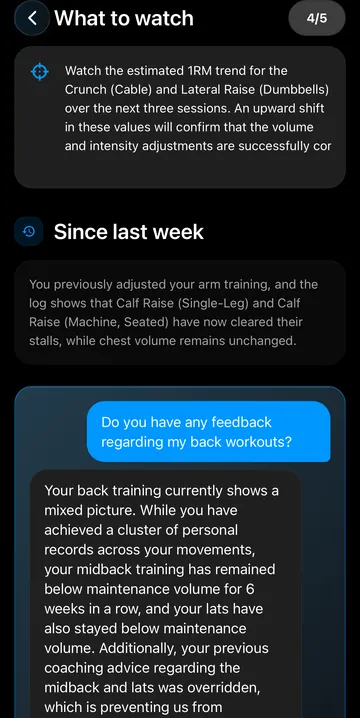
Short answer: an AI personal trainer is software that plans or adjusts your training from your goals and logged workouts. In the randomized trials so far, lifters coached in person gained the most strength. Apps beat a printed plan for sticking with training. For healthy, informed lifters, an app plus occasional coached sessions is a strong value option.1,2
Below is what the research actually measured: what human supervision adds, what software can and cannot copy, and how to choose.
Disclosure: fitzap workout, which publishes this blog, has AI features. To stay neutral, we cite only peer-reviewed studies and official reports, include the results that favor human coaches, and keep our app out of the comparison. Last reviewed Nov 21, 2026.
What the research says
- Supervision adds a modest strength benefit. A meta-analysis of 12 studies found a moderate effect on strength (SMD 0.40) but a trivial one on body composition (0.07).2 Moderate evidence
- Many lifters pick lighter loads than they could. Across 18 studies, self-selected loads averaged about 53% of 1RM, and lifters who trained with a personal trainer chose heavier loads.3,4 Moderate evidence
- An app beat a PDF plan on adherence, not on strength. In a 2025 trial, 81% of the app group and 52% of the PDF group met the adherence target; in-person supervision gave the largest squat gain.1 Emerging evidence
- AI-written plans have not matched coached training in outcome trials. In the few head-to-head trials so far, human-designed programs did better, and the studies are small.5,6 Emerging evidence
- Data-driven progression works about as well as fixed loading. Adjusting load from effort ratings produced strength gains similar to fixed percentages.7 Moderate evidence
Evidence grades reflect the number and quality of studies (meta-analyses > single RCTs > acute/mechanistic data).
What counts as an AI personal trainer?
"AI personal trainer" is used for three quite different things, and the evidence for each is different:
- Chatbots that write a static plan. You describe yourself to a large language model (LLM) such as ChatGPT or Gemini and it writes a program. The plan does not change unless you ask again. Most published studies test this kind.
- Adaptive systems that adjust from logged data. Software reads the loads, reps and effort ratings you record and suggests the next session's weights, reps or sets. This is closest to what a coach does week to week, and it rests on well-studied progression methods rather than on language models.
- Camera-based form feedback. Pose-estimation software watches your movement through a phone camera. One uncontrolled 2026 study found 95.8% agreement with a physiotherapist on pose classification, but there is no evidence yet that it improves results compared with a human coach.8
"Human coach" varies too. Most of the research below compares in-person supervision with training alone; remote online coaching has barely been studied on its own.
One more caveat applies throughout: the studies of AI-written plans mostly tested GPT-3.5, GPT-4, GPT-4o/4.1 and Gemini versions up to 2.5.9,10,11 Newer models may do better, but nobody has published that yet. For a broader look at how these systems work and where they are heading, see our guide to AI strength coaches.
What a human coach adds, according to research
More strength, less difference in body composition
The best summary is a 2022 exploratory meta-analysis of 12 studies, with 301 supervised and 276 unsupervised participants. Supervision had a moderate effect on strength (standardized mean difference 0.40, 95% CI 0.06 to 0.74) and a trivial, non-significant one on body composition (0.07).2 An SMD of 0.40 is a standardized effect size, not "40% more strength", and the confidence interval is wide.
Individual trials point the same way:
- In moderately trained men following an identical 12-week program, the supervised group (n = 10) trained with heavier loads, progressed load faster and ended with higher squat and bench press 1RMs than the unsupervised group (n = 8).12
- In a 2023 randomized trial of 36 trained men and women, supervision produced larger gains in muscle thickness at several sites, more lean mass and a greater squat 1RM. Bench press 1RM was similar, and jump performance slightly favored the unsupervised group.13
- In 124 untrained young men, a 1:5 coach-to-trainee ratio raised bench press 1RM by 15.9%, against 10.2% with a 1:25 ratio, over 11 weeks. Attendance was similar; more of the closely coached group trained at maximal intensity.14
Why: coaches push heavier, more consistent loading
Much of what a coach adds seems to be effort. Left alone, lifters tend to under-load. A 2022 review of 18 studies (368 participants) found that people chose loads averaging 53% of their 1RM, with little difference by training experience.3 Most of those studies were single sessions with vague instructions, so treat the exact number loosely; the direction is the point.
Training with a trainer is linked to heavier choices. Trained women who worked with a personal trainer self-selected about 51.4% of 1RM, against 42.3% for women training alone.4 In 21 trained men and women, those who trained with a personal trainer chose loads 12% to 27% heavier across four exercises, though still well below 10RM-based loads.15
Who benefits most
The gap is largest for people who need the most help. In adults aged 65 and over, a meta-analysis of 11 studies found supervised training beat unsupervised training for strength and power (SMD 0.51). The gap was biggest against completely unsupervised programs; even a few supervised sessions narrowed it. The authors recommended supervising two of every three weekly sessions.16
What about technique and injuries?
A coach watching your squat is the most obvious thing software lacks, but the trials above did not measure technique or injuries directly, so we cannot put a number on that benefit. For context, weight training is relatively safe: in bodybuilding, injury rates were roughly 0.24 to 1 per 1,000 hours of training, relatively low compared with team sports, with the shoulder, lower back and knee most often affected.17 We found no trial showing that either a coach or an app reduces injury rates.
App-guided vs coached vs self-guided: the 2025 trial
Key study
In-person, app or PDF? (Gavanda et al., 2025)
- Design
- Randomized trial, 10 weeks, three full-body sessions per week, identical program in every group
- Who
- 112 trained adults enrolled; 79 analyzed (48% women)
- Compared
- In-person supervision vs a coaching app (TrueCoach, with exercise videos, progress tracking and automated reminders) vs a PDF plan
- Result
- Met the 85% adherence target: 88.2% supervised, 81.2% app, 52.2% PDF. Squat 1RM: +26.6 kg supervised, +19.2 kg app, +19.4 kg PDF; supervised was significantly greater than both. Bench press rose in all groups (+9.1, +8.2, +7.7 kg). Fat-free mass increased (+1.4 kg) only in the supervised group.
Why it matters: in-person coaching gave the best strength and lean-mass results. The app kept far more people training than the PDF did, but among those who trained consistently, app and PDF strength gains were about the same.1
Three details matter when you read this study:
- The app was not AI. It delivered videos, tracking and reminders. It tells us what a structured app adds, not what an adaptive or AI coach adds.
- Only adherent participants were analyzed for strength. Anyone below 85% adherence was excluded, which tilts the sample toward motivated people.
- The groups were unequal. 17 people were in the supervised group against 48 and 47 in the others, and the supervised group was younger.
AI-written plans vs coach-written plans
Plans written by language models have been compared with human work in two ways: experts rating plans on paper, and a very small number of training trials.
- On paper, the plans can look similar. For one 24-year-old woman, a GPT-4 plan and plans from three professional coaches got similar expert ratings for personalization, effectiveness, safety and comprehensiveness, with no significant differences. With one case and three coaches, the study could not show that they were equivalent, and the authors concluded GPT-4 "cannot fully replace human coaches".18
- The plans often leave out intensity. When 10 coaches rated 16-week plans from GPT-3.5 and Gemini, overall quality was moderate, and every model lacked detailed intensity parameters such as proximity to failure and load prescription.9 The raters also disagreed strongly with each other, a reminder that human coaching is not a single gold standard.
- In training trials, humans have done better so far. A 2026 systematic review of 24 studies (2,512 participants) reported that LLM programs did worse in most comparisons of physiological results. Read closely, only three of those trials pitted an LLM directly against human experts, so the fair summary is that in the few head-to-head trials so far, human-designed programs did better.5 The same review found safety flaws in 14 of the 24 studies, such as contraindicated exercises for clinical groups.
- The one lifting trial is confounded. In a 12-week study with 10 young men per group, a personal-trainer group improved more than a group following GPT-4 programs. But the trainer also supervised every session, while the GPT-4 group trained alone, so it compares supervised human coaching with unsupervised AI plans, not AI programming with human programming.6
If you want to try a chatbot plan anyway, how you prompt it matters: more detailed prompts produced higher-rated plans.19 Our separate article on whether ChatGPT can write a good workout plan covers prompts and a checklist for reviewing one.
Where software already holds its own
Answering common questions
In a 2026 study, nine personal trainers submitted their most frequently asked questions and their own answers, and the same questions went to ChatGPT-3.5. Rated by 18 trainers and 9 topic experts, ChatGPT scored higher overall on 6 of 9 questions, and no trainer answer was rated higher on any question or measure.20 That is information, not coaching: answering a question well is not the same as getting someone to act on it.
Tracking and progression from your data
Logging is one of the best-supported behavior-change techniques. In a meta-regression of 122 healthy-eating and physical-activity interventions, interventions that combined self-monitoring with at least one related technique, such as goal setting or feedback, were more effective than those that did not (effect size 0.42 vs 0.26).21
Adaptive progression also has solid research behind it. A 2022 meta-analysis found that adjusting load from effort ratings (RPE/RIR) or bar speed gave strength gains similar to fixed percentage loading, with a non-significant trend in favor of autoregulation.7 Its practical advantage is individualization without max testing. The catch is that effort ratings are noisy: lifters underestimate their reps in reserve by about one rep on average, with large differences between studies.22 That makes calibrating your RPE and RIR worth the effort if software is going to act on your ratings.
Because supervision seems to work largely through heavier, steadily progressed loads, software that logs every set and suggests the next load could plausibly recover part of that benefit. That is a hypothesis; no trial has tested an adaptive app against a coach. More on the mechanics in progressive overload beyond weight and reps.
Consistency, availability and cost
An app is available at 6 a.m. on a Sunday and on vacation, and it typically costs far less than regular in-person sessions. That matters because the program details matter less than many people think. The 2026 ACSM position stand, an overview of 137 systematic reviews, found that few prescription variables mattered much. Strength improved with heavier loads, two to three sets and at least two sessions a week; muscle growth improved with at least 10 sets per week.23 The 2027 ACSM trends report summarizes it as emphasizing consistency.24 Apps that prescribe resistance training improve strength and related fitness slightly compared with no intervention or usual care (d = 0.18), though that evidence is mostly from clinical groups doing bodyweight exercise.25
What a human still does better
- Eyes on your technique, in real time. A coach sees a knee caving or a back rounding and corrects it on the next rep. Chatbots cannot see you, and camera-based feedback has not been tested against human coaching.8
- Judgment for injuries and medical conditions. When a chatbot gave exercise advice for 26 clinical populations, it covered only about 41% of what guideline-based prescriptions include, although about 91% of what it did say was accurate. Over half of the inaccuracies concerned medical clearance before exercise.26 A 2026 study of Gemini 2.5 on complex clinical cases found structured output, but experts agreed poorly on its quality.11 If you have a medical condition, AI output is a draft for a qualified professional to review.
- Effort and accountability. The supervision trials above suggest a person next to you raises effort and load.14,12 Apps have their own dropout problem: pooled dropout from app-based programs for chronic disease was about 43%.27
- Context software does not have. Models built on wearable data can be overconfident when context is missing, and reviewers describe them as decision-support tools rather than autonomous coaching agents.28 LLM agents improve engagement, but evidence of a lasting effect on measured activity is limited, and users tend to treat them as human, which can lead to over-reliance.29
Privacy is another practical difference. A study of 20,991 mobile health apps found 88% contained code that could collect user data and 28.1% had no privacy policy.30 Among U.S. adults who use AI for health information, 41% have uploaded personal medical information to an AI tool.31 Check what any AI coach stores and shares before giving it health details.
AI vs human vs hybrid at a glance
| Factor | AI or app only | Human coach (in person) | Hybrid |
|---|---|---|---|
| Strength gains in trials | Similar to a PDF plan when people adhere (non-AI app) | Largest; moderate effect on strength | Not tested directly; a few supervised sessions narrowed the gap in older adults |
| Muscle and body composition | No advantage shown | Small or inconsistent advantage | Unknown |
| Adherence | Better than a PDF (81% vs 52%) | Highest (88%) | Unknown |
| Load selection and effort | Can suggest loads from your log; untested against a coach | Linked to heavier self-selected loads | Both |
| Technique feedback | None from chatbots; camera tools unproven | Real time | From the coached sessions |
| Injuries or medical conditions | Gaps and safety flaws reported | Individual judgment, if qualified | Human handles these |
| Answering common questions | Rated as good as or better than trainers | Good | Both |
| Tracking and progression data | Strong | Depends on the coach | Strong |
| Availability | Any time | Scheduled sessions | Mostly any time |
| Cost | Low (free or subscription) | Highest (billed per session) | In between |
Sources for each row are cited in the sections above.1,2,16,15,5,20 "Unknown" means no study in our evidence base tested it.
Is an AI personal trainer worth it? Who should pick which
It depends on what you are missing. Use this as a starting point, not a rule:
| If you are… | Reasonable starting point | Why |
|---|---|---|
| A complete beginner | Hybrid, leaning human | Technique is new, and closer coaching helped untrained lifters in a large trial |
| Returning after a break, healthy | Hybrid or AI/app | You know the lifts; a coached session or two can re-check form |
| Intermediate, consistent, healthy | AI/app, with occasional checks | Tracking and progression matter most, and you already show up |
| Advanced or competing | Human coach, with your own data | AI plans have lacked intensity detail; meet prep needs judgment |
| Injured or with a medical condition | Human professional | AI advice has missed medical clearance and contained safety flaws |
| An older adult | Hybrid, mostly supervised | Supervision helped most here; even some sessions narrowed the gap |
| Struggling to stay motivated | Human coach, or hybrid with fixed appointments | Supervision gave the highest adherence; apps have dropout too |
| On a tight budget | AI/app, with one coached session if you can | An app beat a printed plan on adherence at low cost |
A human coach is the better choice if you are new to lifting, have pain or a medical condition, are preparing for competition, or know that you only train when someone is expecting you. An app is a reasonable choice if you are healthy, already train consistently, and mainly need structure, tracking and progression. Before you trust any plan, human or AI, run it through our workout program review checklist; beginners can use the beginner routine check.
A hybrid setup that matches the evidence
The research points toward a split: let software handle what it does well, and spend money on a human for the parts it cannot do. This is a practical synthesis, not a tested protocol:
- Book a few coached sessions on your main lifts. Use them for technique and to see what a hard set really feels like. Even a few supervised sessions narrowed the gap in older adults.16 Our exercise guides cover setup and cues between sessions.
- Log every set. Record load, reps and effort (RPE or RIR). That is the raw material for any adaptive system and for any coach reviewing your training.21
- Let the data drive progression. Add reps or load when effort at the same weight drops. Effort-based adjustment works at least as well as fixed percentages.7 Track weekly sets per muscle with a training volume tracker.
- Check in with a human when something changes. New pain, a plateau you cannot explain, or a competition are good reasons. Bring your log so the session is spent on judgment, not on remembering numbers.
- Use benchmarks, not only feelings. Compare your lifts against strength standards to see whether progress is on track over months.
If you are comparing apps for this role, our workout tracker comparison and guide to adaptive progression explain what to look for.
Will AI replace personal trainers?
Parts of the job are already being automated, mainly program writing, tracking and answering routine questions. Supervision is not. The 2027 ACSM worldwide fitness trends survey ranked wearable technology first, mobile exercise apps second and data-driven training technology eighth. Personal training came 14th, and "AI-driven fitness" did not make the global top 20, appearing only in some national lists. ACSM also stresses that a high ranking does not show a product or program is effective.24
Reviews of the research reach a similar verdict. A 2026 review of 64 studies called generative AI a promising adjunct but found the evidence insufficient for widespread use, citing poor individualization, unstable outputs and safety concerns in high-risk groups.32 The likelier future is trainers who use software for programming and data and spend their time on technique, judgment and accountability.
AI personal trainer FAQ
Is an AI personal trainer worth it?
For healthy lifters who already train consistently, often yes: it handles planning, tracking and progression at low cost. It is not a substitute for a human if you are new to lifting, injured, have a medical condition or need someone to keep you accountable.
Can an AI personal trainer correct my form?
Not reliably yet. Chatbots cannot see you, and camera-based form feedback has only been tested in an uncontrolled study. A coach in person, or a few coached sessions, is still the dependable option for technique.
Do you get stronger with a personal trainer than training alone?
On average, yes, modestly. Meta-analyses and randomized trials show supervised lifters gain more strength, probably because they lift heavier and progress faster. The difference in muscle and body composition is smaller and less consistent.
Is an AI trainer good for beginners?
It can provide a sensible structure, but beginners gain the most from human coaching, especially for learning technique and effort. A good compromise is a few coached sessions on the main lifts, then an app for logging and progression.
How much does supervision really matter?
It matters most for strength, for beginners and for older adults. In one 2025 trial, the supervised group gained about 7 kg more on the squat than the app and PDF groups over 10 weeks. For body composition the benefit was small across studies.
Will AI replace personal trainers?
Unlikely in the near term. AI is taking over parts of programming and tracking, but research still favors in-person supervision for strength gains, technique and complex cases. Trainers who use software well are the more likely future.
The bottom line
Human coaches earn their fee mainly through supervision: heavier loads, steadier progression, real-time technique feedback and judgment when something hurts. Software is already good at the paperwork of training: plans, logs, progression rules and answers to common questions. Pick based on what you lack. If it is knowledge and structure, an app may be enough. If it is technique, safety or showing up, pay for a human, even for a few sessions.
References
- Gavanda S, Held S, et al. Optimizing resistance training outcomes: comparing in-person supervision, online coaching, and self-guided approaches: a randomized controlled trial. J Strength Cond Res. 2025;39(11):1129-1137. DOI · PubMed
- Fisher J, Steele J, Wolf M, Androulakis Korakakis P, Smith D, Giessing J. The role of supervision in resistance training; an exploratory systematic review and meta-analysis. Int J Strength Cond. 2022;2(1). DOI
- Steele J, Malleron T, Har-Nir I, et al. Are trainees lifting heavy enough? Self-selected loads in resistance exercise: a scoping review and exploratory meta-analysis. Sports Med. 2022;52(12):2909-2923. DOI · PubMed
- Ratamess NA, Faigenbaum AD, Hoffman JR, Kang J. Self-selected resistance training intensity in healthy women: the influence of a personal trainer. J Strength Cond Res. 2008;22(1):103-111. DOI · PubMed
- He T, Lu D, Ma Y, et al. The AI recommendation paradox: a systematic review evaluating the promise, peril, and path forward for large language models in exercise recommendation. Biol Sport. 2026;43:949-961. DOI · PubMed
- Genç A, Aydin R, Canuzakov K, et al. Digital coaches: an alternative to expert coaches for men's fitness goals. Physical Activity Review. 2025;13:35-44. DOI
- Hickmott LM, Chilibeck PD, Shaw KA, Butcher SJ. The effect of load and volume autoregulation on muscular strength and hypertrophy: a systematic review and meta-analysis. Sports Med Open. 2022;8:9. DOI · PubMed
- Heo S, Choi T, Choi W. Clinical validation of an on-device AI-driven real-time human pose estimation and exercise prescription program; prospective single-arm quasi-experimental study. Healthcare (Basel). 2026;14(4):482. DOI · PubMed
- Havers T, Jelonnek C, Masur L, et al. A professional assessment of training plans for muscle hypertrophy and maximal strength developed by generative artificial intelligence. Biol Sport. 2025;42(4):353-366. DOI · PubMed
- Genç A, Aydın GR, Kasap M, et al. Comparative evaluation of ChatGPT versions in training program design: scientific approach, accuracy, and practical applicability. BMC Sports Sci Med Rehabil. 2025;18(1):19. DOI · PubMed
- Choi M, Park J, Lee M, Beom J, Jung SY, Lee K. AI-generated exercise prescriptions for at-risk populations: safety and feasibility of a large language model assessed by expert evaluation. J Clin Med. 2026;15(6):2457. DOI · PubMed
- Mazzetti SA, Kraemer WJ, Volek JS, et al. The influence of direct supervision of resistance training on strength performance. Med Sci Sports Exerc. 2000;32(6):1175-1184. DOI · PubMed
- Coleman M, Burke R, Benavente C, et al. Supervision during resistance training positively influences muscular adaptations in resistance-trained individuals. J Sports Sci. 2023;41(12):1207-1217. DOI · PubMed
- Gentil P, Bottaro M. Influence of supervision ratio on muscle adaptations to resistance training in nontrained subjects. J Strength Cond Res. 2010;24(3):639-643. DOI · PubMed
- Dias MRC, Simão RF, Saavedra FJF, Ratamess NA. Influence of a personal trainer on self-selected loading during resistance exercise. J Strength Cond Res. 2017;31(7):1925-1930. DOI · PubMed
- Lacroix A, Hortobágyi T, Beurskens R, Granacher U. Effects of supervised vs. unsupervised training programs on balance and muscle strength in older adults: a systematic review and meta-analysis. Sports Med. 2017;47(11):2341-2361. DOI · PubMed
- Keogh JWL, Winwood PW. The epidemiology of injuries across the weight-training sports. Sports Med. 2017;47(3):479-501. DOI · PubMed
- Li G, Li H, Su Y, Li Y, Jiang S, Zhang G. GPT-4 as a virtual fitness coach: a case study assessing its effectiveness in providing weight loss and fitness guidance. BMC Public Health. 2025;25:2466. DOI · PubMed
- Havers T, Masur L, Isenmann E, et al. Reproducibility and quality of hypertrophy-related training plans generated by GPT-4 and Google Gemini as evaluated by coaching experts. Biol Sport. 2025;42(2):289-329. DOI · PubMed
- D'hoe B, Kirk D, Boone J, Colosio A. ChatGPT outperforms personal trainers in answering common exercise training questions. J Sports Sci Med. 2026;25(1):235-261. DOI · PubMed
- Michie S, Abraham C, Whittington C, McAteer J, Gupta S. Effective techniques in healthy eating and physical activity interventions: a meta-regression. Health Psychol. 2009;28(6):690-701. DOI · PubMed
- Halperin I, Malleron T, Har-Nir I, et al. Accuracy in predicting repetitions to task failure in resistance exercise: a scoping review and exploratory meta-analysis. Sports Med. 2022;52(2):377-390. DOI · PubMed
- Currier BS, D'Souza AC, Singh MAF, et al. American College of Sports Medicine position stand. Resistance training prescription for muscle function, hypertrophy, and physical performance in healthy adults: an overview of reviews. Med Sci Sports Exerc. 2026;58(4):851-872. DOI · PubMed
- McAvoy CR, Stanfield JT, Camhi SM, Cooper SL, Reed RA, Batrakoulis A. 2027 ACSM worldwide fitness trends: future directions of the health and fitness industry. ACSM's Health Fit J. 2026;30(6):20-36. DOI · ACSM press release
- Cox ER, Beacroft S, Jansson AK, et al. Effects of mHealth interventions to prescribe resistance training: a systematic review and meta-analysis of randomized controlled trials. Int J Behav Nutr Phys Act. 2025;23:7. DOI · PubMed
- Zaleski AL, Berkowsky R, Craig KJT, Pescatello LS. Comprehensiveness, accuracy, and readability of exercise recommendations provided by an AI-based chatbot: mixed methods study. JMIR Med Educ. 2024;10:e51308. DOI · PubMed
- Meyerowitz-Katz G, Ravi S, Arnolda L, Feng X, Maberly G, Astell-Burt T. Rates of attrition and dropout in app-based interventions for chronic disease: systematic review and meta-analysis. J Med Internet Res. 2020;22(9):e20283. DOI · PubMed
- Madrigal-Cerezo R, Domínguez-Sanz N, Martín-Rodríguez A. Wearable biosensing and machine learning for data-driven training and coaching support. Biosensors (Basel). 2026;16(2):97. DOI · PubMed
- Silacci A, Boldi A, Caon M, Rapp A. Large language models for promoting physical activity: a review of experiential and behavioral outcomes, social roles, and human-likeness in persuasive LLMs. Front Digit Health. 2026;8:1869793. DOI · PubMed
- Tangari G, Ikram M, Ijaz K, Kaafar MA, Berkovsky S. Mobile health and privacy: cross sectional study. BMJ. 2021;373:n1248. DOI · PubMed
- KFF. KFF tracking poll on health information and trust: use of AI for health information and advice. Published March 25, 2026. KFF
- Liu S, Huang Y, Shen Y. Is generative artificial intelligence catalyzing a paradigmatic transformation in sport science? Evidence from a mixed-methods systematic review. Biol Sport. 2026;43:1693-1712. DOI · PubMed