An AI strength coach is software that plans and adjusts your resistance training from your goals and logged workouts. Today’s tools can draft guideline-consistent programs and suggest load changes, but chatbot-written plans often miss effort and progression detail.1,2 In the few head-to-head trials so far, human-designed programs did better.3 The realistic near future is hybrid.
This guide is the overview. It separates the different tools sold as “AI coaches,” explains the training science that makes adaptive coaching possible, summarizes what peer-reviewed studies from 2024 to 2026 found, and sets out where the field is heading. For the head-to-head question, read AI personal trainer vs human coach. For prompting a chatbot, read can ChatGPT write a good workout plan?
Disclosure: we make fitzap workout, a training log with AI features. To stay neutral, every research claim below links to a peer-reviewed study or a published report, and we report the results that favor human coaches as plainly as the ones that favor software.
What the research says
- Chatbot-written plans are moderate in quality. In a 2025 study, 10 coaches rated 16-week plans from three AI tools mostly 3–4 out of 5, and every tool left out detailed intensity targets such as proximity to failure.2 Emerging evidence
- Better input gives better plans. Two expert-rated studies found that detailed prompts produced higher-rated programs than brief ones.4,5 Emerging evidence
- Adjusting load from daily effort works at least as well as fixed percentages. A 2022 meta-analysis found similar strength gains, with a non-significant trend toward autoregulation.6 Moderate evidence
- An app helped adherence; in-person coaching still won on strength. In a 2025 randomized trial with 79 trained adults analyzed, an app kept far more people on track than a PDF plan, but supervision produced the largest squat gains.7 Emerging evidence
- Outcome evidence for AI coaching is thin. A 2026 review of 24 studies found safety flaws in 14 and only a handful of trials that compared AI programs with human experts.3 Emerging evidence
Evidence grades reflect the number and quality of studies (meta-analyses > single RCTs > acute/mechanistic data).
What is an AI strength coach?
An AI strength coach is software that plans and adjusts resistance training from your goals and logged data. The label covers several quite different technologies, and most marketing blurs them. The difference matters, because the evidence for each one is different.
Chatbot planners: a plan from a prompt
Large language models (LLMs) such as ChatGPT, Claude and Gemini write a program from whatever you type. The output is a static plan: it changes only when you come back and ask again. Early tests found ChatGPT could draft a sensible-looking 12-week plan, but it produced very similar plans for men and women and needed expert fine-tuning.8 Most published studies tested GPT-3.5, GPT-4, GPT-4o, GPT-4.1 and Gemini versions up to 2.5, so their results describe the models tested so far, not the newest ones.2,9,10
Adaptive progression engines: adjustments from your log
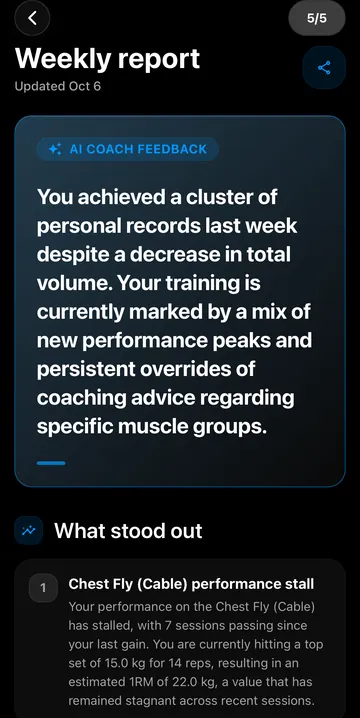
An adaptive app reads what you actually did (load, reps, an effort rating such as RPE or reps in reserve, your estimated one-rep max or e1RM trend, and weekly sets per muscle) and suggests the next step: add weight, hold, reduce, or change volume. Many of these systems are rule-based and use no language model at all. Their value comes from applying well-studied training principles to your own numbers every session. That is the gap a static plan leaves open: a 2025 systematic review found AI-written plans generally follow guidelines but lack specificity, progression and adaptability to real-time feedback.1
Computer-vision form coaches
A third group uses your phone camera to estimate body position, count reps and flag technique. A 2026 study reported 95.8% agreement between an on-device pose model and a physiotherapist. The study had no control group, though, and about a third of its 216 participants did not finish, so its effectiveness compared with human coaching is not established.11
Assistants connected to your data
A newer hybrid connects a general chatbot to your training log, so it answers from your actual sessions rather than from a short description of you. Grounding matters: a 2026 scoping review of 32 studies rated hallucination risk as critical for general-purpose chatbots but much lower in retrieval-augmented systems, which look up stored information before answering.12
| Type | What it works from | What it does well | Main limit |
|---|---|---|---|
| Chatbot planner | Your prompt | Fast, readable draft plans and answers | Static; quality depends on your input and can vary between runs |
| Adaptive progression engine | Logged sets, effort ratings, e1RM and weekly volume | Session-to-session load and volume decisions | Only as good as your logging and effort ratings; cannot see form |
| Computer-vision coach | Phone camera | Rep counting and posture flags | Early, uncontrolled evidence |
| Connected assistant | A chatbot plus your synced log | Questions about your own training | Inherits chatbot limits; raises privacy questions |
Is AI coaching really growing?
Interest in training technology is high. In the American College of Sports Medicine (ACSM) survey for 2027, based on 1,433 valid responses, wearable technology ranked No. 1 for the 10th time, mobile exercise apps rose to No. 2 from No. 4, and data-driven training technology held No. 8. Personal training ranked No. 14.13
Two caveats. “AI-driven fitness” is not in ACSM’s global top 20; it appears only in some national lists, such as Brazil’s and Finland’s, though the report notes that apps are increasingly AI-driven. And the survey rates how widely a trend is observed, not whether it works: ACSM says a high ranking “does not establish that a particular product or program is effective.”13
People already ask AI about their health. In a KFF poll of 1,343 U.S. adults in early 2026, 32% had used an AI chatbot for health information in the past year, health in general rather than training.14
The training science adaptive coaching is built on
An AI coach does not need new training science. It needs to apply existing science to your data, every session, without getting bored or forgetting. The good news for software is that the variables that matter most are measurable.
Consistency and progressive overload
The 2026 ACSM position stand on resistance training, an overview of 137 systematic reviews with more than 30,000 participants, found that few prescription variables mattered much. Strength improved with heavier loads (at least 80% of 1RM), 2–3 sets and two or more sessions a week; hypertrophy improved with 10 or more sets a week.15 ACSM’s 2027 trends report summarizes the position stand as putting consistency first.13 Overload does not have to mean more weight: in an 8-week trial of 43 trained adults, adding reps and adding load produced similar results, so a coach should track both.16 More in progressive overload is more than weight and reps.
Logging is part of the mechanism. In a meta-regression of 122 healthy-eating and physical-activity interventions, self-monitoring paired with a technique such as goal setting or feedback was associated with larger effects (effect size 0.42 vs 0.26).17 It was not a lifting study, but it fits the idea that a log plus feedback does more than a log alone.
Weekly volume: why counting sets matters
Muscle growth rises with weekly hard sets, with diminishing returns. A 2017 meta-analysis estimated about 0.37% more growth for each extra weekly set.18 A 2026 meta-regression of 67 studies and 2,058 participants confirmed that size and strength gains rise with volume, with diminishing returns that are more pronounced for strength. Frequency mattered for strength but had little or no clear effect on hypertrophy, and counting indirect sets as half a set fit the data best.19 That last point is a job software does well: crediting every bench press partly to the triceps is tedious by hand. More in how many sets per week to build muscle, or check your numbers with the training volume calculator.
Autoregulation: adjusting to the day
Autoregulation means setting today’s load from how you perform today, rather than from a fixed percentage of a max you tested weeks ago. The usual tool is the RPE scale based on reps in reserve (RIR), where RPE 8 means about two reps left. In its 2016 validation, these ratings tracked bar speed closely (r = −0.88 in experienced squatters).20
The outcome data are encouraging but modest. In 21 trained men, RPE-based loading increased the squat by 17.1 kg versus 13.9 kg with percentages over 8 weeks, a difference that was not statistically significant.21 A 12-week trial of 31 trained men found larger back-squat gains with RIR-based loading (10.8% vs 7.1%).22 Pooled across six studies, the two approaches produced similar 1RM gains (mean difference 2.07 kg, p = 0.09).6 The honest summary: autoregulation is at least as effective as fixed loading, and its practical advantage is individualizing load without regular max testing. That is the calculation an adaptive app automates.
The weak link is the input. Across 12 studies, people underestimated how many reps they had left by about one rep on average, with very large differences between studies.23 An app that relies on your ratings is only as accurate as they are, so it pays to calibrate your RPE and RIR and to judge progress by your estimated 1RM trend rather than by any single set.
Effort targets depend on the goal
How close to failure you should train depends on the goal. Training to failure gave only a trivial hypertrophy advantage in a 2023 meta-analysis,24 and a 2024 series of meta-regressions found growth increased as sets ended closer to failure while strength gains were similar across a wide range of reps in reserve.25 Many people also lift lighter than they could: across 18 studies, mostly single sessions with loose instructions, self-selected loads averaged 53% of 1RM.26 A good coach, human or software, nudges effort up where it helps (see do you need to train to failure?) and notices when performance slides for other reasons, which is where fatigue scores and a deload week come in.
What AI coaches do well today
Answering common training questions
As a reference source, chatbots are strong. In a 2026 study, 9 personal trainers submitted their clients’ most frequent questions along with their own answers, and the same questions went to ChatGPT-3.5. Rated by 18 trainers and 9 topic experts, ChatGPT’s answers scored higher overall on 6 of 9 questions, and no trainer’s answer was rated higher on any question or measure.27 That study tested answering questions, not coaching a person over months.
Drafting a plan from good information
Plan quality depends heavily on what you provide: 12 coaching experts rated GPT-4 and Gemini plans from detailed prompts higher than plans from brief ones.4 Newer versions also help. GPT-4.1 wrote more detailed and consistent plans than GPT-3.5 and GPT-4o, though the authors still called human expertise essential.9 A prompt template and a checklist for reviewing the result are in can ChatGPT write a good workout plan?
Keeping people training
The most directly relevant trial randomized trained adults to the same 10-week program delivered three ways. The share meeting the study’s 85% adherence threshold was 88.2% with in-person supervision, 81.2% with a coaching app (videos, tracking and reminders, not AI) and 52.2% with a PDF plan. Strength gains with the app were similar to the PDF, and supervision produced the largest squat gain (+26.6 kg vs about +19 kg). Only adherent participants were analyzed, which favors motivated people.7 Across 32 trials, apps that prescribe resistance training improved fitness only slightly compared with no intervention (d = 0.18), mostly in clinical groups doing bodyweight exercise.28
Where AI coaches still fall short
Missing effort and progression detail
The most consistent finding across expert-rated studies is that chatbot plans skip the variables that drive progress. When 10 coaches rated 16-week hypertrophy and strength plans on 27 criteria, quality was moderate, no model was consistently best, and all lacked detailed intensity parameters such as proximity to failure and load prescription.2 GPT-4 plans for five health profiles were safety-conscious but imprecise, often putting caution ahead of effectiveness.29 One twist: those 10 coaches barely agreed with each other (Fleiss’ kappa near zero), so human expert judgment is not a single gold standard either.2
Inconsistent outputs and made-up details
Ask the same question twice and you may get a different program. When 11 experts blind-rated GPT-4 plans, detailed prompts scored higher for individualization, safety and feasibility but not for effectiveness, and identical prompts still produced structurally different plans.5 General-purpose chatbots also carry a real risk of confidently stating things that are wrong, which reviews rate as lower when the system retrieves grounded information first.12
No eyes on your form
No published trial shows that an AI coach reduces injuries or corrects technique as well as a human coach. The app arm in the 2025 randomized trial offered exercise videos, not live correction.7 Camera-based pose estimation is technically feasible, but the main study so far was uncontrolled.11
Effort and accountability
Supervision helps, modestly. An exploratory meta-analysis of 12 studies found a moderate strength advantage for supervised training (standardized effect 0.40, 95% CI 0.06–0.74) but a trivial one for body composition.30 The one small randomized trial of a followed GPT-4 plan favored the trainer group, but those 10 men were also supervised while the 10 on the AI plan trained alone, so it compares supervision more than programming.31
Much of supervision’s benefit seems to come from effort. Supervised lifters on an identical program used heavier loads and progressed them faster,32 and in 124 untrained men, closer coaching (1:5 vs 1:25) meant larger bench press gains (+15.9% vs +10.2%) and more trainees reaching maximal intensity.33 Software can plausibly target part of this with logged loads, effort prompts and progression suggestions, but that is a hypothesis, not a proven effect. Apps also have their own dropout problem: 43% pooled dropout in app-based chronic-disease programs.34 And people tend to treat LLM agents as human, which can lead to over-reliance.35
Medical conditions and safety
For anyone with a health condition, AI output is a draft for a professional to check. In a 2024 study of chatbot advice for 26 clinical populations (not healthy lifters), answers covered only about 41% of what guideline-based prescriptions include, though about 91% of what they did say was accurate; over half of the inaccuracies concerned medical clearance.36 A 2026 review found safety flaws in 14 of 24 studies, such as contraindicated exercises for clinical populations.3
Privacy
An AI coach is only useful with your data, so ask where that data goes. A 2021 analysis of 20,991 mobile health apps found that 88% contained code that could collect user data, 28% had no privacy policy, and 23% of data transmissions were insecure.37 In the 2026 KFF poll, 41% of people who used AI for health had uploaded personal medical information, and 77% of all adults were concerned about the privacy of medical information shared with AI.14
The evidence at a glance
| Study | Design and size | What was tested | Main finding |
|---|---|---|---|
| Washif 20248 | Narrative comparison, hypothetical trainees | GPT-3.5, GPT-4 | Sensible-looking drafts, very similar for men and women; needed expert fine-tuning |
| Havers 2025a4 | 8 plans, 12 expert raters | GPT-4, Gemini | Detailed prompts rated higher; consistent on 27 of 28 criteria |
| Havers 2025b2 | 16-week plans, 10 coaches, 27 criteria | GPT-3.5 (ChatGPT, Copilot), Gemini | Moderate quality; all lacked intensity detail; raters disagreed |
| Yang 20265 | Crossover, 8 programs, 11 experts | GPT-4 | Detail improved individualization and safety, not effectiveness; same prompt, different plans |
| Genç 2025a9 | 7 instruction sets, rubric scoring | GPT-3.5, GPT-4o, GPT-4.1 | GPT-4.1 most detailed and consistent; experts still needed |
| Li 202538 | Single case, 3 coaches | GPT-4 | Rated in the same range as coaches; one case only |
| D’hoe 202627 | 9 common questions, 27 raters | GPT-3.5 | Answers rated higher than trainers’ on 6 of 9 questions |
| Genç 2025b31 | RCT, 12 weeks, 10 per group | GPT-4 plan alone vs supervised trainer | Trainer group gained more; supervision confounds the comparison |
| Gavanda 20257 | RCT, 10 weeks, 79 analyzed | Supervision vs non-AI app vs PDF plan | App adherence near supervision and well above PDF; supervision best for squat |
| Heo 202611 | Single-arm, 16 weeks, 146 of 216 completed | On-device pose estimation | 95.8% agreement with a physiotherapist; no control group |
| He 20263 | Systematic review, 24 studies | LLM exercise recommendations | Safety flaws in 14 studies; in the few head-to-head trials, human-designed programs did better |
Most of these studies rated plans on paper rather than measuring strength or muscle gained, and most tested models that are now one or two generations old.
Where AI strength coaching is heading
Predictions are cheap, so here is what the evidence supports and what it does not yet.
From static plans to coaching that reads your log
The clearest direction is grounding. Studies that varied input detail found that more detailed, structured information produced better-rated plans, at least up to a point,4,5,10 and retrieval-based systems make fewer things up.12 The logical endpoint is a coach that works from your actual training history instead of a paragraph describing you. That is where chatbot planners and adaptive systems are converging.
Decision support, not autopilot
Machine learning on wearable data can support training adjustments and recovery estimates when properly validated, but it can make overconfident predictions when context is missing. A 2026 review frames these tools as decision support rather than autonomous coaching agents.39 Expect the useful products to show their reasoning and let you override them.
Hybrid coaching
In older adults, supervised training beat unsupervised training for strength, and in indirect comparisons, even a few supervised sessions narrowed the gap.40 Together with the 2025 trial in which an app came close to supervision on adherence, the evidence points to a split: software for programming, logging and progression; people for technique, judgment and accountability.7 Whether that adds up to AI replacing personal trainers, and whether an AI trainer is worth paying for, is the subject of AI personal trainer vs human coach.
Better evidence
The research base is young. Reviews describe few high-quality randomized trials, short study durations, unstable outputs and weak individualization, and call generative AI a promising adjunct that does not yet support widespread use.41,3 Most studies tested GPT-3.5 to GPT-4.1 and Gemini up to 2.5. Newer models may well do better, but published studies have not yet tested them for training prescription, and an expert’s rating of a plan on paper is not the same as strength gained over months.
How to choose an AI strength coach
Whatever you use, these questions separate a useful coach from a plan generator with a chat window:
- Data: does it use your logged sets (load, reps, effort), or only an onboarding questionnaire?
- Reasons: does it explain why it suggests a change, so you can disagree?
- Volume: does it count weekly sets per muscle, ideally giving partial credit to muscles worked indirectly?19
- Effort: does it accept RPE or reps in reserve, and does it still behave sensibly when your ratings are a little off?23
- Control: can you override any suggestion without the plan falling apart?
- Bad weeks: does it hold or reduce load when performance drops, instead of pushing on regardless?
- Privacy: is it clear what is collected, who can read it and how to delete it?
- Honesty: does it say what it cannot do, such as see your form, judge pain or clear you medically?
A training volume tracker or a spreadsheet can count sets per muscle; the adaptive part is turning those numbers into the next session. For a product comparison, see our best workout trackers in 2026, written with the conflict of interest disclosed above.
What this means for you
- Beginners. Some of the largest supervision benefits come from studies of untrained men and older adults, and technique is hardest to learn from a screen.33,40 A few coached sessions on the main lifts, followed by an app or simple program with conservative progression, is a sensible start.
- Intermediate lifters. This is where adaptive tools fit best. You know the lifts, progress has slowed, and the decisions are about load, volume and effort. Calibrate your RPE and let the data argue with your instincts.
- Advanced lifters. Chatbot plans in the studies were weakest on intensity and progression detail, the variables you care about most.2 Use AI to track volume and e1RM trends and to check your reasoning, not to write your next peaking block unsupervised.
- Injury, pain or a medical condition. Treat AI output as a draft for a clinician or qualified coach to review. The safety evidence is weakest exactly here.36,3
AI strength coach FAQ
Can an AI coach replace a strength coach?
Not fully, based on current evidence. AI tools can draft programs and adjust loads from your logs, but in the few head-to-head trials so far, human-designed programs did better, and in-person supervision produced the largest strength gains.
Are AI workout apps safe for beginners?
For healthy beginners, an app that starts conservatively is a reasonable option, but it cannot see your technique. A few coached sessions on the main lifts are worth it, and anyone with a medical condition should get clearance first.
How does an AI coach decide when to add weight?
Adaptive apps compare your latest sets with the target: reps completed, effort rated as RPE or reps in reserve, and your recent estimated 1RM trend. If you hit the reps with effort to spare, they suggest more load; if effort was high or performance is slipping, they hold or reduce it.
Is AI coaching better than following a fixed program?
Not clearly. Effort-based autoregulation, which adaptive apps automate, produced similar strength gains to fixed percentages in a 2022 meta-analysis, with a non-significant trend in its favor. Its practical advantage is adjusting to your day without max testing.
What data does an AI coach need to be useful?
At minimum, the exercises, load, reps and sets from every session, plus an effort rating such as RPE or reps in reserve. Your goal, training days, equipment and injuries improve the plan; studies found that more detailed input produced higher-rated programs.
Will AI coaches replace personal trainers?
The evidence so far points to AI taking over more programming and tracking while people keep coaching technique, effort and judgment. We cover the research in AI personal trainer vs human coach.
The bottom line
An AI strength coach is not a robot personal trainer. Today it is a fast planner and a tireless bookkeeper that applies well-established rules (progressive overload, weekly volume, effort-based loading) to your own numbers. The evidence says those rules work, that software helps people keep training, and that humans still add something real through supervision and judgment. The near future belongs to tools that read your actual training data and explain their suggestions, used alongside occasional human expertise.
Last reviewed November 21, 2026. We will update this page when the 2028 ACSM trends report is published or when new randomized trials of AI-generated programs appear.
References
- Puce L, Bragazzi NL, Currà A, Trompetto C. Harnessing generative artificial intelligence for exercise and training prescription: applications and implications in sports and physical activity—a systematic literature review. Appl Sci. 2025;15(7):3497. DOI
- Havers T, Jelonnek C, Masur L, et al. A professional assessment of training plans for muscle hypertrophy and maximal strength developed by generative artificial intelligence. Biol Sport. 2025;42(4):353-366. DOI · PubMed
- He T, Lu D, Ma Y, et al. The AI recommendation paradox: a systematic review evaluating the promise, peril, and path forward for large language models in exercise recommendation. Biol Sport. 2026;43:949-961. DOI · PubMed
- Havers T, Masur L, Isenmann E, et al. Reproducibility and quality of hypertrophy-related training plans generated by GPT-4 and Google Gemini as evaluated by coaching experts. Biol Sport. 2025;42(2):289-329. DOI · PubMed
- Yang Z, Zhang X, Li H, Ye J. More details, less variability? A crossover design study on the impact of information granularity on ChatGPT's training program stability. Biol Sport. 2026;43:379-392. DOI · PubMed
- Hickmott LM, Chilibeck PD, Shaw KA, Butcher SJ. The effect of load and volume autoregulation on muscular strength and hypertrophy: a systematic review and meta-analysis. Sports Med Open. 2022;8(1):9. DOI · PubMed
- Gavanda S, Held S, et al. Optimizing resistance training outcomes: comparing in-person supervision, online coaching, and self-guided approaches: a randomized controlled trial. J Strength Cond Res. 2025;39(11):1129-1137. DOI · PubMed
- Washif JA, Pagaduan J, James C, Dergaa I, Beaven CM. Artificial intelligence in sport: exploring the potential of using ChatGPT in resistance training prescription. Biol Sport. 2024;41(2):209-220. DOI · PubMed
- Genç A, Aydın GR, Kasap M, et al. Comparative evaluation of ChatGPT versions in training program design: scientific approach, accuracy, and practical applicability. BMC Sports Sci Med Rehabil. 2025;18(1):19. DOI · PubMed
- Choi M, Park J, Lee M, Beom J, Jung SY, Lee K. AI-generated exercise prescriptions for at-risk populations: safety and feasibility of a large language model assessed by expert evaluation. J Clin Med. 2026;15(6):2457. DOI · PubMed
- Heo S, Choi T, Choi W. Clinical validation of an on-device AI-driven real-time human pose estimation and exercise prescription program; prospective single-arm quasi-experimental study. Healthcare (Basel). 2026;14(4):482. DOI · PubMed
- Dergaa I, Dergaa MA, Razzak M, et al. Generative AI and large language models in sports medicine: a scoping review of applications, accuracy, and ethical implications. Front Public Health. 2026;14:1843535. DOI · PubMed
- McAvoy CR, Stanfield JT, Camhi SM, Cooper SL, Reed RA, Batrakoulis A. 2027 ACSM worldwide fitness trends: future directions of the health and fitness industry. ACSMs Health Fit J. 2026;30(6):20-36. DOI · ACSM press release
- KFF. KFF tracking poll on health information and trust: use of AI for health information and advice. Published March 25, 2026. KFF
- Currier BS, D'Souza AC, Singh MAF, et al. American College of Sports Medicine position stand. Resistance training prescription for muscle function, hypertrophy, and physical performance in healthy adults: an overview of reviews. Med Sci Sports Exerc. 2026;58(4):851-872. DOI · PubMed
- Plotkin D, Coleman M, Van Every D, et al. Progressive overload without progressing load? The effects of load or repetition progression on muscular adaptations. PeerJ. 2022;10:e14142. DOI · PubMed
- Michie S, Abraham C, Whittington C, McAteer J, Gupta S. Effective techniques in healthy eating and physical activity interventions: a meta-regression. Health Psychol. 2009;28(6):690-701. DOI · PubMed
- Schoenfeld BJ, Ogborn D, Krieger JW. Dose-response relationship between weekly resistance training volume and increases in muscle mass: a systematic review and meta-analysis. J Sports Sci. 2017;35(11):1073-1082. DOI · PubMed
- Pelland JC, Remmert JF, Robinson ZP, Hinson SR, Zourdos MC. The resistance training dose response: meta-regressions exploring the effects of weekly volume and frequency on muscle hypertrophy and strength gains. Sports Med. 2026;56(2):481-505. DOI · PubMed
- Zourdos MC, Klemp A, Dolan C, et al. Novel resistance training-specific rating of perceived exertion scale measuring repetitions in reserve. J Strength Cond Res. 2016;30(1):267-275. DOI · PubMed
- Helms ER, Byrnes RK, Cooke DM, et al. RPE vs. percentage 1RM loading in periodized programs matched for sets and repetitions. Front Physiol. 2018;9:247. DOI · PubMed
- Graham T, Cleather DJ. Autoregulation by “repetitions in reserve” leads to greater improvements in strength over a 12-week training program than fixed loading. J Strength Cond Res. 2021;35(9):2451-2456. DOI · PubMed
- Halperin I, Malleron T, Har-Nir I, et al. Accuracy in predicting repetitions to task failure in resistance exercise: a scoping review and exploratory meta-analysis. Sports Med. 2022;52(2):377-390. DOI · PubMed
- Refalo MC, Helms ER, Trexler ET, Hamilton DL, Fyfe JJ. Influence of resistance training proximity-to-failure on skeletal muscle hypertrophy: a systematic review with meta-analysis. Sports Med. 2023;53(3):649-665. DOI · PubMed
- Robinson ZP, Pelland JC, Remmert JF, et al. Exploring the dose-response relationship between estimated resistance training proximity to failure, strength gain, and muscle hypertrophy: a series of meta-regressions. Sports Med. 2024;54(9):2209-2231. DOI · PubMed
- Steele J, Malleron T, Har-Nir I, et al. Are trainees lifting heavy enough? Self-selected loads in resistance exercise: a scoping review and exploratory meta-analysis. Sports Med. 2022;52(12):2909-2923. DOI · PubMed
- D'hoe B, Kirk D, Boone J, Colosio A. ChatGPT outperforms personal trainers in answering common exercise training questions. J Sports Sci Med. 2026;25(1):235-261. DOI · PubMed
- Cox ER, Beacroft S, Jansson AK, et al. Effects of mHealth interventions to prescribe resistance training: a systematic review and meta-analysis of randomized controlled trials. Int J Behav Nutr Phys Act. 2025;23:7. DOI · PubMed
- Dergaa I, Ben Saad H, El Omri A, et al. Using artificial intelligence for exercise prescription in personalised health promotion: a critical evaluation of OpenAI's GPT-4 model. Biol Sport. 2024;41(2):221-241. DOI · PubMed
- Fisher J, Steele J, Wolf M, Androulakis Korakakis P, Smith D, Giessing J. The role of supervision in resistance training; an exploratory systematic review and meta-analysis. Int J Strength Cond. 2022;2(1). DOI
- Genç A, Aydin R, Canuzakov K, et al. Digital coaches: an alternative to expert coaches for men's fitness goals. Phys Act Rev. 2025;13:35-44. DOI
- Mazzetti SA, Kraemer WJ, Volek JS, et al. The influence of direct supervision of resistance training on strength performance. Med Sci Sports Exerc. 2000;32(6):1175-1184. DOI · PubMed
- Gentil P, Bottaro M. Influence of supervision ratio on muscle adaptations to resistance training in nontrained subjects. J Strength Cond Res. 2010;24(3):639-643. DOI · PubMed
- Meyerowitz-Katz G, Ravi S, Arnolda L, Feng X, Maberly G, Astell-Burt T. Rates of attrition and dropout in app-based interventions for chronic disease: systematic review and meta-analysis. J Med Internet Res. 2020;22(9):e20283. DOI · PubMed
- Silacci A, Boldi A, Caon M, Rapp A. Large language models for promoting physical activity: a review of experiential and behavioral outcomes, social roles, and human-likeness in persuasive LLMs. Front Digit Health. 2026;8:1869793. DOI · PubMed
- Zaleski AL, Berkowsky R, Craig KJT, Pescatello LS. Comprehensiveness, accuracy, and readability of exercise recommendations provided by an AI-based chatbot: mixed methods study. JMIR Med Educ. 2024;10:e51308. DOI · PubMed
- Tangari G, Ikram M, Ijaz K, Kaafar MA, Berkovsky S. Mobile health and privacy: cross sectional study. BMJ. 2021;373:n1248. DOI · PubMed
- Li G, Li H, Su Y, Li Y, Jiang S, Zhang G. GPT-4 as a virtual fitness coach: a case study assessing its effectiveness in providing weight loss and fitness guidance. BMC Public Health. 2025;25:2466. DOI · PubMed
- Madrigal-Cerezo R, Domínguez-Sanz N, Martín-Rodríguez A. Wearable biosensing and machine learning for data-driven training and coaching support. Biosensors (Basel). 2026;16(2):97. DOI · PubMed
- Lacroix A, Hortobágyi T, Beurskens R, Granacher U. Effects of supervised vs. unsupervised training programs on balance and muscle strength in older adults: a systematic review and meta-analysis. Sports Med. 2017;47(11):2341-2361. DOI · PubMed
- Liu S, Huang Y, Shen Y. Is generative artificial intelligence catalyzing a paradigmatic transformation in sport science? Evidence from a mixed-methods systematic review. Biol Sport. 2026;43:1693-1712. DOI · PubMed