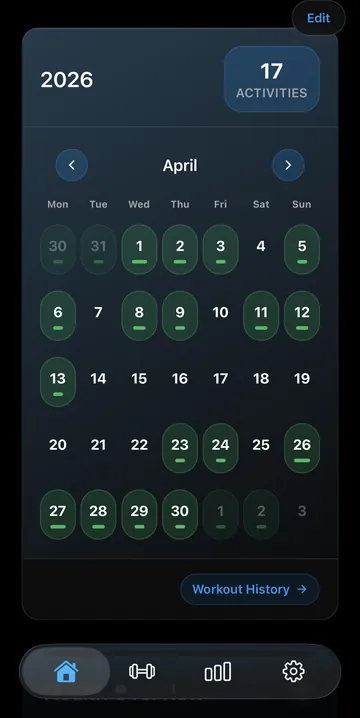
Schedule full-body training by alternating two workouts, A and B, on nonconsecutive days. Train once weekly by alternating A and B from week to week, twice weekly with A/B, or three times weekly with A/B/A followed by B/A/B.
The exercise prescription should remain the same across those schedules. Frequency changes how often you perform the plan; it is not permission to triple each session's volume.
What the research says
- This plan gives ~3–4, ~6–8 or ~9–12 weekly sets per major muscle at one, two or three sessions. Each A/B pass holds about 6 chest, 6 back and 8 quad sets. More weekly sets meant more growth in a 15-study meta-analysis, about 0.37 percentage points per extra set.1 Strong evidence
- One session a week can hold on to muscle. A review of the minimal dose concluded that strength and muscle size can be maintained for up to 32 weeks with one session and one set per exercise per week if the load stays heavy, at least in younger adults.2 In a 70-person trial, cutting to one-third or one-ninth of the original training dose preserved hypertrophy in 20–35-year-olds but not in 60–75-year-olds.3 Moderate evidence
- Frequency matters mostly through the sets it adds. With volume equated, frequency made no significant difference to hypertrophy across 25 studies; without equating, higher frequencies had a modest edge.4 Strong evidence
- Full body is not inferior to a split. A 14-study meta-analysis found similar strength and muscle growth with full-body and split routines when volume was matched.5 Moderate evidence
Evidence grades reflect the number and quality of studies (meta-analyses > single RCTs > acute/mechanistic data).
The schedules at a glance
| Frequency | Week 1 | Week 2 | Best fit |
|---|---|---|---|
| 1 day/week | A | B | Very constrained schedules or a minimal lifting complement |
| 2 days/week | A / B | A / B | Strong balance of recovery and practice |
| 3 days/week | A / B / A | B / A / B | More frequent practice and exposure |
Use the complete beginner and intermediate full-body workout plans for the exact exercises, equipment, order, sets, repetitions, level, and duration. This guide explains scheduling and deliberately does not duplicate those program tables.
One full-body workout per week
Alternate the workouts across weeks:
- Week 1: A
- Week 2: B
- Week 3: A
- Week 4: B
A true beginner may repeat Workout A briefly during onboarding while becoming familiar with the gym, then begin alternating. Do not permanently repeat A simply because its exercises feel more familiar; B provides the other half of the program.
One weekly session is a useful minimum when life is crowded, but it provides fewer practice opportunities than two or three sessions. Make that day reliable rather than compensating with an exhausting marathon.
Expect it to maintain more than it builds. At one session, each major muscle gets roughly 3–4 hard sets per week, below the 6–10 that How Many Sets per Week to Build Muscle? suggests for beginners. The minimal-dose research is reassuring for holding on to what you have: heavily reduced training, down to one weekly session with heavy loads, preserved strength and size in younger adults for months,2,3 while older adults may need up to two sessions and 2–3 sets per exercise.2 The early frequency meta-analysis also found twice-weekly training produced a larger hypertrophy effect than once weekly (0.49 vs 0.30), so move to two days when you can.6
Two full-body workouts per week
Perform A and B on nonconsecutive days. Monday and Thursday or Tuesday and Friday are simple options.
| Day | Session |
|---|---|
| Monday | Workout A |
| Tuesday | Rest |
| Wednesday | Rest or light activity |
| Thursday | Workout B |
| Friday–Sunday | Rest or other planned activity |
Two days often suits lifters balancing strength training with sport, work, or family commitments. It preserves both workouts every week and leaves generous recovery time.
Three full-body workouts per week
Alternate which workout receives the third exposure:
| Week | Monday | Wednesday | Friday |
|---|---|---|---|
| 1 | A | B | A |
| 2 | B | A | B |
Do not reset to A every Monday. The alternating sequence keeps exposure to both workouts balanced over two weeks. Monday, Wednesday, and Friday are convenient, but any three nonconsecutive days work.
Which frequency should you choose?
Choose the frequency you can perform for the next several months, not the most ambitious week you can imagine.
- Choose one day when lifting is secondary or current constraints are severe.
- Choose two days when recovery or competing activities matter and you want both workouts weekly.
- Choose three days when lifting is a higher priority and you recover well between sessions.
Research does not suggest that more frequent training is automatically better when weekly volume is matched,4 and full-body routines perform about as well as splits.5 Frequency can distribute work and increase practice opportunities. In this specific plan, however, moving from one to three days also increases how much prescribed work you perform, so monitor recovery rather than treating the schedules as equivalent doses. How Often Should You Train Each Muscle? covers the frequency evidence in full.
How hard should each session be?
Start around two to three RIR. Add the smallest practical load only after completing every prescribed repetition on every set with stable technique and roughly two RIR. If prescribed reps are missed repeatedly, reduce the load and rebuild.
That effort level is enough. A 15-study meta-analysis found failure training is not required for strength or size,7 and in trained lifters, leg sets stopped at 1–2 RIR grew the quadriceps as much as sets to failure over eight weeks (0.182 vs 0.181 cm).8 Two to three RIR is a sensible start while technique settles; as your estimates get more accurate, letting some sets drift toward 1–2 RIR is consistent with Do You Need to Train to Failure to Build Muscle?
Do not make the one-day schedule an all-out failure session, and do not make three days artificially easy. Use the same progression standard at every frequency so your log remains interpretable.
What if you miss a workout?
Continue with the next workout in the sequence.
- Miss A? Perform A at your next available training time, then continue to B.
- Miss Friday in an A/B/A week? Start the next session with A, then continue to B.
- Miss repeatedly? Adopt the lower frequency that matches your real calendar.
Avoid squeezing two full-body sessions onto consecutive days merely to preserve weekday labels. The A/B sequence matters more than whether Workout A occurs on Monday.
Combining full-body lifting with cardio
Place demanding intervals away from lower-body-intensive lifting where possible. Easy cardio can often sit on rest days or after lifting. If cardio begins to reduce repetitions, load, or technique across several sessions, adjust its placement or dose before altering the strength plan.
When an upper/lower split becomes a better fit
Full-body training remains useful as long as sessions fit your time and you can perform the listed work with quality. If you want four reliable lifting days and prefer to concentrate each session on one region, compare the best upper/lower split.
The switch is logistical, not a graduation ceremony. A well-run full-body plan is not inherently less advanced than a split routine. To compare every option by available days, see full body vs upper/lower vs PPL.
Frequently asked questions
Is one full-body workout a week enough?
It can be a useful minimum and is better than an unsustainable plan. Alternate A and B each week. If strength or hypertrophy is the main goal and recovery allows, two or three sessions provide more opportunities to perform and practice the prescribed work.
Is two or three days better for beginners?
Both can work. Two days leaves more recovery and may be easier to sustain; three days provides more practice. Start with the schedule you can complete without rushing or repeatedly missing workouts.
Can I train full body on consecutive days?
Avoid it for these plans when possible. Nonconsecutive days make recovery and repeatable performance easier. Resume the sequence at the next sensible opportunity instead of cramming sessions together.
Do I repeat Workout A every Monday?
Only on the two-day A/B schedule. With three days, alternate continuously: A/B/A, then B/A/B.
Should I add exercises on a one-day schedule?
No. Perform the complete plan as written first. Turning one session into a very long catch-all workout can reduce set quality and increase soreness without creating consistency.
The practical takeaway
Preserve the A/B rotation: alternate weekly for one day, use A/B for two nonconsecutive days, or alternate A/B/A and B/A/B for three days. Log performance and progress only after all prescribed reps are stable at about two RIR.
References
- Schoenfeld BJ, Ogborn D, Krieger JW. Dose-response relationship between weekly resistance training volume and increases in muscle mass: a systematic review and meta-analysis. J Sports Sci. 2017;35(11):1073-1082. PubMed
- Spiering BA, Mujika I, Sharp MA, Foulis SA. Maintaining physical performance: the minimal dose of exercise needed to preserve endurance and strength over time. J Strength Cond Res. 2021;35(5):1449-1458. PubMed
- Bickel CS, Cross JM, Bamman MM. Exercise dosing to retain resistance training adaptations in young and older adults. Med Sci Sports Exerc. 2011;43(7):1177-1187. PubMed
- Schoenfeld BJ, Grgic J, Krieger J. How many times per week should a muscle be trained to maximize muscle hypertrophy? A systematic review and meta-analysis of studies examining the effects of resistance training frequency. J Sports Sci. 2019;37(11):1286-1295. PubMed
- Ramos-Campo DJ, Benito-Peinado PJ, Andreu-Caravaca L, Rojo-Tirado MA, Rubio-Arias JÁ. Efficacy of split versus full-body resistance training on strength and muscle growth: a systematic review with meta-analysis. J Strength Cond Res. 2024;38(7):1330-1340. PubMed
- Schoenfeld BJ, Ogborn D, Krieger JW. Effects of resistance training frequency on measures of muscle hypertrophy: a systematic review and meta-analysis. Sports Med. 2016;46(11):1689-1697. PubMed
- Grgic J, Schoenfeld BJ, Orazem J, Sabol F. Effects of resistance training performed to repetition failure or non-failure on muscular strength and hypertrophy: a systematic review and meta-analysis. J Sport Health Sci. 2022;11(2):202-211. PubMed
- Refalo MC, Helms ER, Robinson ZP, Hamilton DL, Fyfe JJ. Similar muscle hypertrophy following eight weeks of resistance training to momentary muscular failure or with repetitions-in-reserve in resistance-trained individuals. J Sports Sci. 2024;42(1):85-101. PubMed