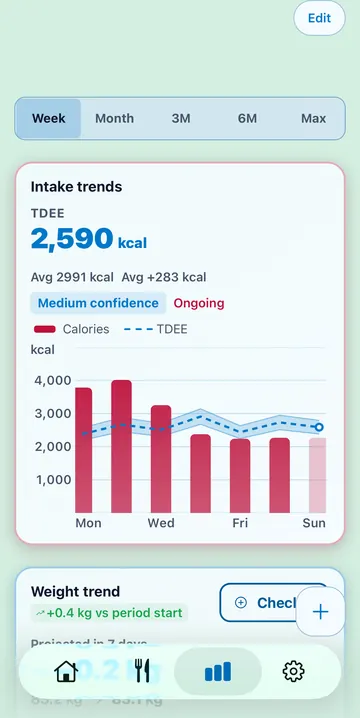
A lean bulk uses a small, adjustable energy surplus to support resistance training and gradual weight gain. There is no universally optimal surplus: the energy surplus needed to maximize muscle gain has never been validated in lifters.1 Your maintenance estimate, training experience, appetite, body-composition priorities, and actual response all affect how much extra food is useful.
Start from a reasonable maintenance estimate, add a conservative amount, and judge it from several weeks of average bodyweight and gym performance. The objective is not to gain as quickly as possible. It is to give productive training enough energy without letting fat gain outrun the benefit of the phase.
What the research says
- Bigger surpluses mostly add fat. In trained lifters over 8 weeks, faster bodyweight gain strongly predicted skinfold gain (R² = 0.49) but did little for muscle thickness or squat strength.2 Emerging evidence
- Elite athletes showed the same pattern. A planned surplus raised bodyweight 3.9% versus 1.5% with ad libitum eating, but fat mass rose 15% versus 3% and lean-mass gain was the same.3 Moderate evidence
- A deficit does hold back muscle gain. Training in an energy deficit impaired lean-mass gains compared with no deficit, and a deficit of about 500 kcal/day prevented them.4 Moderate evidence
- Gain slowly. A review of off-season bodybuilding nutrition suggests about 0.25–0.5% of bodyweight per week for novice and intermediate lifters, and less for advanced lifters.5 Moderate evidence
Evidence grades reflect the number and quality of studies (meta-analyses > single RCTs > acute/mechanistic data).
How big should a lean-bulk surplus be?
An extra 5–10% above estimated maintenance is a defensible starting experiment for many lifters. For someone maintaining around 2,500 kcal, that is roughly 125–250 kcal per day. It is an initial setting, not a physiological requirement. It sits at the conservative end of the roughly 10–20% surplus suggested in a review of off-season bodybuilding nutrition,5 because the direct trial data favor erring small.
Key study
Small versus large surplus in trained lifters (Helms et al., 2023)
- Design
- 8-week randomized parallel-group trial, resistance training 3 days per week
- Who
- 21 trained lifters randomized, 17 completers (sample reduced by COVID-19)
- Compared
- Maintenance energy versus a 5% surplus versus a 15% surplus
- Result
- Group comparisons found no difference in muscle thickness or squat 1RM; the 15% group improved bench 1RM more and gained more skinfold thickness. Across individuals, bodyweight gain strongly predicted skinfold gain (R² = 0.49) and only weakly predicted biceps thickness (R² = 0.24)
Why it matters: It is the most direct test of surplus size in trained people, and the authors conclude that faster gain mainly increases fat gain rather than muscle or strength. The caveats: a small sample, mixed training experience, moderate volume, and only 8 weeks.2
A randomized trial in 39 elite athletes points the same way. Over 8–12 weeks with four extra strength sessions a week, a dietitian-guided surplus (about 3,585 versus 2,964 kcal/day) produced more weight gain, but lean-mass gain was no different from eating ad libitum, while fat mass rose 15% versus 3%.3
That does not mean energy is irrelevant. A meta-analysis of resistance training in an energy deficit found that lean-mass gains were impaired compared with training without a deficit, and the regression suggested a deficit of about 500 kcal/day prevented lean-mass gain altogether.4 The useful zone appears to be “not in a meaningful deficit, and not much above maintenance.” If you are carrying extra fat or returning from a layoff, you may be able to gain some muscle near maintenance or even in a small deficit; see body recomposition.
Novices who are lean, active, and progressing quickly may tolerate a faster rate. Advanced lifters usually have less muscle left to gain and therefore less reason to force the scale upward. Read how fast you can build muscle to set a realistic expectation for your training age.
Use a rate of gain, not a calorie promise
Calorie calculators estimate maintenance; they do not measure it. Food labels, activity, digestion, and spontaneous movement all introduce error. A review of energy surplus and hypertrophy also notes that textbook surplus calculations ignore the energy cost of building tissue and the metabolic adjustments people make when overfed.1 Use the calorie target to begin, then use the trend to steer.
A commonly cited bodybuilding starting range is about 0.25–0.5% of bodyweight per week for novice and intermediate lifters, with advanced lifters advised to be more conservative.5 Treat that as a broad ceiling and context, not a target everyone must hit.
| Bodyweight | 0.25% per week | 0.5% per week |
|---|---|---|
| 60 kg / 132 lb | 0.15 kg / 0.3 lb | 0.3 kg / 0.7 lb |
| 70 kg / 154 lb | 0.18 kg / 0.4 lb | 0.35 kg / 0.8 lb |
| 80 kg / 176 lb | 0.2 kg / 0.4 lb | 0.4 kg / 0.9 lb |
| 90 kg / 198 lb | 0.23 kg / 0.5 lb | 0.45 kg / 1.0 lb |
| 100 kg / 220 lb | 0.25 kg / 0.6 lb | 0.5 kg / 1.1 lb |
An advanced lifter may deliberately aim below the 0.25% column. Weigh under similar conditions and compare seven-day averages. A single high morning after a salty meal is not evidence that the surplus is too large. Likewise, three flat days do not prove you need more food.
Run a three-week calibration
Use this sequence:
- Estimate maintenance from recent intake and weight, or use a validated dynamic tool such as the NIDDK Body Weight Planner.6
- Add roughly 5–10% and keep the target stable for three weeks.
- Record daily weight when practical and compare weekly averages.
- Keep training, sodium, carbohydrate intake, and weigh-in conditions reasonably consistent.
- Review weight, waist or skinfold trend if used, and performance together.
If average weight is flat after two to three complete weeks and you want to gain, add a small amount such as 100–150 kcal per day. If weight is climbing faster than intended for several weeks and waist measurements are accelerating without clearer training progress, remove a similar amount.
Do not chase every fluctuation. More carbohydrate can increase glycogen and associated water before new tissue is built. A new creatine routine can also raise scale weight; does creatine build muscle explains how much of that is water. Those changes are not fat gain, but they can temporarily obscure the rate.
Training has to justify the gaining phase
A surplus creates favorable conditions; it does not replace progressive resistance training. The training program is still the main driver of growth, as laid out in the science of muscle growth. Look for improvements that match the program:
- more repetitions at a comparable load and effort;
- small load increases with stable technique;
- better performance across later sets;
- improved recovery between repeated sessions; or
- progress in the muscles or lifts the block prioritizes.
Not every metric must improve every week. Still, if weight and waist rise for a month while the relevant exercises remain flat, review the program, effort, sleep, and exercise execution before adding more calories.
The opposite also matters. If training is progressing, weight is slowly rising, and recovery is good, do not increase the surplus merely because an online calculator prescribed a faster bulk.
Build the surplus with macros that fit
Set protein first. Around 1.6 g/kg/day captures most of the average benefit observed in a large resistance-training meta-analysis, where gains in fat-free mass plateaued at 1.62 g/kg/day; a range up to roughly 2.2 g/kg can be a practical buffer.7 The off-season review suggests 1.6–2.2 g/kg protein, 0.5–1.5 g/kg fat, and the remaining energy mostly from carbohydrate (at least 3–5 g/kg/day).5
The exact split is secondary to adequate energy, protein, food quality, and adherence. The guide to macros for strength training gives a grams-first setup without pretending everyone needs the same percentages.
A surplus does not require a separate “bulk food” category. Add portions to meals you already digest well: more rice or potatoes, milk or yogurt, bread, olive oil, nuts, fruit, or an additional snack. Liquid calories can help low-appetite lifters but can also make an oversized surplus easy to miss.
When maintenance is the better choice
Stay at or return to maintenance when:
- the current program is new and you need a clean baseline;
- bodyweight is already rising without an intentional surplus;
- appetite or digestion makes consistent eating difficult;
- waist gain is outpacing useful performance changes;
- a stressful period makes training inconsistent; or
- gaining weight is worsening your relationship with food or body image.
Maintenance can be a productive fitness phase, not a failed bulk. It gives you time to stabilize habits and assess whether the training itself is working.
If you are pregnant, under 18, managing diabetes or gastrointestinal disease, recovering from an eating disorder, or experiencing unexplained weight change, use individualized medical or dietetic guidance rather than a generic surplus target.
The practical takeaway
Start with a modest 5–10% surplus, hold it long enough to see a trend, and adjust in small steps toward roughly 0.25–0.5% of bodyweight per week or less. Use rate of gain and relevant training performance together. A lean bulk is successful when it supports better training and slow tissue gain—not when it makes the scale move at a predetermined speed.
Health note: This article is general information for healthy adults, not medical or dietetic advice. If you are pregnant, under 18, managing a medical condition such as kidney disease or diabetes, or have a history of disordered eating, check with a doctor or registered dietitian before changing how you eat.
References
- Slater GJ, Dieter BP, Marsh DJ, Helms ER, Shaw G, Iraki J. Is an energy surplus required to maximize skeletal muscle hypertrophy associated with resistance training? Front Nutr. 2019;6:131. PubMed
- Helms ER, Spence AJ, Sousa C, et al. Effect of small and large energy surpluses on strength, muscle, and skinfold thickness in resistance-trained individuals: a parallel groups design. Sports Med Open. 2023;9(1):102. PubMed
- Garthe I, Raastad T, Refsnes PE, Sundgot-Borgen J. Effect of nutritional intervention on body composition and performance in elite athletes. Eur J Sport Sci. 2013;13(3):295-303. PubMed
- Murphy C, Koehler K. Energy deficiency impairs resistance training gains in lean mass but not strength: a meta-analysis and meta-regression. Scand J Med Sci Sports. 2022;32(1):125-137. PubMed
- Iraki J, Fitschen P, Espinar S, Helms E. Nutrition recommendations for bodybuilders in the off-season: a narrative review. Sports (Basel). 2019;7(7):154. PubMed
- National Institute of Diabetes and Digestive and Kidney Diseases. Body Weight Planner. NIDDK
- Morton RW, Murphy KT, McKellar SR, et al. A systematic review, meta-analysis and meta-regression of the effect of protein supplementation on resistance training-induced gains in muscle mass and strength in healthy adults. Br J Sports Med. 2018;52(6):376-384. PubMed