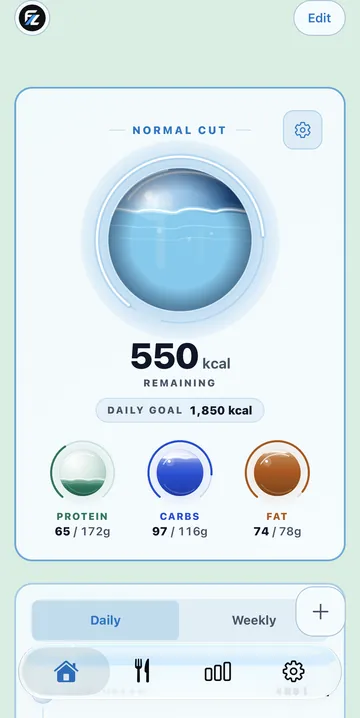
Set strength-training macros in grams, not by searching for one perfect percentage. First establish the calorie target for your current phase. Then set protein, choose a sustainable amount of fat, and allocate the remaining energy to carbohydrate according to training demand and food preference.
A useful starting order is:
- Calories: deficit, approximate maintenance, or surplus.
- Protein: commonly 1.6–2.2 g/kg/day.
- Fat: enough for food preference, essential nutrients, and adherence; often around 0.6–1.0 g/kg is a practical starting range, not a medical minimum.
- Carbohydrate: the remaining calories, adjusted if training volume or another sport demands more.
Percentages hide important differences. Twenty-five percent protein gives 125 g at 2,000 kcal but 188 g at 3,000 kcal. Your body size and phase did not necessarily change with that percentage. Grams make the decision clearer.
What the research says
- Protein is the macro with the clearest target. Across 49 trials, extra protein stopped adding fat-free-mass gains at about 1.62 g/kg/day.1 Strong evidence
- Calories and protein matter more than the carb-to-fat ratio. The ISSN concludes that a wide range of approaches, from low-fat to low-carbohydrate and everything between, can be similarly effective for improving body composition.2 Strong evidence
- More carbohydrate rarely helps a normal, fed lifting session. Benefits showed up mainly against fasted controls and in sessions with more than ~10 sets per muscle group.3 Moderate evidence
- Very low fat may modestly lower testosterone in men. Six intervention studies (206 men) found a small drop in total testosterone on low-fat diets (standardized mean difference −0.38).4 Emerging evidence
- Protein distribution is a refinement, not the foundation. Position stands suggest 20–40 g doses every 3–4 hours but treat total daily intake as the priority.5,6 Moderate evidence
Evidence grades reflect the number and quality of studies (meta-analyses > single RCTs > acute/mechanistic data).
Step 1: set calories from the phase
Macros cannot rescue an energy target that conflicts with the goal. The ISSN’s review of diets and body composition is blunt about it: fat-loss diets are driven by a sustained caloric deficit, and muscle-gain diets by a sustained surplus.2
- A cut requires an average energy deficit.
- Maintenance aims for a broadly stable weight trend.
- A gaining phase uses a controlled surplus when one is appropriate.
Maintenance is an estimate and weight normally moves within a range. Use several weeks of average bodyweight rather than treating a calculator as a measurement; the guide to finding maintenance calories shows how. If gaining is the goal, the lean-bulk surplus guide explains how to calibrate intake, and realistic rates of muscle gain show why a large surplus rarely pays off.
Step 2: how much protein for strength training?
For healthy adults doing resistance training, 1.6 g/kg/day is a strong evidence-based anchor.
Key study
Protein and resistance-training gains (Morton et al., 2018)
- Design
- Systematic review, meta-analysis and meta-regression of randomized trials lasting ≥6 weeks
- Who
- 49 studies, 1,863 healthy adults
- Compared
- Protein supplementation vs control during resistance training
- Result
- Protein added about 2.5 kg to 1RM gains and 0.3 kg to fat-free-mass gains; benefits for fat-free mass leveled off at a total intake of ~1.62 g/kg/day. Effects were larger in trained lifters and smaller with age.
Why it matters: it gives a defensible floor for protein. The caveat: 1.62 g/kg/day is a population average with a wide 95% confidence interval (1.03–2.20 g/kg/day), so going somewhat higher is a reasonable hedge.1
Using 1.6–2.2 g/kg/day is reasonable for many lifters. The ISSN’s protein position stand calls 1.4–2.0 g/kg/day sufficient for most exercising people and notes that 2.3–3.1 g/kg/day may help lean, resistance-trained people retain lean mass during a deficit.5 More is not automatically better, though; it can crowd out carbohydrate, fat, fiber, and foods you enjoy. The protein target guide goes deeper.
At 80 kg, the range is approximately 128–176 g per day. Spread that across meals in whatever pattern is sustainable; 20–40 g per meal every three to four hours is a sensible default, but total daily intake matters more than hitting a narrow post-workout window.6
People with kidney disease or another condition requiring protein management should get an individualized target from their clinician or dietitian.
Step 3: how much fat should a lifter eat?
Fat provides essential fatty acids, carries fat-soluble vitamins, and makes many diets more enjoyable. It is also energy dense at about nine calories per gram.
A practical starting range such as 0.6–1.0 g/kg/day works for many lifters. For most people that lands within the 15–30% of calories from fat an evidence review of natural bodybuilding preparation recommends.7 It is not a universal hormonal threshold. Someone who prefers Mediterranean-style meals may sit higher. Someone prioritizing carbohydrate for a demanding sport may sit lower while still eating varied sources of unsaturated fat.
There is a reason not to go very low for long. A meta-analysis of six intervention studies in 206 men found that low-fat diets reduced total testosterone by a small amount (standardized mean difference −0.38, 95% CI −0.75 to −0.01) compared with higher-fat diets.4 The studies were small, did not measure muscle or strength, and mostly compared very different diets, so this supports avoiding extreme fat restriction rather than chasing high fat intakes.
At 80 kg, 0.8 g/kg equals 64 g, or about 576 kcal. Review the whole diet: oily fish, nuts, seeds, avocado, olive oil, eggs, dairy, and other foods contribute. Do not assess fat intake from added cooking oil alone.
Persistent restriction, loss of menstrual function, recurrent bone stress injury, reduced libido, unusual fatigue, or declining performance can reflect inadequate energy availability rather than one macro percentage. The IOC’s REDs consensus applies to male and female athletes and warrants qualified assessment, not simply adding a spoonful of fat while the overall diet remains inadequate.8
Step 4: how many carbs do you need for lifting?
Carbohydrate is useful fuel, but its acute benefit for lifting is conditional. A systematic review of 49 studies found that extra carbohydrate did not improve performance in 13 of 19 acute trials, typically already-fed sessions containing up to roughly ten sets per muscle group. Benefits appeared more often in fasted comparisons, glycogen-depleted conditions, twice-daily training, or very high-volume sessions, and 15 of 17 longer-term studies found no effect on training outcomes.3
A narrative review likewise argued that the commonly quoted 3–7 g/kg/day of carbohydrate for resistance training rests largely on endurance research, because typical lifting sessions are unlikely to cause true glycogen depletion.9 That is a reason to treat carbohydrate as flexible energy, not to cut it out.
That means neither “carbs are essential before every workout” nor “carbs never matter for strength” is accurate.
Prioritize more carbohydrate when you:
- train with high volume or long sessions;
- combine lifting with running, cycling, field sport, or multiple daily sessions;
- train after a long fast;
- notice repeatable late-session performance improvements when carbohydrate is higher; or
- need a convenient way to raise calories during a gaining phase.
A short, low-volume strength session after normal meals may perform similarly without a special carbohydrate dose. The guide to what to eat before lifting turns that context into meal options.
Worked macro examples
Consider an 80 kg lifter maintaining around 2,600 kcal:
- Protein: 1.8 g/kg = 144 g = 576 kcal.
- Fat: 0.8 g/kg = 64 g = 576 kcal.
- Remaining energy: 1,448 kcal.
- Carbohydrate: about 362 g because carbohydrate provides roughly four calories per gram.
The same method across three phases:
| Phase (80 kg) | Calories | Protein | Fat | Carbohydrate |
|---|---|---|---|---|
| Cut | 2,100 kcal | 2.0 g/kg = 160 g | 0.7 g/kg = 56 g (24% of kcal) | ~239 g |
| Maintenance | 2,600 kcal | 1.8 g/kg = 144 g | 0.8 g/kg = 64 g (22% of kcal) | ~362 g |
| Lean gain | 2,900 kcal | 1.6 g/kg = 128 g | 0.9 g/kg = 72 g (22% of kcal) | ~435 g |
This is arithmetic, not an optimal prescription. If 362 g of carbohydrate feels excessive, the lifter could raise fat and reduce carbohydrate while keeping calories and protein similar. If the athlete also completes high-volume sport training, the higher carbohydrate allocation may be useful.
During a cut, reduce calories without automatically cutting every macro equally. Keep protein stable or slightly higher, protect enough dietary fat and food variety, then adjust carbohydrate and/or fat according to training demands and adherence. The guide to cutting without losing strength covers the training side, and body recomposition covers eating near maintenance while trying to gain muscle and lose fat.
Judge the split from outcomes
Hold the setup stable for two to four weeks, then review:
- average bodyweight relative to the phase;
- repetitions and load on stable exercises;
- RPE or RIR at matched work;
- hunger, digestion, sleep, and meal adherence;
- performance late in demanding sessions; and
- menstrual, bone-health, libido, mood, and recovery concerns that may indicate low energy availability.
Change one main variable at a time. If lower-body performance repeatedly improves when more daily carbohydrate is allocated around those sessions, that is useful personal evidence. If nothing changes, the previous intake may already have been sufficient.
The practical takeaway
Calories set the direction. Protein anchors the plan at 1.6–2.2 g/kg/day. Fat is chosen deliberately, usually 0.6–1.0 g/kg/day, rather than forced to a universal percentage or pushed very low. Carbohydrate receives the remaining energy and rises when the actual training demand supports it. The best macro split is the one that meets health needs, fits the phase, and repeatedly supports the work you intend to perform. For how nutrition fits with training stimulus, see the science of muscle growth.
Health note: This article is general information for healthy adults, not medical or dietetic advice. If you are pregnant, under 18, managing a medical condition such as kidney disease or diabetes, or have a history of disordered eating, check with a doctor or registered dietitian before changing how you eat.
References
- Morton RW, Murphy KT, McKellar SR, et al. A systematic review, meta-analysis and meta-regression of the effect of protein supplementation on resistance training-induced gains in muscle mass and strength in healthy adults. Br J Sports Med. 2018;52(6):376-384. PubMed
- Aragon AA, Schoenfeld BJ, Wildman R, et al. International Society of Sports Nutrition position stand: diets and body composition. J Int Soc Sports Nutr. 2017;14:16. PubMed
- Henselmans M, Bjørnsen T, Hedderman R, Vårvik FT. The effect of carbohydrate intake on strength and resistance training performance: a systematic review. Nutrients. 2022;14(4):856. PubMed
- Whittaker J, Wu K. Low-fat diets and testosterone in men: systematic review and meta-analysis of intervention studies. J Steroid Biochem Mol Biol. 2021;210:105878 (corrigendum published 2025). PubMed
- Jäger R, Kerksick CM, Campbell BI, et al. International Society of Sports Nutrition position stand: protein and exercise. J Int Soc Sports Nutr. 2017;14:20. PubMed
- Kerksick CM, Arent S, Schoenfeld BJ, et al. International Society of Sports Nutrition position stand: nutrient timing. J Int Soc Sports Nutr. 2017;14:33. PubMed
- Helms ER, Aragon AA, Fitschen PJ. Evidence-based recommendations for natural bodybuilding contest preparation: nutrition and supplementation. J Int Soc Sports Nutr. 2014;11:20. PubMed
- Mountjoy M, Ackerman KE, Bailey DM, et al. 2023 International Olympic Committee's (IOC) consensus statement on Relative Energy Deficiency in Sport (REDs). Br J Sports Med. 2023;57(17):1073-1097. PubMed
- Escobar KA, VanDusseldorp TA, Kerksick CM. Carbohydrate intake and resistance-based exercise: are current recommendations reflective of actual need? Br J Nutr. 2016;116(12):2053-2065. PubMed