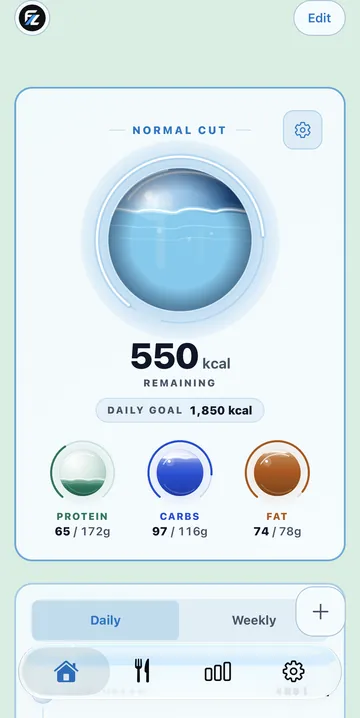
Track the least detail that still supports a useful decision. Calories plus bodyweight trend are most direct for changing weight; protein tracking adds a muscle-support target; full macros help allocate carbohydrate and fat around training, health, and preference. Some lifters need none of these numbers and do better with repeatable meal templates.
The research backs this order of priority. When calories are matched, the split between carbohydrate and fat makes little difference to fat loss, while protein is the one macro with a consistent, measurable effect on muscle. Detail beyond that mostly adds work and the illusion of precision.
What the research says
- Calories drive weight change; the carb/fat split barely does. In a 12-month trial of 609 adults, healthy low-fat and low-carb diets produced almost identical weight loss (5.3 vs 6.0 kg).1,2 Strong evidence
- Protein is the macro worth tracking for muscle. Across 49 trials, extra protein added lean mass up to about 1.6 g/kg/day, with no further gain on average beyond that.3 Strong evidence
- Carbohydrate matters mainly for high-volume or fasted training. Higher carbs did not improve fed workouts of up to about 10 sets per muscle in most studies.4 Moderate evidence
- Food logs are estimates, often low ones. Even with careful weighed records, non-dietitians under-reported intake by about 430 kcal/day.5,6 Moderate evidence
- Consistency beats comprehensiveness. In 220 women after a weight-loss program, how often and how consistently they logged predicted weight regain; how detailed the records were did not.7 Emerging evidence
Evidence grades reflect the number and quality of studies (meta-analyses > single RCTs > acute/mechanistic data).
The four tracking levels
| Method | What it helps answer | Main limitation |
|---|---|---|
| Meal template or portions | “Can I make my eating more consistent?” | Intake remains difficult to quantify |
| Protein only | “Am I consistently reaching a protein target?” | Does not establish a calorie deficit or surplus |
| Calories plus protein | “Is intake aligned with weight direction while protein stays adequate?” | Carbohydrate and fat distribution remains flexible |
| Full macros | “How are protein, carbohydrate, and fat allocated inside calories?” | More work and a greater risk of false precision |
Calories and macros are not separate substances. Protein, carbohydrate, and fat contribute most food energy, while alcohol and some fiber-related label conventions complicate exact arithmetic. Tracking all macros is one way to estimate calories, not an inherently more advanced goal.
What does calorie tracking tell you?
Average energy intake explains the general direction of bodyweight over time. The ISSN position stand on diets and body composition puts it plainly: diets focused on fat loss are driven by a sustained calorie deficit, and a wide range of approaches, from low-fat to ketogenic, can be similarly effective when that deficit is in place.8
That does not mean a daily calorie target predicts tomorrow’s scale reading. Water, glycogen, sodium, food in the digestive tract, training soreness, creatine, and menstrual-cycle-related changes can obscure tissue trends. Energy expenditure also changes with body size and activity, and weight loss is resisted by counter-regulatory physiology rather than following a fixed calculation.2
Calorie tracking is useful when you need to troubleshoot a cut, gaining phase, or maintenance estimate. It is less useful when entries are inconsistent enough that the number creates confidence without information.
Logged calories are an estimate, not a measurement
Self-reported intake tends to run low. In a classic doubly-labelled-water study, people who believed they were “diet resistant” under-reported their intake by an average of 47% and over-reported activity by 51%; their metabolism was normal.6 That was a small, selected group of 10 people with obesity, so the size of the gap does not transfer to everyone. A tighter test is more sobering: when 10 registered dietitians and 10 comparable women kept 7-day weighed food records, the non-dietitians still under-reported by about 429 kcal/day and the dietitians by about 223 kcal/day.5
The practical conclusion is not that tracking is pointless. It is that a log is most useful as a consistent estimate you compare with your bodyweight trend, which is how finding maintenance calories with weight and gym trends works.
Does the carb-to-fat ratio matter for fat loss?
Much less than most people expect. Two strands of evidence point the same way.
Key study
Low-fat vs low-carb for a year (Gardner et al., 2018, DIETFITS)
- Design
- 12-month randomized clinical trial with 22 diet-specific group sessions
- Who
- 609 adults aged 18–50 without diabetes, BMI 28–40
- Compared
- A healthy low-fat diet versus a healthy low-carbohydrate diet, both emphasizing diet quality
- Result
- Weight change of −5.3 kg (low-fat) vs −6.0 kg (low-carb), a non-significant 0.7 kg difference; neither genotype nor insulin secretion predicted who did better
Why it matters: Even with very different macro splits (about 48% vs 30% of energy from carbohydrate at 12 months), outcomes converged. The caveat: participants were not lifters, and the trial measured weight, not muscle. For lifters, protein is the variable that changes the picture.
Controlled feeding studies, where researchers provide all the food, tell the same story at a finer scale. A meta-analysis of 32 isocaloric studies that swapped carbohydrate for fat found differences of about 26 kcal/day in energy expenditure and 16 g/day in fat loss, both slightly favouring the lower-fat diets.2 Statistically detectable; practically trivial next to a 300–500 kcal deficit.
So when the goal is weight direction, getting calories roughly right matters far more than hitting exact carbohydrate and fat grams.
What does protein tracking tell you?
Protein tracking answers a narrower question: whether daily intake is reasonably aligned with resistance training and muscle-related goals. A meta-analysis of 49 trials and 1,863 participants found protein supplementation added about 0.30 kg of fat-free mass and 2.49 kg of 1RM strength over training alone, with no further fat-free-mass gain beyond about 1.62 g/kg/day on average.3
Needs probably rise when you are lean and dieting. A systematic review of energy-restricted, resistance-trained lean athletes suggested 2.3–3.1 g/kg of fat-free mass, scaled upward with leanness and the severity of the deficit; it was based on only six studies, so treat it as a direction rather than a precise cut-off.9
Protein-only tracking can work when bodyweight is already moving in the intended direction through stable habits. It cannot confirm a calorie deficit, surplus, or maintenance intake. A day can meet its protein target and still land far above or below intended energy intake.
Use the guide to the protein target for building muscle to set an individualized starting range.
What does full macro tracking add?
Full macro tracking records protein, carbohydrate, and fat. It can be useful when you want to experiment with training fuel, meal composition, or dietary preference while keeping calories similar.
Carbohydrate is not a universal on/off performance switch. A systematic review of 49 studies found that, acutely, higher carbohydrate did not improve performance in 13 studies and helped in six, mainly when the comparison group was fasted or the workout exceeded 10 sets per muscle group. Longer-term strength changes were not influenced by carbohydrate intake in 15 of 17 studies.4 Benefit is more plausible after fasting or glycogen depletion and during longer or higher-volume work.
Dietary fat also has roles beyond making meals satisfying. Food quality and essential nutrients matter, so do not force fat arbitrarily low simply to create more carbohydrate room. A percentage split alone can be misleading because it ignores body size and absolute grams. For the full calculation, see the macro split for strength training.
How to choose your tracking level
Choose a meal template when numbers are unnecessary or harmful
Use repeat meals, protein at main meals, planned snacks, and consistent portions. This can suit someone maintaining weight, learning basic habits, or stepping away from compulsive logging.
Choose protein only when weight direction is already stable
This is a low-burden choice if appetite and repeatable meals already produce the intended weight trend, but protein consistency is uncertain.
Choose calories plus protein for most body-composition troubleshooting
This combination captures the primary energy target and the one macro with a clear muscle effect, without forcing exact carbohydrate and fat numbers. Many lifters do not need more detail. There is some support for this in the weight-management literature: in one long-term follow-up, logging frequently and on more than three days a week predicted less weight regain, while the comprehensiveness of the records did not.7
Choose full macros for a specific question
Full macros may help when comparing higher- versus lower-carbohydrate setups, planning around high-volume training, or meeting a clinical nutrition plan. Track them because the information changes a decision, not because three targets look more serious than two.
Recommendations by phase
| Phase | Track by default | Add only if needed |
|---|---|---|
| Cutting | Calories, protein, weekly-average weight, anchor-lift performance | Carb/fat split if training quality or hunger suffers |
| Gaining | Calories, protein, weekly-average weight, training progression | Full macros for very high-volume training |
| Recomposition | Protein, weight trend, waist, training progression | Calories if weight drifts outside a narrow band |
| Maintenance | Protein habit, periodic weigh-ins | A 2–4 week calorie audit if weight drifts |
Cutting
Calories, protein, and weekly-average weight usually provide the clearest core data. Add full macros only if carbohydrate/fat distribution affects training, hunger, health, or preference. See cutting plateau or tracking drift before lowering calories after a noisy week.
Gaining
Average bodyweight, calorie intake, protein, and training progression are useful together. A surplus is an estimate, and gym performance does not prove that gained weight is muscle. Review how to set a lean-bulk calorie surplus, and keep expectations realistic with How Fast Can You Build Muscle Naturally?
Recomposition
If you are trying to lose fat and gain muscle at roughly stable bodyweight, protein and training progression carry most of the signal, and the scale moves little by design. Can You Build Muscle and Lose Fat at the Same Time? covers who this works for.
Maintenance
You may need detailed calorie tracking only during calibration. Once bodyweight and routines are stable, a protein habit and repeatable meals can be enough. Finding maintenance calories explains the test.
When to add or remove detail
Add detail when the current method cannot answer a recurring question. If weight has been unexpectedly flat for several weeks, temporarily recording calories may reveal portion or activity changes. If sessions repeatedly feel poor under a low-carbohydrate setup, tracking macros for a short comparison may help. If you are choosing an app for the job, compare macro tracker apps by how quickly they log and whether they show a weight trend.
Remove detail when it does not change decisions or creates distress. Food logging is not required for muscle gain or fat loss. A 2024 meta-analysis found no significant overall association between weight-related self-monitoring and eating-disorder symptoms in general adult samples, while a 2025 systematic review found fairly consistent cross-sectional associations between tracker use and disordered eating.10,11 Neither establishes cause, and individual warning signs matter more than averages. If tracking creates guilt, compensatory restriction, binge–restrict cycles, or fear around unlogged meals, step back and seek qualified support. Read how to track food without obsessing.
A simple example
A lifter whose weight is falling gradually during a cut and whose meals are highly repeatable may track protein only. If the trend stalls unexpectedly, they could track calories plus protein for two to four weeks to audit intake. They need not immediately prescribe exact carbohydrate and fat targets unless those variables answer a separate performance or adherence question.
Frequently asked questions
Is tracking calories more important than tracking macros?
For weight direction, average energy intake is the primary variable. Full macros add information about how that energy is allocated, and at matched calories the carb/fat split has only a small effect on weight loss.
Can I build muscle while tracking only protein?
Yes, if training, total energy, recovery, and the broader diet support progress. Protein-only tracking does not guarantee those conditions.
Do macro grams always equal the displayed calories?
Not exactly. Label rounding, fiber conventions, alcohol, and database differences can produce discrepancies. Treat logs as estimates.
What is the simplest reliable system?
For many lifters, calories plus protein during an active phase and a meal template during stable maintenance is sufficient. The answer depends on the problem you need to solve.
Health note: This article is general information for healthy adults, not medical or dietetic advice. If you are pregnant, under 18, managing a medical condition such as kidney disease or diabetes, or have a history of disordered eating, check with a doctor or registered dietitian before changing how you eat.
References
- Gardner CD, Trepanowski JF, Del Gobbo LC, et al. Effect of low-fat vs low-carbohydrate diet on 12-month weight loss in overweight adults and the association with genotype pattern or insulin secretion: the DIETFITS randomized clinical trial. JAMA. 2018;319(7):667-679. PubMed
- Hall KD, Guo J. Obesity energetics: body weight regulation and the effects of diet composition. Gastroenterology. 2017;152(7):1718-1727.e3. PubMed
- Morton RW, Murphy KT, McKellar SR, et al. A systematic review, meta-analysis and meta-regression of the effect of protein supplementation on resistance training-induced gains in muscle mass and strength in healthy adults. Br J Sports Med. 2018;52(6):376-384. PubMed
- Henselmans M, Bjørnsen T, Hedderman R, Vårvik FT. The effect of carbohydrate intake on strength and resistance training performance: a systematic review. Nutrients. 2022;14(4):856. PubMed
- Champagne CM, Bray GA, Kurtz AA, et al. Energy intake and energy expenditure: a controlled study comparing dietitians and non-dietitians. J Am Diet Assoc. 2002;102(10):1428-1432. PubMed
- Lichtman SW, Pisarska K, Berman ER, et al. Discrepancy between self-reported and actual caloric intake and exercise in obese subjects. N Engl J Med. 1992;327(27):1893-1898. PubMed
- Peterson ND, Middleton KR, Nackers LM, et al. Dietary self-monitoring and long-term success with weight management. Obesity (Silver Spring). 2014;22(9):1962-1967. PubMed
- Aragon AA, Schoenfeld BJ, Wildman R, et al. International society of sports nutrition position stand: diets and body composition. J Int Soc Sports Nutr. 2017;14:16. PubMed
- Helms ER, Zinn C, Rowlands DS, Brown SR. A systematic review of dietary protein during caloric restriction in resistance trained lean athletes: a case for higher intakes. Int J Sport Nutr Exerc Metab. 2014;24(2):127-138. PubMed
- Roth AM, Gruber JR, Reif A, Schultze M, Matura S. Exploring weight-related self-monitoring as a potential risk factor for eating disorder symptoms in adults: a systematic review and meta-analysis. Appetite. 2024;202:107610. PubMed
- Moody S, Ross L, Opitz MC, et al. Associations between the use of fitness and diet tracking technology and disordered eating behaviour: a systematic review. Eur Eat Disord Rev. 2025;33(6):1288-1313. PubMed