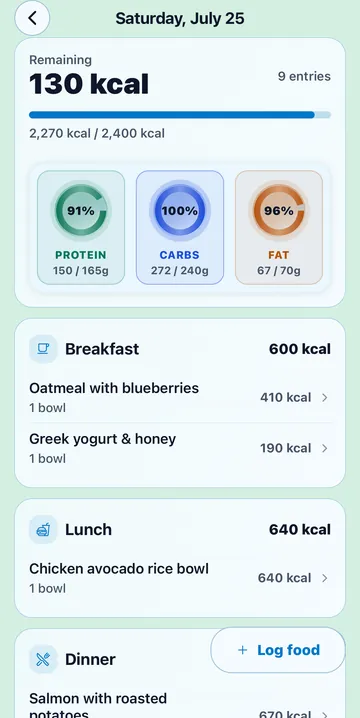
Track the least amount of food data that still helps you make the intended decision. That may mean full calories and macros for a short calibration period, calories plus protein, a protein target alone, or no numerical tracking at all. If logging increases guilt, anxiety, compensatory exercise, restriction, or binge-restrict behavior, stop and seek appropriate support.
Food tracking is a tool, not proof that you ate well or behaved correctly. The research suggests it is neutral or helpful for many people and closely tied to eating-disorder symptoms for some, and it cannot yet tell us which comes first.
What the research says
- For most adults, self-monitoring is not clearly linked to eating-disorder symptoms. A 2024 meta-analysis of general-population samples (9 studies, 13,507 people) found no significant association with global eating-disorder scores.1 Moderate evidence
- But tracker use and disordered eating often travel together. Two 2025 systematic reviews (27 and 38 studies) found fairly consistent cross-sectional associations, especially in young adults and frequent users.2,3 Moderate evidence
- Direction is unknown. The association was not replicated in experimental studies, so we cannot say whether tracking causes symptoms, people with symptoms are drawn to tracking, or both.2 Moderate evidence
- People with an eating disorder often feel apps made things worse. In a clinical sample of 105, about 75% used a calorie-tracking app and 73% of those users felt it contributed to their eating disorder.4 Emerging evidence
- Supervised weight-management programs usually do not raise risk, but a minority develop symptoms. Across 49 trials, eating-disorder and binge-eating scores fell on average, yet up to 6.5% of participants in some studies developed new symptoms.5 Moderate evidence
Evidence grades reflect the number and quality of studies (meta-analyses > single RCTs > acute/mechanistic data).
Is food tracking harmful?
The evidence is mixed and does not support a simple yes-or-no claim. It is worth looking at what the studies actually measured.
The population-level picture
A preregistered 2024 systematic review and meta-analysis pooled 28 studies (17,370 adults from the general population) on weight-related self-monitoring, such as food logging and self-weighing. The meta-analysis of the nine studies with usable data found no significant association with global eating-disorder scores (r = 0.13, 95% CI −0.02 to 0.28), and the diet-monitoring subgroup showed the same pattern. The authors concluded that individual factors probably decide whether self-monitoring becomes a problem.1
Two 2025 systematic reviews looked more specifically at diet and fitness apps. One, covering 27 studies in general and clinical populations, found reasonably consistent cross-sectional associations between tracker use and global disordered eating, dietary restraint, excessive exercise, and disordered muscle-oriented behaviour, but the association was not replicated in experimental research.2 The other, covering 38 articles, found higher disordered-eating symptoms in young adults who use these apps and in those who use them more often, and qualitative reports of pressure to meet goals and guilt.3 Both stressed that no causal conclusions can be drawn.
What individual studies found
| Study | Who | Finding |
|---|---|---|
| Simpson & Mazzeo, 20176 | 493 US college students | Calorie-tracker users had higher eating concern and dietary restraint, adjusted for BMI |
| Hahn et al., 20217 | 10,010 students at 12 US universities | 12.8% counted calories. In women, every self-monitoring pattern was linked to more symptoms than none; in men, only the “all forms” pattern was |
| Linardon & Messer, 20198 | 122 men, mostly recruited via fitness social media | 56% had used a calorie-tracking app; users reported more eating-disorder symptoms (large effect sizes), and roughly a third or more felt the app contributed |
| Levinson et al., 20174 | 105 people diagnosed with an eating disorder | About 75% used a calorie-tracking app; 73% of users perceived it as contributing to their eating disorder |
All four are cross-sectional surveys. They show that tracking and symptoms co-occur, sometimes strongly, but cannot establish whether tracking caused symptoms, whether people already struggling were more likely to track, or whether both were driven by something else such as dieting pressure or body dissatisfaction. Notice also who was studied: students, men recruited through fitness communities, and a clinical sample. Lifters in a fitness culture are not a neutral population.
Key study
Eating-disorder risk during weight-management programs (Jebeile et al., 2023)
- Design
- Systematic review and meta-analysis of behavioral weight-management trials measuring eating-disorder symptoms before and after
- Who
- 49 trials, 6,337 adults with overweight or obesity (about 81% women), interventions lasting 4 weeks to 18 months
- Compared
- Eating-disorder and binge-eating scores at baseline versus post-intervention and follow-up
- Result
- Global eating-disorder scores fell (Hedges’ g −0.27) and binge eating fell more (g −0.66); four studies reported new symptoms in 0–6.5% of participants
Why it matters: Structured programs, which usually include food self-monitoring, did not raise average risk and often lowered it. The caveats: these were within-group changes in supervised programs for people with obesity, not self-directed tracking by lean lifters, and the average hides a small group who got worse. That is why monitoring your own response matters.5
The honest summary: tracking may be neutral or useful for one person and destabilizing for another. Use your response, not the existence of an app, as the deciding evidence.
Check for warning signs first
Pause numerical tracking and consider help from a qualified clinician or eating-disorder-informed dietitian when you notice:
- guilt, panic, or shame after exceeding a target;
- skipping later meals to compensate for an earlier one;
- exercise used to “earn” or erase food;
- repeated binge-restrict cycles;
- avoiding social events because foods cannot be logged precisely;
- weighing food prepared by other people without a medical need;
- escalating targets despite fatigue or continued weight loss;
- dizziness, fainting, menstrual disruption, recurrent injury, or other signs of under-fueling; or
- food and body thoughts interfering with work, relationships, or sleep.
Someone with an eating-disorder history should not assume that a generic fitness workflow is appropriate. In the clinical sample above, most app users felt the app had contributed to their illness.4 If that is you, decide with your treatment team whether any numerical tracking belongs in your routine.
Where to get support
- Your doctor or GP is a good first contact and can refer you to specialist eating-disorder care.
- The National Institute of Mental Health eating-disorders resource explains symptoms and treatment routes.
- Many countries have a national eating-disorder charity or helpline; searching for “eating disorder helpline” plus your country will usually find it.
- In an urgent medical or mental-health crisis, use local emergency services rather than self-managing through an app.
Eating disorders affect people of every gender, body size, and training background, including muscular men. Reaching out early is a reasonable step, not an overreaction.
Use a minimum-effective tracking ladder
Begin at the lowest level that answers your question. Move upward only when the simpler method does not provide enough information. There is some support for keeping detail low: in a long-term weight-management study, logging frequency and consistency predicted outcomes, while how comprehensive the records were did not.9
Level 1: no numerical food tracking
Use repeatable meal structure, regular eating times, protein-rich foods, fruits and vegetables, and hunger or performance notes. This can work for maintenance, general health, or anyone for whom numbers create more cost than value.
Level 2: meal or habit tracking
Record behaviors rather than calories:
- protein at three meals;
- fruit or vegetables at several meals;
- planned snacks;
- water with meals; or
- a consistent pre-workout meal.
This answers whether the routine happened without assigning moral value to an exact intake.
Level 3: protein-only tracking
Track a daily protein range when muscle retention or growth is the main question and bodyweight is already stable. The protein-target guide provides an evidence-based range.
Level 4: calories and protein
This can be sufficient for a cut or lean gain when detailed carbohydrate and fat targets do not change the decision. Set minimum dietary-fat and food-quality guardrails rather than ignoring them. The macro calculator can give a starting point you then round into ranges.
Level 5: full calories and macros
Use detailed tracking when it serves a defined purpose, such as calibrating maintenance or preparing for a sport with specific requirements. It should not become the permanent default merely because the app displays more numbers.
Compare these levels in calories versus macros versus protein tracking.
Do you need to track precisely?
Accuracy is not the same as perfection, and perfection is not available anyway. When 10 registered dietitians and 10 comparable women kept a 7-day weighed food record against a gold-standard measure of energy expenditure, the non-dietitians under-reported by about 429 kcal/day and even the dietitians by about 223 kcal/day.10 Chasing gram-level precision buys less certainty than it feels like it does.
During a short calorie audit, prioritize foods that can materially change the estimate:
- cooking oils and butter;
- nut butters and nuts;
- caloric drinks;
- snacks eaten while preparing food;
- restaurant portions; and
- energy-dense sauces or toppings.
Do not interpret this as permission to ignore fruit, vegetables, fiber, or micronutrients. Their logging precision may matter less to the calorie estimate, but their nutritional role still matters.
Packaged labels, restaurant entries, and home measurements all contain error. Recording 2,437 calories does not mean intake is known to the nearest calorie. Use the log to create a consistent estimate and compare it with the bodyweight trend.
Use ranges rather than exact scores
A range can reflect the precision you actually need:
- protein: 140–160 g;
- calories: 2,300–2,450;
- bodyweight: a maintenance range rather than one exact number; and
- steps: a normal activity band.
Ranges are not inherently safer. Someone can become just as rigid about the edge of a range as an exact target. The test is whether small deviations remain emotionally neutral and whether the range supports the intended outcome.
Review the average across a week instead of treating each day as a verdict. Avoid “saving” extreme amounts for the weekend or compensating aggressively after a social meal.
Reduce logging friction
Repeat meals can make tracking faster without requiring a repetitive diet. Save common breakfasts, lunches, recipes, and snacks, then edit the portion when it changes. If you are choosing between apps, compare how much friction each adds, for example fitzap nutrition vs MyFitnessPal.
Other useful boundaries include:
- log only during a two-week calibration;
- pre-log tomorrow’s ordinary meals, then adjust without judgment;
- set a maximum amount of time spent logging;
- estimate restaurant meals once rather than repeatedly editing them; and
- stop displaying nutrients that do not affect the current decision.
The 15-minute nutrition-tracking routine turns these boundaries into a short daily workflow.
Know when to step down
Tracking should end or become simpler when:
- the question has been answered;
- the target can be maintained through a stable routine;
- logging no longer changes decisions;
- accuracy is becoming an end in itself; or
- psychological cost is rising.
For example, once a stable maintenance range has been identified, you might move from daily calorie logging to repeat meals, periodic weigh-ins, and gym-performance trends. Finding maintenance calories with weight and gym trends shows how training data can stand in for a food log, and maintenance as a fitness phase explains how to use that period productively.
Not tracking does not mean giving up on progress. Muscle is built mainly by consistent training and adequate protein over months, and Can You Build Muscle and Lose Fat at the Same Time? shows how much can change at stable bodyweight without chasing a daily number.
Frequently asked questions
Does calorie counting cause eating disorders?
The research cannot say. Tracking and disordered eating are often associated in surveys, but experimental studies have not replicated that link, and general-population meta-analysis found no significant overall association. Individual vulnerability seems to matter most.
Do I need to weigh every ingredient?
No. A short audit may benefit from measuring calorie-dense ingredients, but permanent gram-level precision is unnecessary for most people.
Can I lose fat without tracking calories?
Yes. Meal templates, portion methods, food-environment changes, and trend monitoring can produce a deficit without numerical logging.
Are calorie trackers accurate?
They are estimates, and self-reported intake tends to run low even among trained professionals. Their value comes from consistency and feedback against outcomes, not perfect knowledge of intake or expenditure.
What if I feel anxious when I stop tracking?
That anxiety is worth taking seriously. Step down gradually only if it feels safe, and consider an eating-disorder-informed clinician or dietitian when numerical control has become difficult to release.
The practical takeaway
Choose the smallest tracking system that answers your question. Use ranges, repeat meals, time limits, and periodic audits to keep the process proportionate. When tracking produces guilt, compensation, fear, or physical signs of under-fueling, the appropriate optimization is to stop and get support, not to build a more detailed spreadsheet.
Health note: This article is general information for healthy adults, not medical or dietetic advice. If you are pregnant, under 18, managing a medical condition such as kidney disease or diabetes, or have a history of disordered eating, check with a doctor or registered dietitian before changing how you eat.
References
- Roth AM, Gruber JR, Reif A, Schultze M, Matura S. Exploring weight-related self-monitoring as a potential risk factor for eating disorder symptoms in adults: a systematic review and meta-analysis. Appetite. 2024;202:107610. PubMed
- Moody S, Ross L, Opitz MC, et al. Associations between the use of fitness and diet tracking technology and disordered eating behaviour: a systematic review. Eur Eat Disord Rev. 2025;33(6):1288-1313. PubMed
- Anderberg I, Kemps E, Prichard I. The link between the use of diet and fitness monitoring apps, body image and disordered eating symptomology: a systematic review. Body Image. 2025;52:101836. PubMed
- Levinson CA, Fewell L, Brosof LC. My Fitness Pal calorie tracker usage in the eating disorders. Eat Behav. 2017;27:14-16. PubMed
- Jebeile H, Libesman S, Melville H, et al. Eating disorder risk during behavioral weight management in adults with overweight or obesity: a systematic review with meta-analysis. Obes Rev. 2023;24(6):e13561. PubMed
- Simpson CC, Mazzeo SE. Calorie counting and fitness tracking technology: associations with eating disorder symptomatology. Eat Behav. 2017;26:89-92. PubMed
- Hahn SL, Bauer KW, Kaciroti N, Eisenberg D, Lipson SK, Sonneville KR. Relationships between patterns of weight-related self-monitoring and eating disorder symptomology among undergraduate and graduate students. Int J Eat Disord. 2021;54(4):595-605. PubMed
- Linardon J, Messer M. My fitness pal usage in men: associations with eating disorder symptoms and psychosocial impairment. Eat Behav. 2019;33:13-17. PubMed
- Peterson ND, Middleton KR, Nackers LM, et al. Dietary self-monitoring and long-term success with weight management. Obesity (Silver Spring). 2014;22(9):1962-1967. PubMed
- Champagne CM, Bray GA, Kurtz AA, et al. Energy intake and energy expenditure: a controlled study comparing dietitians and non-dietitians. J Am Diet Assoc. 2002;102(10):1428-1432. PubMed