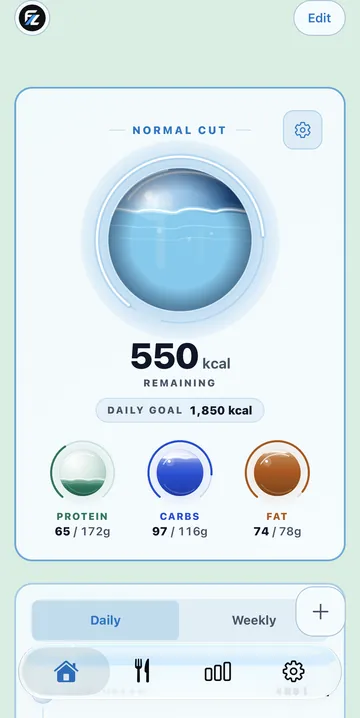
For most healthy adults who lift, about 1.6 grams of protein per kilogram of bodyweight per day is a strong evidence-based target for building muscle. A practical working range is 1.6–2.2 g/kg/day, or approximately 0.7–1.0 g per pound. The higher end creates flexibility; it is not automatically more anabolic.
Training supplies the growth stimulus. Protein helps provide the amino acids needed to repair and build tissue, but it cannot compensate for an ineffective program, inadequate total energy, or poor recovery. If you want the bigger picture of what actually drives hypertrophy, start with the science of muscle growth.
What the research says
- About 1.6 g/kg/day captures most of the benefit. Across 49 trials and 1,863 people, extra protein stopped adding fat-free mass at an average of 1.62 g/kg/day (95% CI 1.03–2.20).1 Strong evidence
- The extra gain is real but small. Eating more protein while lifting adds a modest amount of lean mass on top of what training alone produces (standardized effect 0.22 across 62 resistance-training trials).2,3 Strong evidence
- Needs rise in a deficit. For lean, trained people cutting, reviews and trials support intakes toward the top of the range or higher.4,5 Moderate evidence
- Several protein meals is a sensible default, not a rule. About 0.4 g/kg per meal across four meals is a practical model, and a large single dose keeps working for longer than once assumed.6,7 Emerging evidence
- Plant protein works when the total is adequate. Vegans and omnivores eating 1.6 g/kg gained the same muscle and strength over 12 weeks.8 Moderate evidence
Evidence grades reflect the number and quality of studies (meta-analyses > single RCTs > acute/mechanistic data).
Calculate your daily protein target
Multiply bodyweight in kilograms by 1.6 for the central target, or by 1.6 and 2.2 for the broader range. To fit that number into a full day of carbohydrate and fat, the macro calculator sets the remaining targets in grams.
| Bodyweight | About 1.6 g/kg | Range of 1.6–2.2 g/kg |
|---|---|---|
| 60 kg / 132 lb | 96 g | 96–132 g |
| 70 kg / 154 lb | 112 g | 112–154 g |
| 80 kg / 176 lb | 128 g | 128–176 g |
| 90 kg / 198 lb | 144 g | 144–198 g |
| 100 kg / 220 lb | 160 g | 160–220 g |
Do not treat the calculated number as a daily pass/fail test. A target of 145 g does not make 142 g meaningfully inadequate. A repeatable range is often easier to follow and more honest about normal variation. If you want to see the running total as you eat, log it in fitzap nutrition.
If protein is the only nutrition variable you want to track, compare that approach with calorie, macro, and protein-only tracking.
Why 1.6–2.2 g/kg?
The best single source is a 2018 meta-analysis of 49 randomized trials lasting at least six weeks. Protein supplementation during resistance training added, on average, 0.30 kg of fat-free mass and 2.49 kg to one-rep-max strength compared with training alone. A break-point analysis found that gains in fat-free mass leveled off at a total intake of 1.62 g/kg/day.1
Key study
Where extra protein stops paying off (Morton et al., 2018)
- Design
- Systematic review, meta-analysis and meta-regression of randomized trials with at least 6 weeks of resistance training
- Who
- 49 studies, 1,863 healthy adults, trained and untrained, young and older
- Compared
- Protein supplementation versus training without it, and total daily protein intake versus fat-free-mass change
- Result
- +0.30 kg fat-free mass and +2.49 kg 1RM with protein; benefit plateaued at 1.62 g/kg/day (95% CI 1.03–2.20); effect larger in trained lifters (+0.75 kg) and smaller with age
Why it matters: It is why 1.6 g/kg is the central target and 2.2 g/kg the sensible ceiling: the upper confidence limit sits at about 2.2. The caveat is that the plateau is a group-average estimate with wide uncertainty, so some individuals may benefit from more.
Later work points the same way. A 2022 meta-analysis of 74 randomized trials found that raising daily protein produced small additional lean-mass gains in people doing resistance exercise, and in adults under 65 the effect was significant at intakes of at least 1.6 g/kg/day.2 A dose-response meta-analysis of 105 trials and 5,402 participants estimated that each extra 0.1 g/kg/day was associated with 0.39 kg more lean mass below a total of 1.3 g/kg/day, but only 0.12 kg above it.3 Returns diminish; they do not hit a wall.
The upper end of 2.2 g/kg/day is a practical buffer. It covers the upper confidence limit of the 2018 estimate, individual preference, imperfect tracking, different food quality, and dieting phases. The ISSN position stand lands in a similar place, calling 1.4–2.0 g/kg/day sufficient for most exercising people.9 It should not crowd out carbohydrate, fats, fruits, vegetables, or enough total calories to train well.
The appropriate target also depends on what you already eat. Moving from 0.8 to 1.6 g/kg is likely more consequential than moving from 1.8 to 2.2 g/kg. Set expectations too: even with protein dialed in, realistic rates of muscle gain are slow, especially for trained lifters.
Should you use current or goal bodyweight?
The research-based calculation normally uses current bodyweight. For someone carrying substantially more body fat than their target, however, current weight can produce an unnecessarily large number. Using goal weight or an adjusted weight can be a practical adherence heuristic.
That shortcut is not directly validated by the muscle-gain meta-analyses, so treat it as an estimate rather than a superior formula. For example, a 240 lb lifter aiming for 200 lb could begin near the target calculated from 200 lb, observe satiety, recovery, and training, and adjust with a registered dietitian if needed.
People who are very lean, in a prolonged deficit, or managing a medical condition need more individualized advice than a generic calculator provides.
How much protein per meal?
Daily total matters most, but spreading protein across the day gives you several opportunities to stimulate muscle protein synthesis.
A useful model is three to five protein-containing meals, with roughly 0.3–0.4 g/kg per meal. A 2018 review concluded that about 0.4 g/kg across at least four meals is a sensible way to reach 1.6 g/kg/day, and up to 0.55 g/kg per meal if you are aiming for 2.2 g/kg/day.6 The ISSN position stand similarly suggests 20–40 g doses spread every 3–4 hours.9
For an 80 kg lifter, 0.4 g/kg is approximately 32 g at a meal. It is a planning aid, not a maximum amount the body can digest or use. A meal containing 50 g is not wasted, and you do not need to wake during the night to maintain a perfect schedule.
Key study
100 g of protein after training (Trommelen et al., 2023)
- Design
- Randomized, double-blind, placebo-controlled trial with stable-isotope tracers over a 12-hour recovery period
- Who
- 36 healthy, recreationally active young men (12 per group) after a whole-body resistance session
- Compared
- 0 g, 25 g, or 100 g of milk protein in one dose
- Result
- 100 g produced a larger and longer anabolic response than 25 g, lasting more than 12 hours, with negligible extra amino-acid oxidation
Why it matters: It challenges the idea that anything above 20–25 g per meal is wasted, so fewer, larger meals are a reasonable option. The caveat: it measured acute muscle protein synthesis in one session, not long-term muscle growth, and it does not show that one huge meal beats several moderate ones.7
If you are deciding whether the post-workout meal is urgent, read protein timing after workouts. The short answer is that total daily intake and the meals surrounding training matter more than a narrow countdown.
Build the target from foods you can repeat
Protein can come from:
- meat, poultry, and fish;
- eggs and dairy;
- soy foods such as tofu, tempeh, and edamame;
- legumes, grains, nuts, and seeds; and
- protein powders when convenience helps.
Plant-based diets can support muscle growth. In a 12-week trial, 19 habitual vegans and 19 omnivores trained twice a week with protein adjusted to 1.6 g/kg/day. Both groups gained about 1.2 kg of leg lean mass with no difference in muscle size or leg-press strength.8 The participants were untrained young men, and both groups used protein supplements to reach the target, so use varied sources and consider a slightly larger serving or a blended protein when relying on plants. Total dietary pattern matters more than labeling one food “complete” and everything else inferior.
Protein powder is food in a convenient format, not a requirement. Use it when it makes the target cheaper, easier, or more comfortable—not because shakes build a different kind of muscle. The same logic applies to supplements in general: if you want one with real evidence behind it, read whether creatine builds muscle.
Adjust protein for cutting and gaining
During a gaining phase, the central 1.6 g/kg target is usually sufficient when energy intake and training are appropriate. Extra protein above the useful range often displaces carbohydrate or simply adds calories without a clear hypertrophy advantage. Pair the target with a controlled lean-bulk calorie surplus rather than assuming protein alone drives the gain.
During a cut, higher protein can support satiety and lean-mass retention. A systematic review of energy-restricted, lean, resistance-trained athletes suggested 2.3–3.1 g/kg of fat-free mass, scaled upward as the deficit gets more severe and the lifter gets leaner. It was based on only six studies.4 In a 4-week trial with a roughly 40% energy deficit and six days a week of resistance and interval training, young men eating 2.4 g/kg/day gained 1.2 kg of lean mass while those eating 1.2 g/kg/day gained 0.1 kg; the higher-protein group also lost more fat.5
Note that the review's numbers are per kilogram of fat-free mass, not bodyweight. For most people that lands near the top of the 1.6–2.2 g/kg bodyweight range rather than at a blanket 3 g/kg. If you are trying to lose fat and gain muscle at the same time, see body recomposition.
The deficit size, training, starting body composition, and duration of the cut all affect risk. See cutting mistakes that can cost muscle for the wider picture.
More protein is not always better
Once intake is adequate, the next gram may be less valuable than:
- enough carbohydrate to support hard training;
- dietary fat and essential fatty acids;
- fiber and micronutrient-rich foods;
- adequate total energy; or
- a meal pattern you can sustain.
Do not use a large protein target to moralize food choices or create an unnecessarily restrictive diet. The purpose is to support training, not turn every meal into a supplement calculation.
Medical considerations
These ranges are intended for generally healthy adults. People with chronic kidney disease, kidney failure, or another condition requiring medical nutrition therapy should not adopt a high-protein target from a fitness article. NIDDK notes that some people with kidney disease need moderate protein intake, that needs change with dialysis, and recommends working with a registered dietitian who specializes in kidney disease.10
Pregnancy, adolescence, eating-disorder history, and other clinical circumstances also warrant individualized guidance.
Frequently asked questions
Is 1 gram per pound necessary to build muscle?
No. It fits within the practical upper range, but many lifters can maximize or nearly maximize results with less. Approximately 0.7 g/lb corresponds to 1.6 g/kg.
Can I eat all my protein in two meals?
You can still digest and use it, but three to five protein-containing meals may distribute muscle-building opportunities more evenly and can make a large daily target easier to reach.
Does protein timing matter more than total protein?
No. Total daily intake is the first priority. Timing can refine an already adequate diet, especially around fasted training, but it is not a substitute for reaching the daily target.
Do I need protein powder?
No. It is a convenient option when whole-food meals do not fit your schedule, appetite, budget, or dietary preferences.
The practical takeaway
Start near 1.6 g/kg/day, use up to 2.2 g/kg/day when preference or context supports it, and distribute the total across meals you can repeat. Push toward the top of the range when you are lean and dieting. Then focus on progressive training, sufficient energy, and recovery. Protein should simplify the plan, not dominate it.
Health note: This article is general information for healthy adults, not medical or dietetic advice. If you are pregnant, under 18, managing a medical condition such as kidney disease or diabetes, or have a history of disordered eating, check with a doctor or registered dietitian before changing how you eat.
References
- Morton RW, Murphy KT, McKellar SR, et al. A systematic review, meta-analysis and meta-regression of the effect of protein supplementation on resistance training-induced gains in muscle mass and strength in healthy adults. Br J Sports Med. 2018;52(6):376-384. PubMed
- Nunes EA, Colenso-Semple L, McKellar SR, et al. Systematic review and meta-analysis of protein intake to support muscle mass and function in healthy adults. J Cachexia Sarcopenia Muscle. 2022;13(2):795-810. PubMed
- Tagawa R, Watanabe D, Ito K, et al. Dose-response relationship between protein intake and muscle mass increase: a systematic review and meta-analysis of randomized controlled trials. Nutr Rev. 2021;79(1):66-75. PubMed
- Helms ER, Zinn C, Rowlands DS, Brown SR. A systematic review of dietary protein during caloric restriction in resistance trained lean athletes: a case for higher intakes. Int J Sport Nutr Exerc Metab. 2014;24(2):127-138. PubMed
- Longland TM, Oikawa SY, Mitchell CJ, Devries MC, Phillips SM. Higher compared with lower dietary protein during an energy deficit combined with intense exercise promotes greater lean mass gain and fat mass loss: a randomized trial. Am J Clin Nutr. 2016;103(3):738-746. PubMed
- Schoenfeld BJ, Aragon AA. How much protein can the body use in a single meal for muscle-building? Implications for daily protein distribution. J Int Soc Sports Nutr. 2018;15:10. PubMed
- Trommelen J, van Lieshout GAA, Nyakayiru J, et al. The anabolic response to protein ingestion during recovery from exercise has no upper limit in magnitude and duration in vivo in humans. Cell Rep Med. 2023;4(12):101324. PubMed
- Hevia-Larraín V, Gualano B, Longobardi I, et al. High-protein plant-based diet versus a protein-matched omnivorous diet to support resistance training adaptations: a comparison between habitual vegans and omnivores. Sports Med. 2021;51(6):1317-1330. PubMed
- Jäger R, Kerksick CM, Campbell BI, et al. International Society of Sports Nutrition position stand: protein and exercise. J Int Soc Sports Nutr. 2017;14:20. PubMed
- National Institute of Diabetes and Digestive and Kidney Diseases. Healthy eating for adults with chronic kidney disease. NIDDK