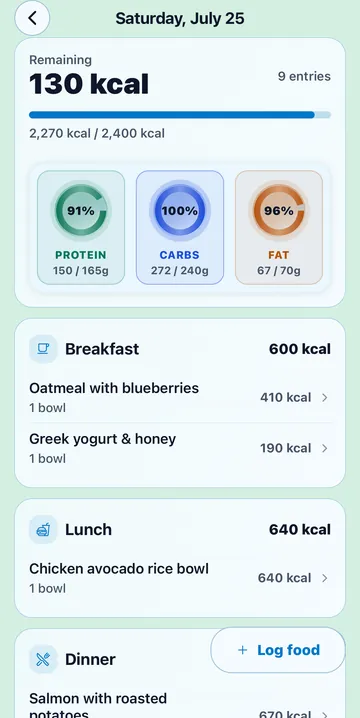
A useful 15-minute nutrition-tracking routine has five steps: pre-log likely meals, place protein anchors, enter the foods that materially change calories, reconcile what you actually ate, and review one trend. The research supports the time budget better than you might expect: in one weight-loss trial, people spent about 23 minutes a day logging in the first month and about 15 by month six, and how often they logged, not how long, separated the most successful.1 The goal is consistent, decision-grade data rather than a perfect diary.
If you are unsure whether to track protein, calories, or every macro, start with calories vs macros vs protein tracking. This workflow assumes you have already chosen what to record.
What the research says
- Self-monitoring is consistently linked to weight loss. Greater digital self-monitoring was associated with more weight loss in 74% of the analyses across 39 randomized trials.2,3 Strong evidence
- Frequency and consistency beat time spent and detail. Logging more often per day and on more than three days a week predicted success; minutes spent and comprehensiveness did not.1,4 Moderate evidence
- Lighter tracking can work. Both high- and low-intensity dietary self-monitoring supported weight loss across 59 intervention studies, and tracking at least two eating occasions a day was the best adherence marker in another analysis.5,6 Moderate evidence
- Logs under-report. Even careful weighed records missed about 430 kcal/day in non-dietitians, which is why trends beat single numbers.7 Moderate evidence
Evidence grades reflect the number and quality of studies (meta-analyses > single RCTs > acute/mechanistic data).
Does food logging actually help?
For weight management, yes, with caveats. A 2011 systematic review of 22 studies found a significant association between self-monitoring and weight loss in study after study, but rated the level of evidence weak because of methodological limits, mostly white, female samples, and reliance on self-report.3 A 2021 review restricted to randomized trials of at least 12 weeks found that greater digital self-monitoring was linked to weight loss in 74% of occurrences, and that few programs achieved logging on 75% or more of days.2 A 2020 meta-analysis of 20 studies found that mHealth self-monitoring produced a moderate additional weight reduction and better adherence than paper records.8
Two limits apply. First, most of this research is in adults with overweight or obesity in structured programs, not lifters adjusting a cut or lean gain. Second, the strongest data are associations: people who log consistently may differ in motivation from those who stop. The practical lesson still holds: a sustainable routine that you actually keep is worth more than an exhaustive one you abandon.
Key study
Log often, lose more (Harvey et al., 2019)
- Design
- 24-week online behavioral weight-control program with time-stamped web-based food logging
- Who
- 142 adults, mean BMI 35.8, 90.8% women
- Compared
- Minutes spent and daily log-ins among those who did and did not lose ≥5% and ≥10% of body weight
- Result
- Logging time fell from 23.2 min/day in month 1 to 14.6 min/day in month 6. Time spent did not differ by success, but those losing ≥10% logged in 2.7 times a day vs 1.7
Why it matters: It is a rare measurement of how long tracking really takes, and it fits a 15-minute budget once the habit is established. Caveat: the sample was mostly women with obesity, and frequency of log-ins is a correlate, not proof that logging more often causes more loss.1
Set up once before using the routine
The routine becomes fast after a small amount of setup:
- Set grams, kilograms, and your preferred energy unit correctly.
- Save meals you genuinely repeat rather than rebuilding them each day.
- Use package labels or verified database entries when possible.
- Create recipes with the total cooked yield or a reliable number of servings.
- Keep a food scale accessible if weighing is appropriate for you.
- Set your calorie and protein targets once with the macro calculator and protein intake calculator.
Food logs are estimates. Restaurant recipes change, labels allow tolerances, and database entries can be wrong. Consistency often matters more than pretending every entry is exact. If micronutrient detail matters to you, see how fitzap nutrition compares with Cronometer.
| Minutes | Step | What you are deciding |
|---|---|---|
| 0–3 | Pre-log the likely day | Rough shape of intake around plans |
| 3–6 | Place protein anchors | Where most protein will come from |
| 6–9 | Enter high-impact foods | The entries that move calories most |
| 9–12 | Fit food around training | Comfort, digestion, and fuel |
| 12–14 | Reconcile with reality | What actually happened |
| 14–15 | Review one trend | Whether anything needs to change |
Minutes 0–3: pre-log the likely shape of the day
Enter the meals and snacks you reasonably expect to eat. Start with calendar constraints: a work lunch, dinner out, or an evening training session. Leave room for uncertainty rather than filling every remaining calorie with imaginary precision.
Pre-logging is a planning tool, not a contract. If plans change, correct the log later. A systematic review of 59 weight-loss studies found that both lower-intensity (recording only certain aspects of diet) and higher-intensity (recording everything) self-monitoring supported weight loss, though it could not say how they compare directly.5 More detail is not automatically better.
Minutes 3–6: place protein anchors
Choose the meals that will carry most of your protein. Three main meals and an optional snack is one workable pattern, but daily intake matters more than forcing a particular meal count.
Protein targets should match body size, training, energy intake, preferences, and health context. If you need to set the number first, use the guide to the protein target for building muscle rather than guessing from a generic meal plan.
Check the foods that provide meaningful protein: meat, fish, eggs, dairy, tofu, tempeh, legumes, or a supplement if convenient. Do not count trace amounts from every vegetable simply to make the total look exact.
Minutes 6–9: enter the foods that move the estimate
Prioritize accuracy where a modest portion error can materially change the day:
- cooking oil, butter, dressings, and sauces;
- nuts, nut butter, cheese, granola, and snack foods;
- caloric drinks and alcohol;
- dry versus cooked weights for grains and pasta;
- restaurant meals and shared dishes.
The reason is that self-reported intake runs low. When 10 dietitians and 10 comparable women kept 7-day weighed food records checked against doubly labelled water, the non-dietitians under-reported by about 429 kcal/day and the dietitians by about 223 kcal/day.7 In an older study of 10 people with obesity who described themselves as unable to lose weight on very low reported intakes, they under-reported their intake by an average of 47% and over-reported activity by 51%; their metabolism was normal.9 That was a small, selected group, but the direction of error is the useful part: missed oils, bites, and drinks are a more likely explanation for a stall than a broken metabolism.
Lower-energy foods can still matter nutritionally, but they rarely deserve more logging effort than the foods above. This is not a rule to ignore vegetables; it is a way to allocate a limited time budget.
For a restaurant meal, choose a plausible comparable entry and accept a range rather than selecting the lowest database result. For a home recipe, log the ingredients once and divide by cooked weight or actual portions.
Minutes 9–12: fit food around training and preference
Check whether the plan leaves you comfortable for training. A normal mixed meal before lifting works for many people. In a systematic review of 49 studies, higher carbohydrate intake did not improve fed workouts of up to about 10 sets per muscle group in most trials; benefits appeared mainly when the comparison was fasted or volume was higher.10 Extra carbohydrate timing is more likely to matter when training is fasted, prolonged, glycogen-depleting, or unusually high in volume, not for every typical session.
If evenings are when hunger is hardest, reserve more food for then. If a large pre-workout meal causes reflux or sluggishness, move it earlier or make it smaller. Distribution should support adherence and digestion rather than make the app look symmetrical.
For practical meal options, see what to eat before lifting.
Minutes 12–14: reconcile the plan with reality
At the end of the day, correct what actually changed:
- Replace a planned meal with the meal you ate.
- Adjust portions rather than deleting an imperfect day.
- Add unplanned drinks, snacks, sauces, and cooking tastes.
- Leave a note when a meal is too uncertain to estimate closely.
One uncertain restaurant meal does not invalidate the week. Inventing false precision is not more useful than acknowledging uncertainty. If time is short, keep the habit alive with a minimum: in an analysis of two mobile weight-loss trials, the number of days on which people logged at least two eating occasions explained more of their 6-month weight loss than any other adherence definition (R² = 0.27).6
Minute 14–15: review one relevant trend
Choose one question for the current phase:
- Cutting: Is average bodyweight moving gradually while hunger and training remain manageable?
- Gaining: Is weight changing slowly enough to reassess over several weeks rather than several days?
- Recomposition: Is weight roughly stable while lifts and waist measurements trend the right way? See Can You Build Muscle and Lose Fat at the Same Time?
- Maintenance: Is the longer average broadly stable under similar activity?
Do not change calories because of one weigh-in or one poor workout. Use nutrition data beside bodyweight and performance trends; finding maintenance calories with weight and gym trends shows how, and use progress data to decide whether to cut, bulk, or maintain when the phase itself is unclear.
Run a short weekly audit
Once per week, look for repeatable sources of error: different weekend portions, unlogged oils, restaurant estimates, changing steps, or entries with implausible nutrition values. Correct the process before making a large calorie adjustment.
Consistency across the week matters more than one perfect day. In 220 women followed for a year after a weight-loss program, frequent logging was linked to less regain only when it was also consistent (more than three days a week), and how comprehensive the records were made no difference.4 Logging tends to fade: in two mobile trials, fewer than half of participants were still tracking after week 10.6 A weekly check is a good moment to notice drift before it becomes a stall.
The purpose is not to “catch” yourself. Tracking drift is common because attention and routines change. A calm audit produces better decisions than guilt.
When a simpler method is safer
Food tracking is optional. A 2024 meta-analysis found no significant overall association between weight-related self-monitoring and eating-disorder symptoms in general adult samples, but the authors concluded that individual factors likely decide who is affected.11 If logging increases guilt, compulsive checking, compensatory restriction, binge–restrict cycles, or fear of eating unlogged food, stop tightening the system. Try meal templates or seek support from a qualified clinician or dietitian. See how to track food without obsessing for lower-detail options.
Frequently asked questions
How long should food tracking take each day?
In a 24-week trial, logging took about 23 minutes a day in the first month and about 15 by month six. Saved meals and recipes bring it down further. Fifteen minutes is a practical budget, not a scientific cutoff.
Do I need to weigh every food?
No. Prioritize foods that meaningfully affect the estimate and use repeatable portions elsewhere. The required precision depends on the decision you are trying to make.
Should I pre-log the entire day?
Only if it helps. Pre-log predictable meals and keep flexibility for plans that may change.
What if I cannot estimate a restaurant meal?
Use a plausible comparable meal, note the uncertainty, and return to your normal routine at the next meal. Do not compensate aggressively.
Should rest-day carbs be lower?
Not automatically. Daily calories, training schedule, appetite, and preference determine whether cycling carbohydrates is useful.
Health note: This article is general information for healthy adults, not medical or dietetic advice. If you are pregnant, under 18, managing a medical condition such as kidney disease or diabetes, or have a history of disordered eating, check with a doctor or registered dietitian before changing how you eat.
References
- Harvey J, Krukowski R, Priest J, West D. Log often, lose more: electronic dietary self-monitoring for weight loss. Obesity (Silver Spring). 2019;27(3):380-384. PubMed
- Patel ML, Wakayama LN, Bennett GG. Self-monitoring via digital health in weight loss interventions: a systematic review among adults with overweight or obesity. Obesity (Silver Spring). 2021;29(3):478-499. PubMed
- Burke LE, Wang J, Sevick MA. Self-monitoring in weight loss: a systematic review of the literature. J Am Diet Assoc. 2011;111(1):92-102. PubMed
- Peterson ND, Middleton KR, Nackers LM, et al. Dietary self-monitoring and long-term success with weight management. Obesity (Silver Spring). 2014;22(9):1962-1967. PubMed
- Raber M, Liao Y, Rara A, et al. A systematic review of the use of dietary self-monitoring in behavioural weight loss interventions: delivery, intensity and effectiveness. Public Health Nutr. 2021;24(17):5885-5913. PubMed
- Turner-McGrievy GM, Dunn CG, Wilcox S, et al. Defining adherence to mobile dietary self-monitoring and assessing tracking over time: tracking at least two eating occasions per day is best marker of adherence within two different mobile health randomized weight loss interventions. J Acad Nutr Diet. 2019;119(9):1516-1524. PubMed
- Champagne CM, Bray GA, Kurtz AA, et al. Energy intake and energy expenditure: a controlled study comparing dietitians and non-dietitians. J Am Diet Assoc. 2002;102(10):1428-1432. PubMed
- Cavero-Redondo I, Martinez-Vizcaino V, Fernandez-Rodriguez R, et al. Effect of behavioral weight management interventions using lifestyle mHealth self-monitoring on weight loss: a systematic review and meta-analysis. Nutrients. 2020;12(7):1977. PubMed
- Lichtman SW, Pisarska K, Berman ER, et al. Discrepancy between self-reported and actual caloric intake and exercise in obese subjects. N Engl J Med. 1992;327(27):1893-1898. PubMed
- Henselmans M, Bjørnsen T, Hedderman R, Vårvik FT. The effect of carbohydrate intake on strength and resistance training performance: a systematic review. Nutrients. 2022;14(4):856. PubMed
- Roth AM, Gruber JR, Reif A, Schultze M, Matura S. Exploring weight-related self-monitoring as a potential risk factor for eating disorder symptoms in adults: a systematic review and meta-analysis. Appetite. 2024;202:107610. PubMed