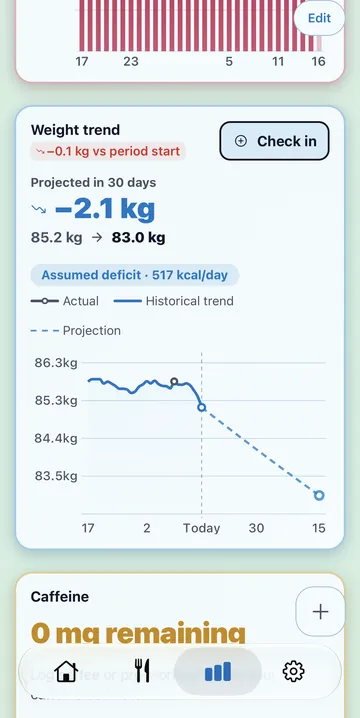
Choose a cut when reducing fat is the clear priority and you can sustain a moderate deficit, losing about 0.5–1% of bodyweight per week. Choose a lean gaining phase when training is consistent, recovery is adequate, and additional body mass fits your goal; aim for about 0.25–0.5% per week or less. Choose maintenance when the evidence is mixed, adherence has been unstable, or diet fatigue and life stress make either direction difficult to execute.
Do not make the decision from one mirror check, one weigh-in, or one disappointing workout. Review several weeks of comparable bodyweight, waist, training, recovery, and adherence data first. The research below gives you the target rates and the reasons behind them; your data tells you which one applies.
What the research says
- Lose about 0.5–1% of bodyweight per week. That is the evidence-based recommendation for natural bodybuilders dieting, and slower loss better preserves lean mass in leaner people.1,2 Moderate evidence
- Slower cuts can still build muscle. Elite athletes losing about 0.7% per week gained 2.1% lean mass, while a faster group losing about 1.0% per week gained none.3 Emerging evidence
- Gain about 0.25–0.5% of bodyweight per week. A 10–20% surplus is suggested for novice and intermediate lifters, and less for advanced lifters.4 Moderate evidence
- Faster gaining mostly adds fat. In trained lifters, faster bodyweight gain predicted more skinfold thickness but not more muscle thickness or squat strength over 8 weeks.5 Emerging evidence
- A deficit blunts muscle gain more than strength gain. Across trials, lean-mass gains were impaired in a deficit (effect size −0.57) while strength gains were similar; deficits around 500 kcal/day prevented lean-mass gains.6 Strong evidence
Evidence grades reflect the number and quality of studies (meta-analyses > single RCTs > acute/mechanistic data).
Start with reliable data
A decision framework cannot rescue unreliable inputs. Before interpreting the last four to eight weeks, ask whether the period was representative.
Collect these signals:
- Bodyweight trend: use several morning weigh-ins per week and compare weekly averages.
- Waist or another repeatable measurement: measure under similar conditions rather than chasing daily changes.
- Training performance: compare the same exercises, technique, approximate rest, and effort target.
- Recovery: review sleep, soreness, hunger, energy, and motivation.
- Adherence: note how closely your actual intake and training matched the plan.
If travel, illness, inconsistent logging, or constantly changing exercises dominated the period, the data may not distinguish a nutrition problem from ordinary noise. A stable maintenance routine can create a cleaner baseline. Start from the maintenance calories calculator or a dynamic model such as the NIDDK Body Weight Planner, which accounts for how expenditure changes as weight changes,7 then calibrate against your trend. The guide to finding maintenance calories from gym progress explains that calibration.
Cut, gain, or maintain at a glance
| Evidence | Most likely phase | Starting target |
|---|---|---|
| Fat loss is the clear goal; adherence and recovery can support a moderate deficit | Cut | Lose 0.5–1% of bodyweight/week; slower end if lean |
| Training is consistent; recovery is good; slow mass gain supports the goal | Lean gain | Gain 0.25–0.5%/week (beginner/intermediate); less if advanced |
| Higher body fat, newer to lifting, wants both muscle and fat loss | Recomposition (maintenance or small deficit) | Stable to slowly falling weight; waist down, lifts up |
| Signals conflict; stress or diet fatigue is high; maintenance intake is uncertain | Maintain | Stable weekly average for 2–4 weeks |
This table is a starting point, not a diagnosis. Training performance can fall because of poor sleep or programming. Scale weight can rise through glycogen, sodium, or food volume. A single signal should rarely decide the phase by itself.
When should you cut?
A cut fits when you deliberately want lower fat mass, have enough time to lose weight gradually, and can maintain resistance training and adequate protein.
Useful supporting evidence includes:
- bodyweight or waist has risen beyond the range you are comfortable maintaining;
- you can describe a realistic end point or time frame;
- recent training and eating habits are stable enough to monitor;
- sleep, recovery, and life stress leave room for a calorie deficit; and
- the goal is yours rather than pressure from a coach, partner, or social feed.
How fast should you lose weight?
For natural bodybuilders preparing for competition, Helms and colleagues recommend setting calories to lose about 0.5–1% of bodyweight per week to maximize muscle retention.1 The ISSN position stand adds the nuance that matters for most lifters: the higher your body fat, the more aggressive the deficit can be, while slower loss better preserves lean mass in leaner people.2
Key study
Slow versus fast weight loss in athletes (Garthe et al., 2011)
- Design
- Randomized trial; diet continued until a target weight was reached (about 8.5 vs 5.3 weeks)
- Who
- 24 elite athletes doing 4 resistance-training sessions per week
- Compared
- A planned 0.7% versus 1.4% weekly bodyweight loss (energy intake cut by 19% vs 30%)
- Result
- Both lost about 5.5% of bodyweight. Actual loss averaged 0.7% vs 1.0% per week. Lean mass rose 2.1% in the slow group and was unchanged (−0.2%) in the fast group
Why it matters: In athletes who keep lifting, a slower cut can preserve or even build lean mass. The caveats: a small sample of elite athletes, a short diet, and a fast group that did not actually reach its 1.4% target.
The meta-analytic picture fits. Across randomized trials, resistance training in an energy deficit produced smaller lean-mass gains than training without one (effect size −0.57), while strength gains were comparable, and deficits of roughly 500 kcal per day were enough to prevent lean-mass gains.6 So a cut can keep you strong; keeping or building muscle needs a moderate deficit. Short-term water changes can obscure the rate, so judge it from several weekly averages, and use the cutting-plateau and tracking-drift audit if it stalls.
Prolonged or severe low energy availability can impair health and performance. The 2023 IOC consensus on Relative Energy Deficiency in Sport (REDs) describes harms in both women and men and provides a clinical tool to assess them.8 Persistent fatigue, recurrent injuries or illness, menstrual disruption, reduced libido, or a worsening relationship with food warrants ending the deficit and seeking qualified sports-medicine or nutrition support. Review cutting mistakes that can cost muscle before setting the deficit.
When should you bulk?
A gaining phase fits when muscle and strength development are the priority, training is structured, and you accept that some fat gain may accompany additional mass.
Look for this combination:
- you have trained consistently for several months;
- the program provides a progressive stimulus;
- protein and sleep are reasonably stable;
- bodyweight is stable or falling unintentionally; and
- adding food is likely to improve recovery or support more productive training.
How fast should you gain weight?
An off-season review for natural bodybuilders suggests a surplus of about 10–20% with a target gain of roughly 0.25–0.5% of bodyweight per week for novice and intermediate lifters, and a more conservative surplus for advanced lifters.4 For an 80 kg intermediate lifter, that is about 0.2–0.4 kg per week, or roughly 1–1.5 kg per month at most.
Key study
Small versus large surpluses in trained lifters (Helms et al., 2023)
- Design
- 8-week randomized parallel-groups study with Bayesian analysis and regression
- Who
- 21 trained lifters randomized (17 completed, reduced by COVID-19), training 3 days per week
- Compared
- Maintenance energy versus a 5% surplus versus a 15% surplus
- Result
- No group differences in muscle thickness or squat 1RM; the 15% group gained more bench 1RM and more skinfold thickness. Across all participants, faster bodyweight gain strongly predicted skinfold increase (R² = 0.49) and only weakly predicted biceps thickness
Why it matters: A bigger surplus mostly bought fat, not muscle. The caveats are a very small sample, mixed training experience, moderate volume, and only 8 weeks, so a longer study could find a small muscle benefit.
Poor gym performance alone does not prove that a surplus is required. First examine exercise selection, volume, effort, rest periods, sleep, illness, and adherence. A novice or someone returning after a layoff may gain muscle at maintenance, while an experienced lifter may benefit from a small surplus once those basics are controlled. For realistic monthly muscle-gain numbers by training age, see How Fast Can You Build Muscle Naturally?; if the scale is rising much faster than those rates, the extra is mostly fat and water.
Use a modest starting surplus and review the trend rather than trying to force rapid scale gain. The lean-bulk calorie-surplus guide turns these rates into calories.
Is recomposition an option?
Sometimes the best answer is neither a cut nor a bulk. People who are newer to lifting, returning after a break, or carrying more body fat can often gain muscle while losing fat at or slightly below maintenance. Trained, lean lifters are less likely to see much of it, which is consistent with the meta-analysis showing that deficits blunt lean-mass gains.6 Can You Build Muscle and Lose Fat at the Same Time? covers who it works for and how to track it: the scale barely moves, so waist and lift trends carry the signal.
When should you maintain?
Maintenance is the best default when you lack a clear reason to move in either direction. It is especially useful when:
- adherence has been inconsistent;
- sleep, work, caregiving, or training stress is unusually high;
- hunger and diet fatigue remain elevated after a cut;
- bodyweight data are too noisy to estimate current needs;
- performance is falling for reasons you cannot yet identify; or
- you are comfortable with your current body composition.
Maintenance can stabilize bodyweight, restore a predictable routine, and show whether performance improves without intentional weight gain. See maintenance as a fitness phase for a fuller explanation.
When the signals disagree
Use this order of operations:
- Check adherence and measurement quality. Do not adjust a target that was rarely followed.
- Check recovery and programming. Training regression is not automatically a calorie problem.
- Check the duration. One unusual week is weaker evidence than a repeated trend.
- Choose the lower-risk option. When uncertainty remains, spend two to four weeks at maintenance and collect cleaner data.
For example, stable bodyweight plus declining lifts does not automatically mean "bulk." If sleep dropped to five hours and program volume doubled, more calories may not fix the real constraint. Conversely, stable bodyweight, good recovery, and months of stagnant hypertrophy-focused training may justify a small surplus after the program itself has been audited. Using a workout log during a diet shows how to read those performance signals fairly.
Reassess without overreacting
Set a review date instead of renegotiating the phase every morning.
| Phase | If the 2–3 week average is… | Then |
|---|---|---|
| Cut | Falling faster than ~1%/week, or lifts dropping | Add back about 100–200 kcal/day |
| Cut | Flat under consistent conditions | Audit tracking and steps first, then reduce modestly |
| Lean gain | Rising faster than ~0.5%/week | Reduce the surplus by about 100–200 kcal/day |
| Lean gain | Flat or falling | Add about 100–200 kcal/day |
| Maintain | Drifting clearly up or down beyond normal noise | Adjust by a small amount and hold another 2 weeks |
- During a cut or gain, review bodyweight averages weekly but make changes from a multiweek trend.
- At maintenance, allow roughly two to four representative weeks to estimate the range unless the initial estimate is clearly far off.
- Compare anchor lifts across repeated exposures at a similar RIR.
- Change one main variable at a time, then observe the result.
The 100–200 kcal steps are practical coaching heuristics, not study-derived doses. If a gaining phase is moving too quickly, reduce the surplus rather than abandoning the phase after one high-sodium weekend.
Frequently asked questions
Should I bulk if my strength has stopped increasing?
Not automatically. Check programming, technique, effort, rest, sleep, and adherence. A surplus is most useful when inadequate energy is a plausible remaining constraint.
How long should I maintain before deciding?
Two to four representative weeks can provide a useful baseline, although longer may be appropriate after a demanding cut or during an unusually stressful period.
Can I build muscle at maintenance?
Some people can, especially beginners, detrained lifters, or people with higher energy reserves. The probability and rate vary with training status, program quality, protein intake, and individual response.
What if I want to cut but performance is already falling?
First identify why performance is falling. Beginning a deficit on top of unresolved fatigue is unlikely to improve the situation. Maintenance and a training audit may be the better next phase.
The practical takeaway
Use a cut for a clear fat-loss goal at about 0.5–1% of bodyweight per week, a lean gain at about 0.25–0.5% per week when additional mass supports consistent progressive training, and maintenance when the evidence or your capacity is uncertain. The best decision is not the most aggressive one. It is the phase you can execute while preserving health, useful training, and enough consistency to interpret the result.
Health note: This article is general information for healthy adults, not medical or dietetic advice. If you are pregnant, under 18, managing a medical condition such as kidney disease or diabetes, or have a history of disordered eating, check with a doctor or registered dietitian before changing how you eat.
References
- Helms ER, Aragon AA, Fitschen PJ. Evidence-based recommendations for natural bodybuilding contest preparation: nutrition and supplementation. J Int Soc Sports Nutr. 2014;11:20. PubMed
- Aragon AA, Schoenfeld BJ, Wildman R, et al. International society of sports nutrition position stand: diets and body composition. J Int Soc Sports Nutr. 2017;14:16. PubMed
- Garthe I, Raastad T, Refsnes PE, Koivisto A, Sundgot-Borgen J. Effect of two different weight-loss rates on body composition and strength and power-related performance in elite athletes. Int J Sport Nutr Exerc Metab. 2011;21(2):97-104. PubMed
- Iraki J, Fitschen P, Espinar S, Helms E. Nutrition recommendations for bodybuilders in the off-season: a narrative review. Sports (Basel). 2019;7(7):154. PubMed
- Helms ER, Spence AJ, Sousa C, et al. Effect of small and large energy surpluses on strength, muscle, and skinfold thickness in resistance-trained individuals: a parallel groups design. Sports Med Open. 2023;9(1):102. PubMed
- Murphy C, Koehler K. Energy deficiency impairs resistance training gains in lean mass but not strength: a meta-analysis and meta-regression. Scand J Med Sci Sports. 2022;32(1):125-137. PubMed
- Hall KD, Sacks G, Chandramohan D, et al. Quantification of the effect of energy imbalance on bodyweight. Lancet. 2011;378(9793):826-837. PubMed
- Mountjoy M, Ackerman KE, Bailey DM, et al. 2023 International Olympic Committee's (IOC) consensus statement on Relative Energy Deficiency in Sport (REDs). Br J Sports Med. 2023;57(17):1073-1097. PubMed