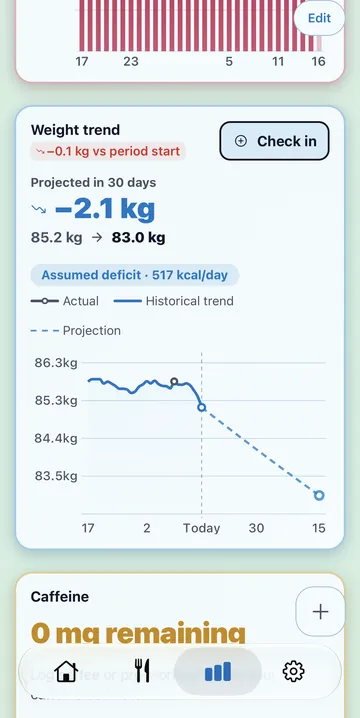
Do not lower calories after one flat week. First standardize weigh-ins, compare weekly averages, audit intake and activity, and check recovery or health factors. A practical plateau is roughly two to four weeks without a downward average under reasonably consistent conditions, but slower targets and noisier circumstances may require longer observation.
The research points to a clear order of suspects. Water and glycogen can hide fat loss for days; logged intake is often lower than real intake; daily movement quietly falls; and only after those comes true metabolic adaptation, which is real but smaller than most people assume. If the rapid first-week drop simply slowed, begin with Why Diet Weight Loss Slows After Two Weeks. This article addresses a persistent flat trend after the early water, glycogen, and food-mass changes.
What the research says
- Glycogen and water can mask fat loss. Glycogen is stored with roughly three to four parts water, so carbohydrate and sodium swings move the scale independently of fat.1 Strong evidence
- Self-reported intake can be far off. People with "diet-resistant" obesity underreported food intake by 47% and overreported activity by 51%; their metabolism was normal.2 Moderate evidence
- Non-exercise activity is the biggest moving part of expenditure. NEAT can differ by up to 2,000 kcal per day between similar-sized people and shifts with energy intake.3,4 Moderate evidence
- True adaptive thermogenesis is modest. Beyond body-size changes it averages about 120 kcal per day and takes more than two weeks to develop.5 Moderate evidence
- Diet breaks do not fix plateaus metabolically. In resistance-trained adults, maintenance breaks matched continuous dieting for fat loss and resting energy expenditure, but reduced hunger.6,7 Moderate evidence
Evidence grades reflect the number and quality of studies (meta-analyses > single RCTs > acute/mechanistic data).
Step 1: make the scale data comparable
Weigh under similar conditions when appropriate: after waking and using the bathroom, before food or drink, on the same scale and surface. You do not need daily weigh-ins if they cause distress; several consistent readings or clinician-guided measures can still be useful.
Compare seven-day averages rather than the highest and lowest points. Glycogen is stored in hydrated form, with about three to four grams of water per gram, in liver, muscle, and fat cells.1 A higher-carbohydrate weekend, a salty meal, constipation, menstrual-cycle-related fluid changes, starting creatine, travel, or a hard new training block can therefore mask a week of fat loss on the scale.
Two to four flat weeks is an operational coaching rule, not a biological definition. Someone targeting very slow loss may need more time to distinguish the signal from normal water variation. A 0.25 kg-per-week target produces a smaller weekly change than ordinary day-to-day water swings.
Step 2: is your logged intake your real intake?
Tracking drift is normal, and it is the most common explanation for a "plateau" that is not real. The landmark evidence is old but striking.
Key study
Why "diet-resistant" dieters were not losing weight (Lichtman et al., 1992)
- Design
- Total energy expenditure, its main components, and actual intake measured over 14 days, compared with self-reports
- Who
- 10 adults with obesity (9 women, 1 man) who reported eating under 1,200 kcal/day without losing weight, plus 80 controls
- Compared
- Reported versus measured intake and activity; measured versus predicted expenditure
- Result
- Energy expenditure and resting metabolic rate were within 5% of predicted values. Participants underreported food intake by 47% ± 16% and overreported physical activity by 51% ± 75%
Why it matters: The "slow metabolism" was not there; the gap was in reporting. The caveat is a small, selected group of people with obesity and a history of diet resistance. Lifters who weigh food may well be more accurate, but the direction of the error, eating more and moving less than we think, is the one to check first.
Common sources of drift:
- oils, sauces, drinks, and bites while cooking;
- larger repeat-meal portions;
- restaurant entries that underestimate preparation;
- weekend meals that differ from weekdays;
- dry versus cooked weight confusion;
- missed days or copied entries that were never corrected.
Audit without blame. A systematic review of 59 behavioral weight-loss studies found that both detailed and lighter-touch dietary self-monitoring were generally associated with weight loss, but adherence varied and logs remain estimates.8 Review the 15-minute nutrition-tracking routine to make the process more repeatable.
Do not respond by weighing every leaf or compensating aggressively. Correct the largest recurring uncertainties first.
Step 3: has your daily movement dropped?
Energy needs are dynamic. As body mass decreases, moving and maintaining a smaller body generally requires less energy, so the deficit you started with shrinks even if nothing else changes.9 Dieting can also reduce spontaneous activity, and scheduled exercise may become less intense when fatigue rises.
Non-exercise activity thermogenesis (NEAT), the energy spent on walking, standing, fidgeting, and daily tasks, is where the biggest swings happen. A review of NEAT describes differences of up to 2,000 kcal per day between people of similar size, driven by occupation, leisure, biology, and food intake itself.4 In Levine's classic overfeeding study, two-thirds of the rise in daily expenditure when 16 volunteers ate 1,000 kcal extra per day came from increased NEAT, and NEAT changes explained a tenfold difference in fat gain.3 That study was in overfeeding, not dieting, but it shows how strongly everyday movement responds to energy intake.
Compare recent steps, cardio time, job activity, and training frequency with the period when weight was falling. A tracker's calorie-burn number is not precise, but consistent step or activity records can reveal a meaningful routine change.
Is it metabolic adaptation or "metabolic damage"?
It is adaptation, not damage. Total expenditure declines during a diet through smaller body size, a lower thermic effect of eating less, reduced activity, and adaptive thermogenesis: hormonal and efficiency changes that minimize the deficit and favour regain.10
The adaptive part is smaller than its reputation. Müller and Bosy-Westphal's review estimates that adaptive thermogenesis, beyond what changes in body weight and composition explain, averages about 0.5 MJ (roughly 120 kcal) per day, takes more than two weeks of underfeeding to develop, and varies considerably between people.5 That is enough to slow a cut, but rarely enough on its own to stop one that is still under consistent conditions.
Step 4: review recovery and health context
Poor sleep, new medication, illness, travel, high stress, constipation, and changes in menstrual cycle can alter scale weight, appetite, activity, or fluid balance. Training soreness can also temporarily increase water retention.
A persistent plateau with worsening fatigue does not automatically call for fewer calories. If performance and recovery are deteriorating, assess the deficit, training volume, sleep, and low-energy-availability risk first. The 2023 IOC consensus on Relative Energy Deficiency in Sport describes how low energy availability harms both health and performance in women and men.11
Seek clinical care for rapid unexplained weight change, edema, shortness of breath, persistent gastrointestinal symptoms, menstrual disruption, or another concerning symptom. Do not troubleshoot a possible medical issue only through a food app.
Step 5: choose one response
Wait
Wait when the average has been flat only briefly, weigh-ins are noisy, intake was inconsistent, or a known temporary factor is present. Return to repeatable conditions before changing the target.
Correct execution
Correct the specific source of drift when planned and actual intake differ. This is not a new calorie cut; it is returning to the plan you intended.
Make a small adjustment
If several weeks are truly flat under consistent intake and activity, reduce intake modestly or add a manageable amount of activity. A figure such as 100–200 calories is a practical starting heuristic, not a guaranteed dose, and is in the same range as the average adaptive drop.5 It may also sit inside normal label or logging error. Choose one lever, hold it long enough to observe, and avoid simultaneous large changes. Keep deficits moderate if muscle matters; see Can You Build Muscle and Lose Fat at the Same Time? for how deficit size affects lean mass.
Use maintenance deliberately
A temporary maintenance phase may help when hunger, adherence, or recovery makes continued restriction unproductive. The idea of intermittent dieting for athletes was first built on theory and studies in non-athletes; Peos and colleagues' 2019 review concluded that evidence for its effectiveness in athletic populations was lacking.12 The trials since then are informative: in 61 resistance-trained adults, one-week breaks did not improve fat loss, fat-free mass, or resting energy expenditure versus continuous restriction, though they reduced hunger.6 A trial in 38 resistance-trained women likewise found no body-composition or metabolic-rate advantage, but no fat regain from the breaks either.7 Maintenance is a tool for adherence, not a metabolic reset.
Learn how to estimate the target in finding maintenance calories, and read maintenance as a fitness phase for how to run it.
Worked example
A lifter's weekly average is unchanged for three weeks. Their weekday logs match the plan, but weekend restaurant meals are copied from low-calorie database entries and steps fell after a work schedule change.
The first response is not an immediate extra calorie cut. They choose more realistic restaurant estimates and restore a manageable walking routine. After holding those conditions for another two weeks, they review the average again. Changing both issues at once means they cannot quantify each contribution, but it restores the intended plan without layering a new aggressive target on top of drift.
A compact plateau checklist
| Check | Why it matters | Typical size of the effect |
|---|---|---|
| Comparable weigh-ins, weekly averages | Water and glycogen swings | Can hide a week or more of fat loss |
| Logged vs real intake | Underreporting | Up to ~47% in the worst documented cases |
| Steps and daily activity | NEAT drifts down on a diet | Up to ~2,000 kcal/day difference between similar-sized people |
| Lower bodyweight | Smaller body burns less | Grows as the cut progresses |
| Adaptive thermogenesis | Efficiency changes beyond body size | ~120 kcal/day on average |
- Are weigh-ins comparable and averages truly flat?
- Did the early rapid water-related phase just end?
- Does logged intake match actual portions and weekends?
- Have steps, cardio, job activity, or training changed?
- Is recovery adequate, and are health symptoms absent?
- Can one small, sustainable change answer the problem?
Use progress data to decide whether to cut, bulk, or maintain if the issue is no longer the plateau but whether the cut should continue.
Frequently asked questions
Is two weeks without weight loss a plateau?
Sometimes, but not always. The appropriate observation window depends on expected loss rate and scale variability.
Can I lose fat while scale weight is flat?
Temporarily, yes. Water, glycogen, digestion, and tissue changes can offset one another on the scale. A longer average is more informative.
Should I add cardio or cut food?
Choose the lever that is most sustainable and measurable. Neither is automatically superior, and changing both obscures what worked. If you add cardio, Does Cardio Kill Gains? The Interference Effect explains how to keep it from competing with lifting.
Does a plateau mean metabolic damage?
No. Energy expenditure changes with body size, intake, movement, and adaptation. "Damage" is misleading and usually unhelpful.
Health note: This article is general information for healthy adults, not medical or dietetic advice. If you are pregnant, under 18, managing a medical condition such as kidney disease or diabetes, or have a history of disordered eating, check with a doctor or registered dietitian before changing how you eat.
References
- Kreitzman SN, Coxon AY, Szaz KF. Glycogen storage: illusions of easy weight loss, excessive weight regain, and distortions in estimates of body composition. Am J Clin Nutr. 1992;56(1 Suppl):292S-293S. PubMed
- Lichtman SW, Pisarska K, Berman ER, et al. Discrepancy between self-reported and actual caloric intake and exercise in obese subjects. N Engl J Med. 1992;327(27):1893-1898. PubMed
- Levine JA, Eberhardt NL, Jensen MD. Role of nonexercise activity thermogenesis in resistance to fat gain in humans. Science. 1999;283(5399):212-214. PubMed
- von Loeffelholz C, Birkenfeld AL. Non-exercise activity thermogenesis in human energy homeostasis. In: Feingold KR, et al., eds. Endotext. MDText.com; updated 2022. PubMed
- Müller MJ, Bosy-Westphal A. Adaptive thermogenesis with weight loss in humans. Obesity (Silver Spring). 2013;21(2):218-228. PubMed
- Peos JJ, Helms ER, Fournier PA, et al. Continuous versus intermittent dieting for fat loss and fat-free mass retention in resistance-trained adults: the ICECAP trial. Med Sci Sports Exerc. 2021;53(8):1685-1698. PubMed
- Siedler MR, Lewis MH, Trexler ET, et al. The effects of intermittent diet breaks during 25% energy restriction on body composition and resting metabolic rate in resistance-trained females: a randomized controlled trial. J Hum Kinet. 2023;86:117-132. PubMed
- Raber M, Liao Y, Rara A, et al. A systematic review of the use of dietary self-monitoring in behavioural weight loss interventions: delivery, intensity and effectiveness. Public Health Nutr. 2021;24(17):5885-5913. PubMed
- Hall KD, Sacks G, Chandramohan D, et al. Quantification of the effect of energy imbalance on bodyweight. Lancet. 2011;378(9793):826-837. PubMed
- Trexler ET, Smith-Ryan AE, Norton LE. Metabolic adaptation to weight loss: implications for the athlete. J Int Soc Sports Nutr. 2014;11(1):7. PubMed
- Mountjoy M, Ackerman KE, Bailey DM, et al. 2023 International Olympic Committee's (IOC) consensus statement on Relative Energy Deficiency in Sport (REDs). Br J Sports Med. 2023;57(17):1073-1097. PubMed
- Peos JJ, Norton LE, Helms ER, Galpin AJ, Fournier P. Intermittent dieting: theoretical considerations for the athlete. Sports (Basel). 2019;7(1):22. PubMed