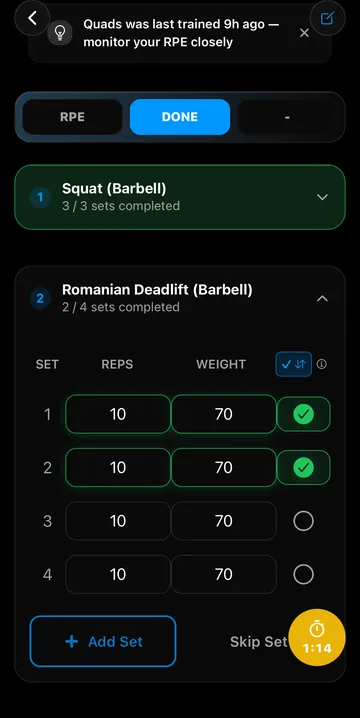
Use a workout log during a diet to compare performance at a similar technique, rest period, and effort, not merely the weight on the bar. A repeated decline across several anchor lifts can warn that fatigue, under-fueling, or programming needs attention. It cannot diagnose muscle loss by itself.
That distinction is backed by the research. In controlled trials, an energy deficit blunted lean-mass gains from lifting but left strength gains largely intact, so strength and muscle can move separately during a cut.1 Bodyweight, glycogen, leverage, sleep, stress, and exercise execution can all change performance. The log narrows the possibilities; it does not identify tissue changes with certainty.
What the research says
- A deficit costs muscle gain more than strength. A meta-analysis found lean-mass gains were impaired in a deficit (effect size −0.57) while strength gains were comparable; deficits of about 500 kcal/day prevented lean-mass gains.1 Moderate evidence
- Slower loss protects lean mass. Elite athletes losing about 0.7% of bodyweight a week gained 2.1% lean mass, while those losing about 1.4% a week gained none.2 Reviews recommend 0.5–1% per week.3,4 Moderate evidence
- Keep training volume up rather than slashing it. Studies with ≥10 weekly sets per muscle, or that increased volume during the diet, tended to show little to no lean-mass loss, though data are incomplete.5 Emerging evidence
- RIR ratings are useful but imprecise. On average lifters misjudge reps to failure by about one rep, with much larger errors on high-rep sets.6 Moderate evidence
Evidence grades reflect the number and quality of studies (meta-analyses > single RCTs > acute/mechanistic data).
What happens to strength and muscle in a calorie deficit?
Key study
Energy deficiency and resistance-training gains (Murphy & Koehler, 2022)
- Design
- Meta-analysis and meta-regression of randomized trials with at least 3 weeks of resistance training in an energy deficit
- Who
- Trials comparing lifting in a deficit with lifting without one, plus matched comparisons across studies
- Compared
- Lean-mass and strength gains with versus without an energy deficit, and lean-mass change by deficit size
- Result
- Lean-mass gains impaired in a deficit (ES −0.57, p = 0.02); strength gains not significantly different (ES −0.31, p = 0.28). A deficit of about 500 kcal/day prevented lean-mass gains
Why it matters: Strength holding up in your log does not prove muscle is holding up, and a dip in strength does not prove muscle loss. The 500 kcal/day figure is a group-level regression estimate, not a hard threshold for any individual, and it is pooled across varied study populations rather than lean, trained lifters specifically.1
The rate of loss matters too. In a study of 24 elite athletes who kept lifting four times a week, a slow reduction of about 0.7% of bodyweight per week (energy intake cut about 19%) increased lean mass by 2.1%, while a fast reduction of about 1.4% per week (cut about 30%) left lean mass unchanged; both groups lost about 5.5% of bodyweight.2 It was a small study, but it lines up with review recommendations of roughly 0.5–1% of bodyweight per week for lifters who want to keep muscle.3,4 Track that rate in your weight trend, not on single weigh-ins.
Protein is the other lever. A systematic review of energy-restricted, resistance-trained lean athletes suggested 2.3–3.1 g/kg of fat-free mass per day, higher with greater leanness and larger deficits.7 Use the protein intake calculator or the guide to the protein target for building muscle to set a number, and the macro calculator to fit it inside your calories.
Establish a baseline before the cut
Collect two to four weeks of representative training before changing calories when possible. Record:
- exercises and equipment;
- working sets, reps, and load;
- RPE or repetitions in reserve (RIR);
- rest periods for key lifts;
- technique or range-of-motion notes;
- session duration and energy; and
- bodyweight averages.
Do not test new one-repetition maximums merely to create a baseline. Normal working sets are more repeatable.
If the program changes at the same time as the diet, interpretation becomes difficult. A new squat variation may fall because the skill is unfamiliar, not because the deficit removed muscle.
What should you track in a workout log during a cut?
| Variable | Why it matters in a deficit | How often to review |
|---|---|---|
| Anchor-lift load × reps at a stated RIR | Best repeatable performance signal | Each exposure; decide on 2–3 |
| Weekly hard sets per muscle | Volume is the main stimulus you can keep while calories drop | Weekly |
| Estimated 1RM trend | Smooths daily noise across rep ranges | Every 2–3 weeks |
| Rest periods and technique notes | Keeps comparisons fair | Each session |
| Bodyweight weekly average | Rate of loss: aim for about 0.5–1%/week | Weekly |
| Sleep, energy, soreness | Separates recovery problems from diet problems | Weekly |
Choose three to five anchor lifts
Anchor lifts are stable exercises that represent important movement patterns or muscle groups. Examples include:
- a bench-press variation;
- a squat or leg press;
- a row or pulldown;
- a hip hinge or leg curl; and
- one stable isolation exercise.
Keep these movements consistent for the dieting phase unless pain, equipment access, or another clear constraint requires a substitution. You can still vary lower-priority work, but the anchors give the log comparable signals.
The goal is not to make every lift rise while calories fall. It is to preserve useful performance as far as practical while fat loss proceeds. The broader cutting-without-losing-strength guide covers the training and nutrition plan.
Compare performance at matched effort
Suppose you bench 90 kg for eight reps at two RIR before the cut. Six weeks later, 90 kg for eight at zero RIR is not identical performance even though the load and reps match. The set now costs more effort.
Useful comparisons include:
- reps at the same load and RIR;
- load for the same reps and RIR;
- total productive sets at the same exercise standard;
- estimated 1RM from a comparable submaximal set; and
- whether warm-ups or early work sets show a repeated change.
RIR is subjective and imperfect. A meta-analysis of 12 studies and 414 participants found that people underpredicted their reps to failure by about 0.95 reps on average, with large variation between studies; accuracy was better on heavier sets (12 reps or fewer) and closer to failure, and training experience did not seem to help.6 So anchor comparisons on heavier, lower-rep sets where you can, and keep rest periods and technique stable enough that the rating has context. A rushed session with 60-second rests should not be compared directly with a baseline using three minutes. For practice, see RPE and RIR calibration and Do You Need to Train to Failure to Build Muscle?
Separate normal noise from a warning trend
One poor workout is weak evidence. It can reflect sleep, hydration, stress, illness, menstrual-cycle effects, a different training time, or simple variation.
For ordinary fluctuations, look for two or three comparable exposures rather than waiting an arbitrary number of calendar weeks. Concern rises when:
- several anchor lifts decline;
- the same load and reps require substantially more effort;
- technique deteriorates despite appropriate load reduction;
- soreness persists longer than normal;
- motivation and session energy fall together; or
- bodyweight is dropping faster than planned (above roughly 1% a week).
Do not wait for repeated exposures when there is sharp or worsening pain, fainting, recurrent illness, menstrual disruption, or other signs of problematic low energy availability. The 2023 IOC consensus on Relative Energy Deficiency in Sport describes how low energy availability can harm both health and performance in women and men.8 Stop or modify training and seek qualified medical or sports-nutrition support.
Use a bodyweight-and-performance matrix
| Bodyweight trend | Training trend | First interpretation |
|---|---|---|
| Falling as planned | Stable | Continue and monitor |
| Falling rapidly | Declining | Deficit or total stress may be too aggressive |
| Flat | Stable | Audit intake/activity before adjusting |
| Flat | Declining | Check recovery, programming, adherence, and illness |
This matrix suggests the next audit, not a diagnosis.
For example, flat bodyweight plus declining performance does not necessarily call for lower calories. The person may be retaining water while losing fat, underestimating intake, sleeping poorly, or performing too much training. Use the cutting-plateau and tracking-drift audit before changing the nutrition target. And if weight is flat while lifts climb, you may be in a recomposition; Can You Build Muscle and Lose Fat at the Same Time? explains when that is realistic.
Use an intervention ladder
When the trend is concerning, change the least disruptive variable that addresses the likely problem.
1. Verify the comparison
Check equipment, exercise order, range of motion, rest, RIR, and weigh-in conditions. Correct obvious logging errors.
2. Review recovery
Audit sleep, life stress, hydration, illness, and session timing. A deficit is only one source of fatigue.
3. Review the rate of loss
If bodyweight is falling faster than about 1% a week, increase calories modestly or reduce added activity.3,4 The cut, bulk, or maintain framework can help determine whether the entire phase still fits, and finding maintenance calories with weight and gym trends shows how to locate your break-even point.
4. Review training demand
Preserve important exercise practice and productive sets. A review of 15 studies on lifters in caloric restriction found that programs with 10 or more weekly sets per muscle, and programs that increased volume during the diet, tended to show little to no lean-mass loss compared with programs that cut volume, but training data were incomplete in most studies, so the authors judged the evidence insufficient for a firm rule.5 Contest-prep recommendations similarly favour training each muscle at least twice a week and limiting failure on heavy, taxing compound lifts.9 For volume ranges, see How Many Sets per Week to Build Muscle?
If recovery truly cannot support your usual volume, a reduced dose is far better than stopping. In a trial of 70 adults after 16 weeks of training, cutting to one-third, or even one-ninth, of the original weekly dose for 32 weeks preserved the muscle gained in young adults; older adults needed more.10 That was not a dieting study, so treat it as a floor, not a target. How Fast Do You Lose Muscle? Detraining & Muscle Memory covers this further.
5. Consider maintenance or professional support
A maintenance phase may fit when diet fatigue is high or performance continues to deteriorate. Symptoms of low energy availability, disordered eating, or a medical problem deserve qualified assessment rather than another spreadsheet adjustment.
Change one main variable, then observe two or three comparable exposures unless safety requires quicker action.
Is strength loss the same as muscle loss?
No. Performance can decline without measurable muscle loss because:
- lower glycogen changes repeated-set performance;
- reduced body mass changes leverage or stability;
- fatigue reduces voluntary effort;
- unfamiliar technique reduces skill expression; or
- a calorie deficit limits new adaptation while existing tissue is largely retained.
The reverse is also true: preserving one lift does not prove every muscle was retained. The Murphy & Koehler meta-analysis is a direct example: strength kept improving in a deficit even when lean-mass gains stalled.1 Strength is specific to the tested movement and influenced by neural skill.
Body-composition tools also have error. Use multiple signals (bodyweight rate, waist, training, photos if appropriate, recovery, and health) without pretending they produce certainty.
Keep comparisons clean
- Use the same exercise variant and equipment.
- Record warm-up changes that may affect work sets.
- Keep rest periods within a normal band.
- Note straps, belt, stance, grip, and range-of-motion changes.
- Compare similar points in the training week.
- Avoid changing every anchor lift during the cut.
Pre-workout nutrition can also affect the signal. If sessions alternate between fasted mornings and well-fed evenings, log that context. The guide to what to eat before lifting explains when meal timing is likely to matter.
Frequently asked questions
How much strength loss is acceptable during a cut?
There is no universal percentage. A small temporary decline may occur, especially after meaningful bodyweight loss. Focus on the pattern, effort, technique, and whether performance returns after recovery improves.
Should I reduce training volume as soon as the diet starts?
Not automatically. Begin with a recoverable program and adjust from evidence. Limited data suggest keeping or even increasing volume is associated with better lean-mass retention, so remove low-value fatigue when recovery declines rather than making a preventive cut without a reason.
How fast should I lose weight to keep muscle?
Roughly 0.5–1% of bodyweight per week is the common recommendation for lifters, with the slower end better suited to leaner people.
Does a lower estimated 1RM mean I lost muscle?
No. The estimate can change through RIR error, fatigue, technique, leverage, or the equation itself.
How often should I review the log?
Review the week briefly, then make decisions from repeated comparable exposures. Daily interpretation encourages overreaction.
The practical takeaway
A workout log is an early-warning system, not a body-composition scan. Establish anchor lifts, compare them at matched RIR and technique, and combine the result with bodyweight rate, weekly sets, recovery, and adherence trends. Keep the loss rate around 0.5–1% a week, protein high, and volume close to normal. When the pattern deteriorates, audit the likely constraint and make one proportionate change.
Health note: This article is general information for healthy adults, not medical or dietetic advice. If you are pregnant, under 18, managing a medical condition such as kidney disease or diabetes, or have a history of disordered eating, check with a doctor or registered dietitian before changing how you eat.
References
- Murphy C, Koehler K. Energy deficiency impairs resistance training gains in lean mass but not strength: a meta-analysis and meta-regression. Scand J Med Sci Sports. 2022;32(1):125-137. PubMed
- Garthe I, Raastad T, Refsnes PE, Koivisto A, Sundgot-Borgen J. Effect of two different weight-loss rates on body composition and strength and power-related performance in elite athletes. Int J Sport Nutr Exerc Metab. 2011;21(2):97-104. PubMed
- Helms ER, Aragon AA, Fitschen PJ. Evidence-based recommendations for natural bodybuilding contest preparation: nutrition and supplementation. J Int Soc Sports Nutr. 2014;11:20. PubMed
- Ruiz-Castellano C, Espinar S, Contreras C, Mata F, Aragon AA, Martínez-Sanz JM. Achieving an optimal fat loss phase in resistance-trained athletes: a narrative review. Nutrients. 2021;13(9):3255. PubMed
- Roth C, Schoenfeld BJ, Behringer M. Lean mass sparing in resistance-trained athletes during caloric restriction: the role of resistance training volume. Eur J Appl Physiol. 2022;122(5):1129-1151. PubMed
- Halperin I, Malleron T, Har-Nir I, et al. Accuracy in predicting repetitions to task failure in resistance exercise: a scoping review and exploratory meta-analysis. Sports Med. 2022;52(2):377-390. PubMed
- Helms ER, Zinn C, Rowlands DS, Brown SR. A systematic review of dietary protein during caloric restriction in resistance trained lean athletes: a case for higher intakes. Int J Sport Nutr Exerc Metab. 2014;24(2):127-138. PubMed
- Mountjoy M, Ackerman KE, Bailey DM, et al. 2023 International Olympic Committee's (IOC) consensus statement on Relative Energy Deficiency in Sport (REDs). Br J Sports Med. 2023;57(17):1073-1097. PubMed
- Helms ER, Fitschen PJ, Aragon AA, Cronin J, Schoenfeld BJ. Recommendations for natural bodybuilding contest preparation: resistance and cardiovascular training. J Sports Med Phys Fitness. 2015;55(3):164-178. PubMed
- Bickel CS, Cross JM, Bamman MM. Exercise dosing to retain resistance training adaptations in young and older adults. Med Sci Sports Exerc. 2011;43(7):1177-1187. PubMed