The best workout app for an advanced lifter should do more than store sets and celebrate personal records. It should make multi-week workload, intensity, strength trends, fatigue, exercise balance and recovery easy to audit without pretending to replace coaching judgment.
This checklist focuses on what the analytics should explain, regardless of which product supplies them. The correct app depends on the decisions the data must support.
Disclosure: fitzap workout publishes this article and builds workout-analytics software. The criteria below are presented as an evaluation framework, not as an independent ranking of fitzap workout or its competitors.
What the research says
- Weekly hard sets per muscle is the volume measure that tracks growth. Each extra weekly set was linked to about 0.37% more muscle gain in an early meta-regression, and a 67-study update found gains keep rising with volume but with diminishing returns, best modeled when indirect sets count as half a set.1,2 Strong evidence
- RIR ratings are useful but imperfect. Across 12 studies and 414 people, lifters underpredicted reps to failure by about one rep on average, with better accuracy closer to failure; trained lifters on bench press were off by about 0.65 reps.3,4 Moderate evidence
- Estimated 1RM is most trustworthy from lower-rep sets. Prediction equations were most accurate from 5RM data, and the authors advise using no more than 10 reps; reps at a given %1RM also differ by exercise.5,6 Moderate evidence
- Effort-based adjustments work as well as fixed percentages. RIR- and velocity-based load autoregulation produced similar strength gains to percentage-based training, and post-session fatigue grows with proximity to failure and total volume.7,8 Moderate evidence
Evidence grades reflect the number and quality of studies (meta-analyses > single RCTs > acute/mechanistic data). The research supports tracking these variables; it does not validate any specific app's algorithm.
Why advanced lifters need different analytics
Beginners can often learn from a simple question: did the exercise improve?
Advanced training creates a more complicated picture:
- one priority may improve while another is maintained;
- volume can rise before strength is expressed;
- a peak can lower workload while increasing specificity;
- exercise substitutions can break simple comparisons;
- the same load can become more fatiguing; and
- small changes need several exposures before they are trustworthy.
The app should help explain those tradeoffs.
1. Weekly workload by exercise and muscle
Total session volume is not enough. Advanced programs distribute work across muscles, lifts and days.
Look for:
- weekly tonnage on stable exercises;
- direct work sets by muscle;
- compound-exercise overlap;
- week-over-week changes; and
- enough history to separate a planned block from a random spike.
Tonnage is strongest for comparing an exercise with itself. Per-muscle sets are stronger for auditing hypertrophy distribution, because weekly sets per muscle are what the hypertrophy dose-response research actually measures.1 How an app counts compound lifts matters: a large meta-regression found that counting indirect sets (for example, triceps work during bench press) as half a set predicted growth better than counting them fully or ignoring them.2 How Many Sets per Week to Build Muscle? gives the target ranges. Read weekly tonnage versus training volume for the limitations of each.
2. Intensity that is clearly defined
An advanced dashboard should distinguish:
- percentage of 1RM;
- entered RPE;
- estimated RIR;
- repetition zone; and
- proprietary intensity scores.
Average intensity is not useful if the app silently mixes warm-ups, machines and competition lifts. Exercise-level detail should remain available behind every summary.
Use the average training-intensity guide to audit how an app calculates the number.
3. Estimated strength trends
Estimated 1RM can help compare performances completed with different loads and repetitions. It is most useful when:
- the exercise and technique are stable;
- sets remain within a sensible repetition range;
- the same estimation method is used; and
- several exposures create the trend.
Estimates are most accurate from heavier, lower-rep sets: in one study, 5RM data predicted 1RM best, and the authors recommend no more than 10 reps in linear equations.5 A 269-study meta-regression also found that people complete more reps at a given %1RM on the leg press than on the bench press, so one formula does not fit every exercise.6
It is not a substitute for a true competition result, and day-to-day estimates can be noisy. A useful app shows the source set and does not overreact to one unusually strong or weak performance.
4. RPE and performance drift
Progress is not only more weight or repetitions.
Completing the same work at lower RPE can indicate improved capacity. Completing the same work at progressively higher RPE can indicate fatigue, changed technique, insufficient rest or an overly aggressive block.
RPE and RIR ratings are informative but imperfect. A meta-analysis found lifters underpredicted their remaining reps by about one on average, with accuracy improving closer to failure and in later sets,3 while resistance-trained lifters calling 1 and 3 RIR on bench press were off by only about 0.65 reps.4 A systematic review also found moderate correlations between effort ratings, bar velocity and %1RM.9 Trends in your own ratings over weeks are therefore more useful than any single number. How to calibrate your RPE and RIR covers how to sharpen them.
The app should preserve entered RPE and let you compare it with load and repetitions. If it only displays a personal-record badge, it may hide the cost of the performance.
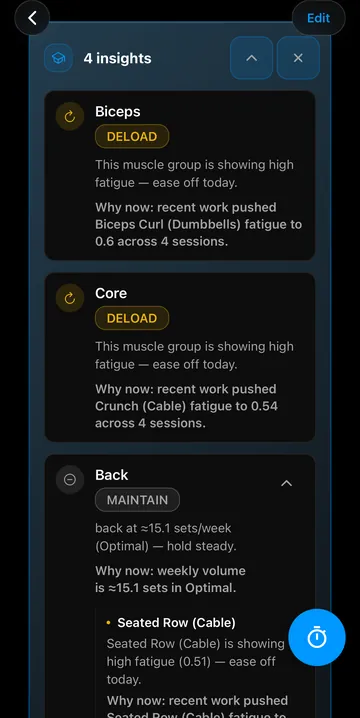
5. Fatigue and recovery with explanations
Advanced lifters benefit from fatigue monitoring because absolute loads and specialization blocks can create large recovery costs. But the feature needs transparency.
Look for warnings tied to visible evidence such as:
- repeated rep misses;
- rising RPE;
- declining estimated strength;
- unusually high recent workload;
- insufficient time since overlapping muscle work; or
- poor physiological recovery from connected wearable data.
The research gives these warnings a basis: a systematic review of 51 studies found that post-session fatigue is driven mainly by set duration, proximity to failure and total volume, and is highest when sets approach failure with high volumes and light loads.8 If you want the hypertrophy side of that tradeoff, read Do You Need to Train to Failure to Build Muscle?
No score measures every aspect of readiness. Read what workout-app fatigue scores mean before allowing one number to control the block.
6. Exercise and muscle balance
A program can increase total volume while neglecting the actual priority.
A useful app should answer:
- Which muscles received the work?
- Are pressing and pulling workloads moving as intended?
- Are secondary muscles receiving substantial overlap?
- Did a new exercise replace work or merely add more?
- Is a priority lift consistently trained after fatiguing work?
This is especially important during hypertrophy specialization, when one area increases and another may need maintenance rather than equal growth.
7. Block and phase context
Advanced training rarely tries to maximize every metric every week.
- Accumulation may raise sets and tonnage.
- Intensification may raise relative load.
- Peaking may lower fatigue and volume.
- A deload intentionally lowers workload.
An app should make these patterns visible without labeling every decrease as regression. Program templates, phase labels, notes or date-range comparisons all help.
8. Data portability and logging consistency
The deepest analytics are useless if the log is incomplete or trapped.
Check whether the app supports:
- custom exercises;
- warm-up and working-set distinctions;
- RPE entry;
- notes;
- imports from an existing tracker;
- exports or account portability;
- offline logging; and
- consistent history across devices.
Advanced lifters may have years of records. Migration and ownership deserve the same attention as charts.
Use the checklist before comparing products
Write down which of the eight capabilities actually affects your next training decision. A powerlifter may prioritize lift-specific intensity and estimated strength. A hypertrophy-focused lifter may care more about muscle workload and exercise overlap. A self-coached athlete may place transparency and data export above a large template library.
Then test the shortlisted app with two normal weeks of training. A feature list cannot show whether the logging workflow is fast enough to use consistently or whether its summaries expose the underlying sessions.
When you are ready to compare documented implementations, see the weight-training app analytics comparison.
What advanced analytics should not do
Be skeptical when an app:
- presents a proprietary number without inputs;
- claims to prevent injury;
- declares an exact maximum-recoverable-volume boundary;
- treats soreness as proof of growth;
- recommends more work whenever progress slows;
- confuses cardiovascular readiness with local muscular recovery;
- changes the program without showing why; or
- implies its exact algorithm was validated by general resistance-training research.
Research can support the use of workload, RPE, autoregulation and fatigue monitoring without validating a specific consumer-app score. For example, a meta-analysis found that RIR- and velocity-based load autoregulation produced strength gains similar to percentage-based programming,7 which supports effort-guided adjustments in principle, not any particular implementation.
A simple evaluation test
Before committing to an app, log two normal training weeks and answer:
- Can I see what changed in workload?
- Can I separate load intensity from effort?
- Can I trace every recommendation to underlying sessions?
- Can I see performance at matched load, reps and RPE?
- Can I identify which muscles or lifts created the trend?
- Does the app admit when data is insufficient?
- Can I export or preserve the history?
An app that fails these questions may still be a good logger. It is not yet an advanced analytics system.
Frequently asked questions
Do advanced lifters need more metrics?
They need more relevant context, not necessarily more dashboards. Weekly workload, intensity, RPE, strength trend and recovery are valuable when each supports a decision.
What is the most important workout-app metric?
Performance on stable exercises remains central. Workload and effort explain the conditions under which that performance changed.
Should an app automatically change an advanced program?
Only with transparent rules and user control. Advanced blocks contain intentional tradeoffs that a generic algorithm may not understand.
Is a fatigue score necessary?
No. A well-organized log can reveal rising RPE, falling repetitions and workload changes without collapsing them into one number. A fatigue feature is helpful when it explains those signals clearly.
Should I choose an app based on the largest exercise library?
Only if the library matches your training. Data quality, exercise mapping and historical consistency matter more than a large headline count.
References
- Schoenfeld BJ, Ogborn D, Krieger JW. Dose-response relationship between weekly resistance training volume and increases in muscle mass: a systematic review and meta-analysis. J Sports Sci. 2017;35(11):1073-1082. PubMed
- Pelland JC, Remmert JF, Robinson ZP, Hinson SR, Zourdos MC. The resistance training dose response: meta-regressions exploring the effects of weekly volume and frequency on muscle hypertrophy and strength gains. Sports Med. 2026;56(2):481-505. PubMed
- Halperin I, Malleron T, Har-Nir I, et al. Accuracy in predicting repetitions to task failure in resistance exercise: a scoping review and exploratory meta-analysis. Sports Med. 2022;52(2):377-390. PubMed
- Refalo MC, Remmert JF, Pelland JC, et al. Accuracy of intraset repetitions-in-reserve predictions during the bench press exercise in resistance-trained male and female subjects. J Strength Cond Res. 2024;38(3):e78-e85. PubMed
- Reynolds JM, Gordon TJ, Robergs RA. Prediction of one repetition maximum strength from multiple repetition maximum testing and anthropometry. J Strength Cond Res. 2006;20(3):584-592. PubMed
- Nuzzo JL, Pinto MD, Nosaka K, Steele J. Maximal number of repetitions at percentages of the one repetition maximum: a meta-regression and moderator analysis of sex, age, training status, and exercise. Sports Med. 2024;54(2):303-321. PubMed
- Hickmott LM, Chilibeck PD, Shaw KA, Butcher SJ. The effect of load and volume autoregulation on muscular strength and hypertrophy: a systematic review and meta-analysis. Sports Med Open. 2022;8(1):9. PubMed
- Varela-Olalla D, Del Campo-Vecino J, Balsalobre-Fernández C. Influence of proximity to failure, relative intensity, and volume on voluntary performance and fatigue symptoms after resistance training: a systematic review. J Strength Cond Res. 2025;39(9):e1129-e1168. PubMed
- Petro JL, Ferrari G, Cardozo LA, et al. Validity of rating of perceived exertion scales in relation to movement velocity and exercise intensity during resistance-exercise: a systematic review. Sports Health. 2025;17(3):621-628. PubMed